A frightened little girl called 911 and whispered, “Daddy says it’s love… but I’m scared.” Four days later, the heartbreaking truth finally surfaced, leaving the entire neighborhood in tears.
“Daddy told me he’d only be gone for thirty minutes… but before he left, he hugged me and said, ‘Whatever happens, Ashley, always remember that it’s love… everything is done for love.’ But it’s been four days now.”
Seven-year-old Ashley’s trembling voice came through the 911 line, barely audible over the relentless rain pounding against the metal awning outside her small rented house.
Victor, the emergency dispatcher working the night shift, leaned closer to his headset.
“Can you tell me your name, sweetheart?”
“Ashley. I’m seven years old.”
The address displayed on his monitor belonged to a modest neighborhood on the outskirts of town, where small houses stood close together behind low chain-link fences and neighbors recognized nearly every car that passed.
“Ashley, are you there all by yourself?”
For several seconds, she said nothing.
Then Victor heard a faint, broken sob.
“Yes. Daddy went out to get my medicine and something to eat. Before he left, he hugged me really tightly and said everything he did was because he loved me… but he never came home.” Her voice shook as she continued. “My stomach hurts so much.”
Victor tightened his grip on his pen.
“When was the last time you ate anything, sweetheart?”
“I don’t know. There was some soup, but it smelled strange. I drank water from the kitchen sink. I gave Buddy some water, too.”
“Who is Buddy?”
“My stuffed puppy.”
Without letting his concern show in his voice, Victor immediately alerted the nearest patrol unit.
“An officer named Laura is on her way to help you. I want you to stay on the phone with me until she arrives, okay? You’re doing the right thing, Ashley. You’ve been very brave.”
Victor kept her talking, asking simple questions about the room she was in, listening to the tiny, shallow breaths between words, marking every second until the radio traffic confirmed the cruiser had turned onto her street.
When Officer Laura reached the address, the house was nearly pitch-black.
Rainwater poured from the porch roof, the mailbox tilted toward the street, and a curtain moved slightly behind the front window.
Laura approached the door and knocked gently.
“Ashley? My name is Laura. I’m here to help you, sweetheart.”
The door opened only a tiny crack.
One frightened eye appeared in the narrow gap.
“Are you going to be mad at me?”
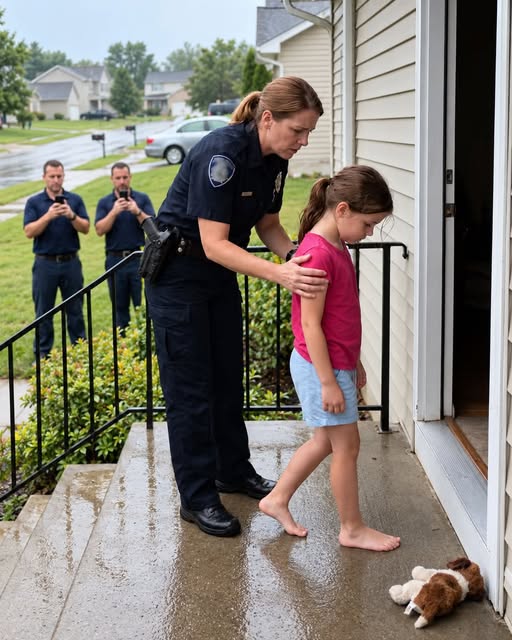
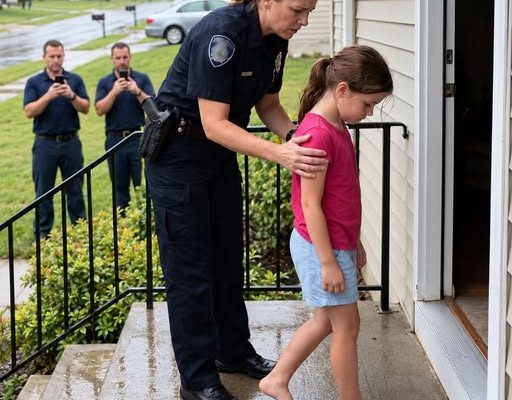
Laura immediately lowered herself to the child’s eye level so Ashley wouldn’t have to stare up at a uniformed officer.
“No, honey. You haven’t done anything wrong. Nobody is going to yell at you.”
Slowly, the door opened wider.
Ashley stood barefoot on the freezing floor, wearing an oversized T-shirt that belonged to her father. She clutched an old stuffed puppy by one floppy ear. Her lips were dry and cracked, her arms were alarmingly thin, and her stomach looked swollen beneath the loose cotton shirt.
A wave of anger surged through Laura, but she forced herself to remain calm. This little girl needed someone who could think clearly, not another frightened person.
“Can I come inside, Ashley?” Laura asked softly, stepping past the threshold only when the child nodded a fraction of an inch.
The air in the house carried the flat, stale smell of closed rooms and empty cupboards. Inside the kitchen, the refrigerator contained almost nothing except a cloudy container of soup and a bottle of mustard.
On the table lay a handwritten shopping list:
Rice. Chicken. Electrolyte drinks. Ashley’s medicine.
Next to the telephone was another note:
Urgent appointment. Call first thing Monday.
These weren’t the belongings of someone who had simply planned to abandon his child and disappear. The ink on the shopping list was slightly smeared, as if written in a hurry or with an unsteady hand.
By then, several neighbors had gathered outside the fence, watching the scene unfold in the beam of the cruiser’s headlights.
A woman standing beneath a raincoat folded her arms and spoke loudly enough for everyone nearby to hear.
“I always knew Raymond wasn’t capable of raising a little girl on his own.”
Another neighbor pulled out a phone and began recording.
“That poor child. Her father just left her here all alone.”
Laura glanced at the urgent appointment note, then looked at Ashley, who was struggling to remain steady on her feet, swaying slightly against the doorframe.
“Ashley, sweetheart, I’m going to pick you up now, all right?”
The little girl gave a faint nod.
Laura slipped one arm behind her back and the other beneath her knees.
As she lifted Ashley, the child whispered weakly, “Please don’t leave Buddy behind.”
“I promise. I’ll bring him with us.”
Laura had barely raised her from the floor when Ashley’s body suddenly went limp.
The stuffed puppy slipped from the child’s hand and fell toward the rain-soaked porch boards as Laura tightened her arms around her and urgently called into her radio.
“Child unconscious! Possible severe dehydration! I need an ambulance here immediately!”
The neighbors fell silent outside, the murmurs cutting off instantly at the sound of the radio traffic.
Laura pressed two fingers against Ashley’s neck, searching for her pulse. When she felt the faint, thready beat, she pulled the little girl close and wrapped her beneath her own rain jacket to shield her from the cold.
Then she turned toward the people who had already judged Raymond without knowing the whole story.
“This doesn’t look like abandonment,” she said firmly. “Something has happened to him.”
The ambulance arrived less than four minutes later, its red lights flashing against the wet brick walls of the houses across the street. Paramedks took Ashley onto a stretcher, working with quiet speed to start an intravenous line while Laura secured the house and gathered the scattered notes from the kitchen table.
At the county hospital, the hours stretched into a long, sterile blur. Ashley was taken straight into pediatric intensive care, where doctors worked to stabilize her electrolytes and manage the severe complications of her dehydration and missed medication. Laura stayed in the waiting room, refusing to leave until she knew the child was out of immediate danger.
The attending doctor came out just before dawn, wiping his hands with a paper towel.
“She’s holding her own now, Officer. Her kidneys were under massive strain, but we caught it just in time. Another twelve hours and we would have lost her.”
“Will she be okay?” Laura asked.
“She’s resting. But we need to find whoever is responsible for her. Social services is already involved, but the apartment manager told us the father has been missing since Thursday night.”
Laura pulled the folded shopping list and the appointment note from her jacket pocket.
“He didn’t abandon her. Look at this list. He went out for her medicine and food. And this appointment note is from the regional medical center downtown. It’s for a cardiac specialist.”
The doctor looked at the paper, his expression shifting from professional detachment to sudden concern.
“Raymond had a heart condition?”
“We’re going to find out,” Laura said.
By mid-morning, working with the precinct desk sergeant, Laura traced Raymond’s name through local emergency room intakes from four nights prior. Hospitals routinely admit unidentified or incapacitated patients who arrive without wallets or phones.
An intake record from St. Jude’s Hospital, three miles away, listed an unidentified male brought in by paramedics late Thursday evening. He had collapsed on a rain-slicked sidewalk outside a pharmacy three blocks from his home. He had suffered a massive myocardial infarction while carrying a bag of groceries and a prescription sack. His phone had been crushed beneath his body during the fall, rendering it inoperable, and his wallet contained no identification card, only a library membership and cash.
Laura drove straight to St. Jude’s, her cruiser splashing through the remaining puddles under a gray, clearing sky.
She walked past the double doors of the intensive care unit and spoke to the charge nurse, who directed her to a private room at the end of the hall.
Raymond lay pale and still against white hospital pillows, an array of monitoring leads taped across his chest. An oxygen cannula rested under his nose, and his hands, calloused from manual labor, rested weakly outside the blanket.
He was awake, staring blankly at the ceiling, but when he heard the door click open, his head turned with a sudden, desperate jerk.
“Ashley?” his voice came out as a dry croak. “Where is my little girl?”
Laura stepped into the room, holding the worn stuffed puppy she had retrieved from the porch.
“Mr. Davis?”
He tried to sit up, his monitors beeping faster in alarm. “Who are you? Please, my daughter. I only went out for her medicine. I told her I’d be right back. I had my chest pains start right outside the pharmacy. I tried to walk back, but I fell. They wouldn’t let me call anyone.” Tears spilled over his dry eyelids, cutting clean tracks down his pale cheeks. “I promised her I wouldn’t leave her alone.”
Laura placed the stuffed puppy gently on the edge of the mattress.
“She’s safe, Mr. Davis. She’s at the county hospital getting the fluids and care she needs. The doctors say she’s going to make it.”
Raymond closed his eyes and buried his face in his hands, his shoulders shaking with silent, exhausted sobs.
“I told her… I told her everything was done for love,” he whispered into his palms. “I didn’t want her to be scared while I was gone.”
Laura stood by the bed, watching the man who had been condemned by his neighbors before anyone knew the truth.
“She remembered those exact words,” Laura said softly. “That’s what made her call 911 when she couldn’t wait any longer.”
Later that afternoon, after social services coordinated the transfer of information between the two hospitals, word began to travel back through the neighborhood on the outskirts of town. The neighbor who had recorded the scene on her phone deleted the video without uploading it. The woman who had stood under the raincoat and shouted about abandonment sat on her front porch in silence, staring down at her own hands.
Two days later, once Raymond was stable enough to be moved to a step-down unit where family visitors were permitted, an ambulance transported him to the county hospital.
When the gurney was wheeled into Ashley’s room, the little girl was sitting propped up against hospital pillows, her color returning, holding Buddy tightly against her chest.
Raymond reached out a trembling hand from his rolling bed, and Ashley leaned forward as far as the IV lines allowed, pressing her small fingers into his palm.
“You came back, Daddy,” she whispered.
“I told you, sweetheart,” Raymond said, his voice breaking as he squeezed her hand. “Everything is done for love.”