The Dinner Check At 68, my mother insisted on hosting our Sunday family dinner at the same local diner we’d visited for nearly fifteen years.

My brother David, 42, always complained about the modest menu, but Mom smiled through his remarks, pulled out her worn vinyl purse, and paid the $145 tab in exact cash just like she always did.

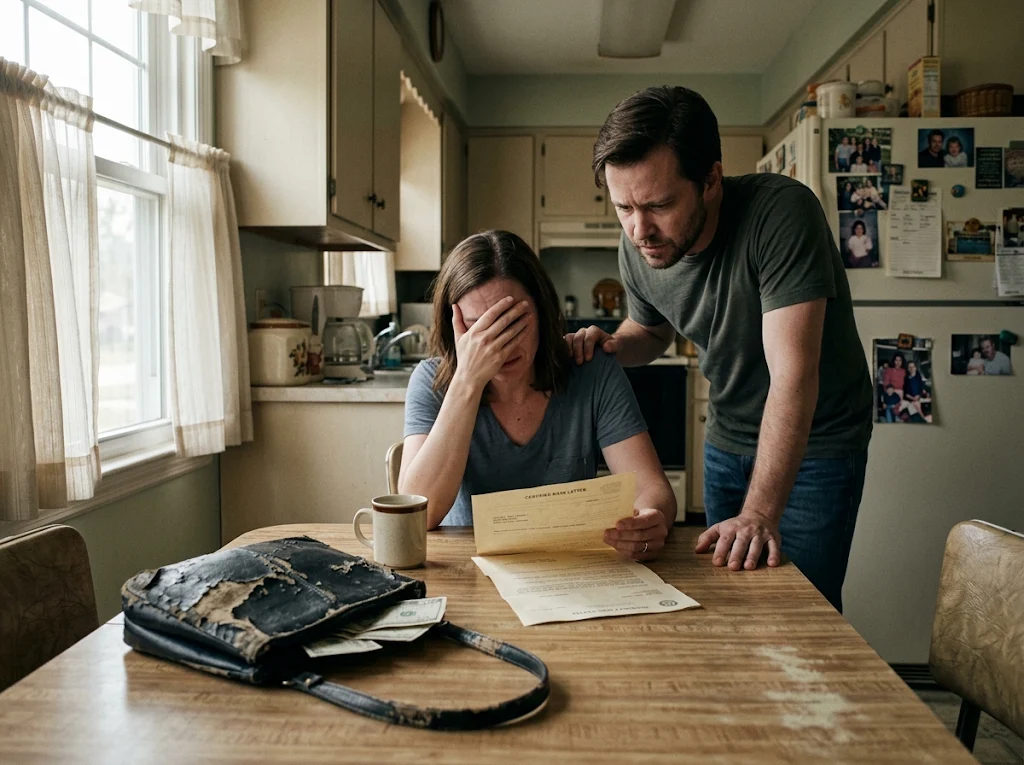
It was a comfortable, predictable routine that none of us thought twice about until three days later. I stopped by her house on Wednesday afternoon to drop off groceries and noticed a certified letter sitting beside her teapot. The envelope bore the logo of a prominent corporate bank, stamped with an urgent red seal. Mom had been living on a modest state pension since 2011, rarely spending beyond basic utilities and simple groceries. When I picked up the paper, I expected to see a utility warning or an overdue medical bill from her knee surgery last spring. Instead, the letter outlined a high-yield trust fund established in 1999 that had matured with a balance of $385,000. The terms explicitly stated that the funds were to be released immediately, but not to David or me. It was addressed to an account holder whose legal address matched a house our family had sold before I was even born.
SEO Title Every Sunday For Fifteen Years, Our Frugal Mother Paid Our Modest Diner Check In Exact Cash, But When A Certified Bank Letter Arrived At Her Quiet Kitchen Table, A Hidden $385,000 Legacy From Before My Birth Shattered Everything
At sixty-eight years old, my mother, Evelyn, regarded this modest establishment with the quiet reverence someone might reserve for a grand cathedral. Her silver hair was neatly pinned behind her ears, her posture upright despite the lingering stiffness from her knee replacement surgery the previous spring. Across from her sat my older brother, David. At forty-two, David wore the perennial expression of an executive who believed his time was being squandered by sentimentality. He tapped his index finger impatiently against the laminated menu, rolling his eyes as he took in the familiar selection of club sandwiches, meatloaf specials, and bottomless black coffee.
“Mom, honestly, we could go somewhere nice for once,” David remarked, his voice carrying that familiar patronizing edge he had honed over a decade of climbing corporate ladders. “There’s that new Italian steakhouse over on 4th Street. Hand-made pasta, white linen tablecloths. I’ll even pay for it. You don’t have to drag us here every single week just to eat turkey melts on paper napkins.”
Mom merely looked at him with an indulgent, gentle smile. Her fingers, weathered and marked by tiny blue veins, smoothed down the floral paper placemat. “The food here is honest, David,” she said softly, her voice carrying the calm authority that always managed to settle him, if only for a few minutes. “They make their broth from scratch, the girls work hard, and the booths don’t mind if you stay an extra twenty minutes to finish a conversation. There’s comfort in knowing where you belong.”
I watched them both from across the table, buttering a warm roll. To me, our weekly lunch was a sanctuary. I had watched Mom carefully manage her life ever since Dad passed away twelve years ago. She lived on a small, predictable state pension that had kicked in back in 2011 after thirty years of working as an administrative secretary at the county water district. She washed and reused foil, kept the thermostat set at sixty-six degrees throughout the harsh winter months, clipped coupons from the circulars, and shopped at the clearance racks of the suburban grocery stores.
When our server, Brenda—a woman who had refilled our mugs since my college days—slid the leather-bound check presenter onto the formica table, David reached casually for his designer leather wallet.
“Don’t you dare, David,” Mom said immediately, her tone firm yet brimming with warmth.
Before David could object, Mom reached into her vintage vinyl handbag—the brown one with the peeling strap she had refused to replace for seven seasons—and retrieved a thin envelope. Inside were crisp bills, neatly organized and counted to the penny. The tab was exactly $145, including Brenda’s customary twenty-five percent tip. Mom placed the exact cash on top of the bill, tapped it once with her thumb, and stood up to zip her coat.
“Same time next week, children,” she said, leaning down to press a soft kiss against my cheek and patting David’s shoulder.
It was a ritual so ingrained in our lives that neither David nor I gave it a second thought. It was just Mom: fiercely independent, obsessively frugal, and hopelessly tied to her routines. But as we walked out into the chilly November afternoon and watched her modest sedan back out of the parking stall, a strange sensation pricked at the back of my mind. It was the way she had looked back at the diner’s front counter just before pushing open the door—a look that held neither hunger nor nostalgia, but the quiet gravity of someone keeping a solemn, solitary vigil.
Her small yellow-clapboard home sat quietly at the end of Elmwood Avenue, a modest post-war dwelling with neatly trimmed shrubbery and a gravel driveway that crunched under my tires. Her sedan was parked beneath the carport, but the porch light was already switched on against the encroaching gloom.
“Mom?” I called out, letting myself in through the kitchen door with my spare key. The house was pleasantly warm, smelling faintly of lemon cleaner and cinnamon tea. “I brought some soup supplies and fresh fruit!”
There was no immediate answer from the front sitting room. I set the heavy grocery bags on the laminate kitchen counter. Sitting on the round wooden table, resting squarely beside her familiar porcelain teapot, was an item that immediately seized my attention.
It was a thick, pristine document envelope made of heavy, cream-colored bond paper. Across the upper left corner ran the embossed, foil-stamped emblem of a prominent corporate private bank headquartered in Boston. Diagonally across the center, stamped in vivid, indelible crimson ink, were the words: CERTIFIED LEGAL NOTICE – IMMEDIATE ACTION REQUIRED.
My hand hovered over it before curiosity overcame my hesitation. Mom’s personal mail was almost entirely composed of circulars, the weekly grocery store ads, water utility bills, and quarterly statements from the state pension office that never exceeded a couple of pages. A certified legal document from a high-tier corporate institution was as foreign in this modest kitchen as an original oil painting in a garden shed.
I glanced down the hallway toward her bedroom. The door was cracked open, and I could hear the rhythmic hum of her small vacuum cleaner in the den upstairs. Feeling a sudden, instinctive pang of worry—fearing it was an unexpected notification of an unpaid medical bill from her knee surgery last spring or an issue regarding her property taxes—I pulled the document from the unsealed flap.
The letterhead was striking, dated just four days earlier. My eyes scanned the opening lines, and my breath caught in my throat.
This was no overdue medical invoice. Nor was it a notice of municipal reassessment.
According to the dense, formal legalese of the trust administrator, the document served as the final maturation disclosure for an irrevocable high-yield asset trust established on October 14, 1999. The initial principal, invested quietly across select treasury notes and private index holdings over the course of twenty-seven years, had compounded uninterrupted. The current, cleared cash balance awaiting immediate disbursement stood at precisely $385,000.
I stared at the figure, my mind refusing to assemble the pieces. My mother had clipped twenty-cent coupons from newsprint. She had worn the same winter overcoat for twelve years. She had spent the last decade worrying aloud about the rising cost of residential heating oil, measuring out coffee grounds with a measuring spoon to avoid wasting a single grain. How could a woman who lived on an eight-hundred-dollar monthly pension have hundreds of thousands of dollars sitting in a private vault?
Then, my eyes dropped to the execution clause at the bottom of the page, and the room seemed to tilt on its axis.
The document explicitly specified that under no circumstances were the funds to be transferred, divided, or liquidated to David or me. It stated with legal precision that the sole beneficiary was an individual named Julian Thomas Ross—an identity I had never heard spoken in my entire life—listing a legal domicile address at 414 North Ridge Road: a craftsman cottage our family had sold nearly thirty years ago, before I was even born.
“Clara? Is that you down there, sweetheart?” Mom’s voice floated down the stairs, light and unsuspecting, accompanied by the careful, measured cadence of her footsteps descending the wooden steps.
I acted on raw instinct. Sliding the letter back into its cream envelope, I smoothed the flap down and set it precisely where I had found it, beside the warm curve of the ceramic teapot. I turned toward the sink, quickly turning on the tap to wash my hands as though I had just walked through the door.
“Yes, Mom! It’s me,” I managed, my voice sounding tight, a whole octave higher than normal. “I brought those groceries you asked for.”
Evelyn walked into the kitchen, wearing her favorite cable-knit cardigan with the patched elbows. She was smiling, her eyes crinkling at the corners, but when her gaze flicked to the kitchen table, her expression tightened almost imperceptibly. Her eyes lingered on the red seal of the bank document, and a fleeting shadow of weariness passed across her face before she smoothly turned her attention back to me.
“You’re a blessing, Clara,” she said softly, taking the carton of broth from the grocery bag and placing it into the pantry. “You didn’t have to drive all the way out here in this cold. The roads look slick.”
“I wanted to make sure you were stocked up,” I replied, leaning against the counter, my heart hammering against my ribs like a trapped bird. I looked at her—really looked at her. I saw the faint silver hairs catching the kitchen light, the delicate lines around her mouth, the modest silver band on her finger that she had worn since marrying our father in 1978. “Mom… is everything okay? I noticed that certified mail on the table. You didn’t get hit with another hospital fee from the surgery, did you?”
Her hands paused for a fraction of a second inside the pantry. Then, with practiced poise, she turned around, offering a reassuring, dismissive wave.
“Oh, that? No, no, just administrative nonsense from the old municipal retirement board,” she lied, the words coming out with a casual smoothness that made my stomach churn. “They’re auditing records from the nineties, moving accounts around. Nothing for you or David to worry about, darling. It’s just paperwork.”
She picked up the envelope, tucked it under her arm without opening it, and carried it straight down the hall toward her locked cedar desk in the study.
I stood alone in the kitchen, staring at the empty space beside the teapot. She had lied to me. In all my thirty-six years, my mother had been the moral compass of our family. She had scolded David when he inflated his high school track times; she had returned extra change to cashiers when they miscalculated; she had taught us that honesty was the only currency that never depreciated. Yet she had just looked me directly in the eyes and concealed a $385,000 secret.
The moment I got into my car, I locked the doors, turned the heater on full blast, and pulled out my phone. My hands were visibly shaking as I dialed David’s direct office line.
“David,” I said the second he picked up. “Don’t interrupt me. Just listen.”
“Clara? I’m right in the middle of reviewing a regional logistics budget, can this—”
“I was just at Mom’s house,” I broke in, my voice dropping to a harsh whisper. “There’s a certified letter from an elite private bank in Boston on her table. Mom has an irrevocable trust fund worth three hundred and eighty-five thousand dollars that just matured.”
A heavy silence fell over the line, broken only by the distant hum of David’s office keyboard. When he finally spoke, his dismissive corporate tone was completely gone. “What did you say?”
“Three hundred and eighty-five thousand dollars, David. Cash. Established in 1999.”
“That’s impossible,” David scoffed, though the tremor in his voice betrayed his sudden panic. “Mom has lived on eighteen hundred dollars a month from the county since Dad passed. Clara, she washes Ziploc bags! She made us split an entrée at the diner when we were kids to save four dollars!”
“I saw the bank statement with my own eyes,” I insisted, staring through the fogged windshield at Mom’s dark kitchen window. “And that’s not even the worst part. The trust explicitly bans either of us from touching a single cent. It’s made out to a man named Julian Thomas Ross… at four-fourteen North Ridge Road.”
David went completely still. On the other end of the line, I heard the sudden scrape of his office chair pushing back against hardwood.
“David?” I asked, a chill creeping down my spine. “Do you know who that is?”
“Clara,” David said, his voice dropped to a gravelly, terrified whisper. “Four-fourteen North Ridge was our house. We moved out of there in the summer of 1988, right after the accident Mom never talks about.”
In it, there were pictures of a sprawling, sun-drenched colonial home with a dark shingled roof, a deep wrap-around porch, and an enormous weeping willow shading the front lawn. That was 414 North Ridge Road. David had spent the first four years of his childhood there; I had never set foot on the property, having been born two years after our family relocated to the modest suburb on Elmwood Avenue. Whenever I had asked about North Ridge as a teenager, Dad had abruptly changed the subject, and Mom’s eyes had gone misty and distant, her voice trailing off into uncomfortable silence. We had simply been told that Dad took a new position across town and they wanted a smaller, more manageable house.
At eight o’clock Thursday morning, David’s sleek silver sedan pulled into my driveway. He didn’t bother ringing the bell; he knocked hard three times, wearing the dark wool coat he usually reserved for board meetings, his face pale and drawn under the gray morning sky.
“Get your coat,” he commanded the moment I opened the door. “We’re going to the county records office.”
“David, wait,” I said, stepping back to let him into the foyer. “We can’t just go digging through sealed property files without talking to her first. If this is something private—”
“Private?” David interrupted, his eyes wild with a mixture of betrayal and indignation. “Clara, our father worked fifty hours a week at the foundry until his lungs gave out. When I was applying for college, Mom told me to my face that they couldn’t afford to cosign my tuition loans. I worked thirty hours a week stocking warehouse shelves on graveyard shifts just to pay my way through state school! And all this time, she had nearly four hundred grand sitting in a private investment trust? Don’t you want to know whose name is on that check?”
His bitterness was palpable, and though I hated to admit it, a sliver of that same hurt had taken root in my own chest. I remembered wearing hand-me-down boots with cardboard insoles during the wet winters of middle school. I remembered Mom meticulously cutting grocery coupons into neat little piles, sighing over the winter heating bills, turning down invitations to travel with her church group because a fifty-dollar bus ticket was deemed an unnecessary luxury. If that money had existed since 1999, why had she chosen to let our family scrape by?
We drove into the city center in tense silence, the windshield wipers swishing rhythmically against the drizzling rain. The county clerk’s office was housed in an imposing granite building smelling of floor wax and centuries of decaying paper. David flashed his corporate identification card and filled out the archival request forms with sharp, aggressive strokes of his pen.
Because property deeds and title transfers were public records, the clerk disappeared into the basement archives without protest. Forty-five minutes later, she returned carrying a thick, graying file folder labeled Parcel 108-B: 414 North Ridge Road (1975–1990).
David spread the documents across a wooden reading table under the buzzing fluorescent lights. We flipped past the original construction permits from the 1960s, past the deed our parents signed when they bought the home as newlyweds in 1979.
Then we reached the sale documents dated August 12, 1988.
“Look at this,” David whispered, his finger tapping the yellowed closing ledger.
The house had not been sold due to a job relocation. It hadn’t even been sold at market value. In the summer of 1988, our father, Arthur Vance, and our mother, Evelyn, had sold the North Ridge property for $110,000—nearly forty percent below its assessed appraisal. But attached to the deed was a court-ordered lien release.
The lien was filed on behalf of a civil judgment in the Municipal Court of Massachusetts, dated July 19, 1988. The plaintiffs were listed as Thomas and Martha Ross, acting as legal guardians for Julian Thomas Ross, a minor.
David’s breath hitched in his throat. He turned the page with a shaking hand to find the attached police collision report.
On a rainy evening in June 1988, a vehicle registered to our father had been involved in an intersection collision at the corner of Ridge and Maple. The other vehicle carried the Ross family. Their six-year-old son, Julian, had suffered severe, catastrophic head trauma that left him permanently impaired.
The final page of the file contained a confidential settlement summary. Our father’s automobile insurance had lapsed two months prior to the crash due to a missed premium notice. To avoid an open-court criminal indictment and lifetime civil wage garnishment that would have bankrupted our family forever, our parents had liquidated everything they owned—their dream home, their retirement accounts, their personal vehicle—and signed a binding, lifelong restitution decree.
“Dear God,” I murmured, clutching the edge of the wooden table as the world seemed to tilt around me. “Dad wasn’t relocated. They lost everything.”
“That explains 1988,” David muttered, his eyes dark with an obsessive intensity that unnerved me. He wasn’t weeping; his mind was calculating. “It explains why we moved to Elmwood. But Clara, that settlement was closed and signed thirty-eight years ago. The lien was discharged. Why would Mom establish a brand-new trust fund in 1999—eleven years later—using her own name, and fund it with tens of thousands of dollars we never had?”
Before I could answer, David pulled out his phone and took high-resolution photographs of every single page in the file.
“What are you doing?” I asked, alarmed by the cold, determined look settling across his features.
“I’m finding Julian Ross,” David said coldly. “He’s thirty-eight years old now. And if our mother has been funneling our family’s wealth to a complete stranger behind our backs for twenty-seven years, I’m going to find out what kind of hold he has over her.”
“David, please, stop this,” I pleaded as he finally disconnected the call. “Look at what that file said. That little boy was six years old when his life was ruined. Dad was driving without insurance! Mom and Dad carried that guilt alone for decades so we wouldn’t have to grow up under the shadow of a lawsuit. Can’t you see the pain in this?”
“I see a secret, Clara,” he shot back, his jaw clenched so tightly the muscles in his cheek twitched. “I see our mother spending twenty-seven years living like a pauper, pretending she couldn’t afford to help her own children, while quietly funneling hundreds of thousands of dollars into a private trust. Do you know what three hundred and eighty-five thousand dollars could have done for us? For Dad’s medical care when he was dying of pulmonary fibrosis? For my tuition? For your down payment on your house?”
He wasn’t thinking rationally. David had spent his entire adulthood measuring his worth by account balances and corporate titles, driven by a deep-seated childhood fear of poverty that had been drilled into him during our lean years on Elmwood Avenue. To discover that poverty was, in some measure, an active choice made by our mother was an affront he could not process.
By five o’clock that evening, David texted me an address.
The investigator had located Julian Ross. He wasn’t living in a luxury estate or lounging on an offshore settlement. He resided at the St. Jude Valley Care Facility, an assisted-living and long-term neuro-rehabilitation center situated in an unincorporated township forty miles northwest of the city.
Without waiting for my agreement, David pulled up to my house, honked twice, and leaned across the passenger seat to push the door open. “Get in,” he said simply. “We’re going.”
“We can’t just barge into a private care facility, David!”
“I’m his legal representative’s relative inquiring about an estate transfer,” he lied smoothly, tapping the leather folder containing the copies of the bank notice. “I have the certified document right here. We’re getting answers tonight, Clara, or I’m confronting Mom on Sunday in front of everyone.”
Knowing I couldn’t let him go alone in that volatile, resentful state, I climbed into the passenger seat.
The November twilight gave way to an inky, starless black as we drove deep into the rural hills. St. Jude Valley Care Facility was a low-slung, single-story brick complex surrounded by ancient pine trees and high security fencing. The lobby smelled of antiseptic, industrial lavender floor soap, and warm laundry. Behind the reception desk sat a middle-aged woman wearing floral scrubs, her glasses hanging from a beaded cord around her neck.
David approached the counter with his typical authoritative boardroom posture. “Good evening. My name is David Vance. This is my sister, Clara. We’re here regarding Julian Ross. We have urgent administrative documents concerning his trust disbursement.”
The receptionist looked up, her tired eyes blinking behind thick lenses. She paused, looking down at the sign-in sheet, and then glanced back up at David with a look of quiet bewilderment.
“Vance?” she asked softly.
“Yes,” David replied, pulling out the bank envelope. “Evelyn Vance is our mother. She established a private trust for Julian in 1999, and we need to speak with his legal guardian immediately.”
The receptionist didn’t reach for the envelope. Instead, a slow, deeply solemn expression settled over her face. She took off her glasses, folded them carefully, and placed them on the counter.
“Mr. Vance… didn’t anyone call you?” she asked, her voice barely louder than a whisper.
David frowned, his aggressive demeanor faltering for the first time all day. “Call me about what? We just discovered the bank records yesterday.”
The woman looked between David and me, her gaze filled with profound, heavy sorrow. “Julian’s legal guardian was his maternal aunt, Martha. But Martha passed away eight years ago. Since then, your mother, Evelyn Vance, has been listed as his sole legal custodian and emergency contact.”
I felt the air rush out of my lungs. “Mom is his legal guardian?”
“Yes, my dear,” the woman said, turning her sympathetic gaze to me. “She has visited him every single Sunday morning at nine o’clock without fail for the last twenty-two years. She sat by his bedside, read him the Sunday papers, brought him fresh woolen socks, and played him old classical records.”
The receptionist paused, swallowing hard, and reached across the counter to lightly touch my sleeve.
“Mr. Vance, Miss Vance… Julian caught severe pneumonia late last week. His respiratory system was already severely compromised from his childhood injuries. He passed away peacefully on Monday morning. Your mother was holding his hand.”
David stood completely paralyzed. The leather folder in his hand slipped slightly, his fingers slackening against the polished hide. “Monday?” he choked out, the word barely audible. “She… she was here on Monday?”
“All morning,” the receptionist nodded gently. “She stayed with him until the funeral home transport arrived at noon. She was devastated, but she kept telling the staff that Julian was finally free of pain. She took care of all the arrangements herself. She paid the administrative intake fee from her personal account, just like she always did.”
The puzzle pieces began slamming into place with terrifying, agonizing clarity.
Sunday dinner. The diner. Mom sitting across from David and me, smiling gently through David’s complaints about the cheap menu. She had come to our family dinner just hours after spending her Sunday morning in a rehabilitation ward, sitting beside a man whose life had been irreparably altered by our family car nearly four decades ago.
And three days later—on Wednesday, when I found the certified envelope by her teapot—she had received the notification that the trust she had poured her life’s savings into had finally matured.
It had matured three days after Julian died.
“Where… where did the money come from?” David asked, his voice cracked and hollow, all his corporate bravado shattered into dust. He looked like a frightened boy standing under the harsh fluorescent light. “Our father died in 2004 with nothing. Mom worked for the county water district. How could she have three hundred and eighty-five thousand dollars?”
The receptionist shook her head softly. “I don’t know anything about a bank trust, Mr. Vance. All I know is that Mrs. Vance made sure Julian’s supplemental medical care, his specialized wheelchair, his speech therapy, and his private nursing aides were never interrupted. Whenever the state Medicaid coverage fell short, she covered the difference. If you want to know about the finances, you should talk to Mr. Holloway. He’s the facility’s retired director. He lives just two miles down the road on Old Mill Path.”
David and I walked out of the facility in total, suffocating silence. The cold mountain air hit my face like an open hand.
I looked at my brother. In the faint yellow glow of the parking lot lamp, tears were streaming down his cheeks. He leaned against the roof of his car, his chest heaving, his hands buried deep into his wool coat.
“She carried it all,” David sobbed, his voice breaking violently against the night wind. “Clara… she carried all of it. By herself. For thirty-eight years.”
“We need to see Mr. Holloway,” I whispered, wiping my own eyes with the sleeve of my sweater. “We need to understand everything before we go home.”
We drove the two miles down Old Mill Path, our headlights cutting through the dense pine woods until we reached a modest, warm-lit log home with smoke curling peacefully from a stone chimney.
Mr. Holloway, an eighty-two-year-old retired administrator with thinning white hair and kind, perceptive eyes behind wire-rimmed glasses, opened the door within seconds of our knock. When David introduced us, the old man did not look surprised. He stepped back and welcomed us into a cozy living room lined with thousands of books and the scent of seasoned birch wood burning in the hearth.
“I expected one of you would come eventually,” Mr. Holloway said gently, gesturing toward a pair of leather armchairs by the fire. “Especially after what happened on Monday.”
“You knew about the trust?” I asked, leaning forward, my voice trembling with exhaustion.
“I helped your mother set it up back in the autumn of 1999,” Mr. Holloway replied, taking a seat across from us and folding his weathered hands over his knee. “Your father had just suffered his first major heart attack, you see. Arthur knew his health was failing, and Evelyn knew she wouldn’t have him much longer. But the money in that trust… it didn’t come from your father’s foundry wages. And it didn’t come from Evelyn’s municipal paycheck.”
David looked up, his red-rimmed eyes wide with confusion. “Then where did three hundred and eighty-five thousand dollars come from?”
Mr. Holloway looked at David with an expression of immense, mournful respect.
“In the summer of 1999, Evelyn’s wealthy, estranged great-aunt Beatrice passed away in Chicago,” Mr. Holloway explained softly. “Beatrice had no surviving children of her own. She left your mother a direct, unencumbered personal inheritance of precisely forty thousand dollars. To a woman living on the edge of poverty, forty thousand dollars in 1999 was a life-altering fortune.”
The old man paused, letting the weight of the year sink into our consciousness.
“Your mother could have paid off her mortgage,” Holloway continued. “She could have bought a new car, sent both of you to private universities without a penny of student debt, or taken the first vacation of her adult life. But instead, she brought that cashier’s check straight to my office.”
“Why?” David asked, his voice barely a rasp. “Why didn’t she keep it for herself? For Dad?”
“Because your mother lived with a broken heart, son,” Mr. Holloway said gently, leaning forward, resting his forearms on his knees. “In 1988, when that collision happened, the Ross family was destroyed. Thomas and Martha Ross were young, full of life, raising a bright, energetic little boy. After the crash, Julian lost his speech, his motor coordination, and his ability to live independently. Within five years, Thomas Ross died of a massive stroke brought on by the immense physical and emotional stress of round-the-clock caretaking.”
The old man sighed, staring into the flickering embers.
“Martha tried to care for Julian alone, but her own health began to fail by the late nineties. Your parents had given them every penny from the sale of the North Ridge house, but long-term specialized neurological care eats through money like dry timber in a forest fire. By 1999, the settlement money was completely gone. Julian was about to be transferred to a substandard state psychiatric ward because Martha couldn’t afford the private facility fees.”
“And that was when Aunt Beatrice died,” I murmured, the horror and beauty of Mom’s sacrifice blooming in my mind.
“Precisely,” Mr. Holloway nodded. “Evelyn came to this very room in October of 1999. She was forty-one years old, exhausted, working sixty hours a week between the water district and night cleaning shifts at the courthouse. She sat right where you’re sitting, Clara, and she placed that forty-thousand-dollar inheritance check on this coffee table.”
Holloway closed his eyes for a moment, recalling the memory with absolute clarity.
“She looked at me and said, ‘Mr. Holloway, my husband was behind the wheel of that car. We made a mistake that took away a little boy’s future. God has given me this money, and it does not belong to my comfort. It belongs to Julian’s dignity.’ She worked with a private trust attorney in Boston to lock that forty thousand dollars into a long-term, aggressive compound growth portfolio. She structured it so that neither she, nor Arthur, nor any creditors could ever touch it. It was designated solely to ensure that if Martha died, Julian would never be abandoned to the state.”
“And the rest of the money?” David asked, his voice shaking violently. “Forty thousand doesn’t become three hundred and eighty-five thousand dollars on standard interest alone.”
“No, it doesn’t,” Mr. Holloway said, looking directly into David’s eyes with an intensity that made my brother flinch. “The market was strong through the 2000s, yes. But your mother didn’t just leave that original deposit alone. For twenty-seven years, every single month, Evelyn Vance deposited an additional two hundred and fifty dollars into that principal balance.”
A gasp caught in my throat. Two hundred and fifty dollars.
Every single month.
I instantly thought of her faded vinyl purse. I thought of the winter thermostat set at sixty-six degrees. I thought of her worn-out sneakers, her refusal to buy new clothes, her meticulous shopping lists scribbled on the backs of used envelopes, and the endless coupons she trimmed with sewing scissors. She had denied herself every earthly pleasure, every luxury, every restaurant dinner that wasn’t a cheap turkey melt at the diner, just to send two hundred and fifty dollars into that private vault.
“When Martha passed away eight years ago,” Holloway continued, “Evelyn legally stepped in as Julian’s guardian. She didn’t want the court to appoint a public conservator who might move him to an unfamiliar ward. She came out here every Sunday morning. She held his hand. She talked to him about the birds in the garden, about the changing seasons, about her children. Even though Julian couldn’t speak, whenever your mother entered the room, his eyes would light up. He knew her touch. He knew her voice. She was the one constant light in his dark world.”
“And on Sunday…” David whispered, burying his face in his hands as the tears spilled through his fingers. “On Sunday, when we were at the diner… she had just come from here.”
“Julian had developed a high fever on Saturday night,” Mr. Holloway said, his voice thick with emotion. “Evelyn sat by his bedside until dawn on Sunday. When his vitals temporarily stabilized that morning, she told the nurses she had to leave for two hours because she had a promise to keep. She said her children were waiting for her at the diner, and she never missed a Sunday with her family.”
The old man paused, wiping a stray tear from beneath his spectacles.
“She left Julian’s bedside, drove forty miles through the rain to sit across from you two, smiled through your complaints, paid for your lunch, and then drove right back up here to spend the night in a vinyl hospital chair. Julian passed away twelve hours later, with Evelyn singing him an old lullaby.”
David let out a broken, agonizing sob that echoed through the quiet room. He leaned his elbows on his knees, clutching his head, completely undone by the realization of his own callousness. All those years of mocking her frugal habits, all those Sundays spent complaining about a twelve-dollar club sandwich, while our mother was quietly carrying the burden of an entire broken universe on her frail shoulders.
“Mr. Holloway,” I asked, my voice cracking, “what happens to the trust now? If Julian is gone, and the bank sent that certified letter…”
Mr. Holloway looked at me with deep solemnity. “The trust agreement of 1999 contained a specific reversionary clause, Miss Vance. In the event of Julian’s death after full maturation, the remaining principal doesn’t simply disappear. But to execute the final clause, the bank requires Evelyn to make an irreversible legal choice—one that will either bury this secret forever, or change your family’s future permanently.”
It was nearly ten o’clock when David pulled into the gravel driveway on Elmwood Avenue. The little yellow house was dark, save for the warm, amber glow spilling from the frosted glass window of the small study at the back of the house.
“Are we going in?” I asked softly, turning to look at my brother.
David stared at the little window, his lower lip trembling. “I don’t know if I have the right to look her in the eye, Clara. The things I said to her on Sunday… about her modest life, about the diner, about being cheap… God, I’ve been such an arrogant fool.”
“She didn’t do this to punish us, David,” I said, reaching over and squeezing his tense hand. “She did it because she loved Dad, because she loved us, and because she believed in redemption. We don’t confront her. We go in there and we hold her.”
We walked up the front porch steps together, our footfalls quiet against the wooden planks. I didn’t use my key this time; I knocked gently, two soft taps against the glass.
A moment later, the porch light flickered on. The brass deadbolt slid back, and the door opened.
Mom stood in the doorway, wrapped in her worn cable-knit sweater, holding her reading glasses in one hand. When she saw the two of us standing there in the cold, her tired eyes widened with alarm.
“David? Clara? What on earth has happened? Are you two alright?”
David didn’t say a word. He stepped forward, crossed the threshold, fell to his knees on the entryway rug, and wrapped his arms tightly around our mother’s waist, burying his face into her apron. A deep, guttural sob tore from his throat.
Evelyn froze in utter astonishment. Her reading glasses slipped from her fingers, clattering softly onto the floor. “David… sweetheart, what is it? What’s wrong?”
I stepped into the hallway and closed the door behind us against the freezing night wind. “Mom,” I whispered, tears blurring my vision. “We know. We went to St. Jude’s.”
At the mention of the name, Evelyn’s entire body seemed to deflate. The stiffness that had held her upright for sixty-eight years melted away in a single, trembling instant. Her hand went to David’s hair, her slender fingers stroking his head with the same instinctive, tender motion she had used when we were frightened children.
“You went to St. Jude’s?” she breathed, her voice paper-thin.
“We saw the file at the county clerk’s office,” David wept, clutching her tighter, refusing to let go. “We know about 1988. We know about Dad’s accident. We know about Aunt Beatrice’s inheritance, and the two hundred and fifty dollars every month… and we know you were holding Julian’s hand on Monday morning.”
Evelyn closed her eyes tightly, two clear tears carving paths down her weathered cheeks. She did not defend herself. She did not offer excuses. She simply leaned down, resting her cheek against the crown of David’s head, and let out a long, shuddering breath that sounded like the release of a four-decade-long exhale.
“I never wanted you children to carry that weight,” she whispered, her voice thick with unshed grief. “Your father… Arthur never forgave himself. He died with that guilt eating a hole through his spirit. When that collision happened, when I saw what had happened to that poor, beautiful boy, I made a vow to God. I promised that as long as I had breath in my body and two hands to work, Julian would never suffer for our carelessness. I wanted to pay the debt myself. I wanted my children to grow up clean, without the world pointing fingers at them for their father’s mistake.”
She reached out with her other hand, pulling me into the embrace. The three of us knelt together in the small entryway of that humble, drafty house, weeping for the years of silence, for the unuttered sacrifices, and for the quiet saint who had walked among us unnoticed.
After a long time, Mom helped David to his feet. Her face looked exhausted, yet there was a profound, radiant peace in her eyes that I had never seen before. The crushing secret she had carried alone for thirty-eight years had finally been brought into the light, and it had not broken us; it had bound us together tighter than we had ever been.
“Come,” she said softly, leading us down the hallway into the warm den. “There’s something I have to show you both.”
Sitting on the blotter of her antique cedar desk was the certified letter from the Boston private bank. But beside it lay another document—a fresh legal instrument prepared by the bank’s probate trust division, awaiting her final, notarized signature.
“The bank sent this yesterday morning,” Mom said, her fingers resting lightly on the crisp paper. “Julian’s passing closed the primary mandate of the trust. But the terms your father and I agreed to in 1999… they didn’t end with Julian’s life.”
David and I looked down at the document. Across the top, printed in bold, undeniable type, was the legal header: IRREVOCABLE TRUST DISBURSEMENT: FINAL TESTAMENTARY DIRECTION.
“When Arthur and I established this fund with Mr. Holloway and the bank’s attorneys,” Mom began, her voice steady and full of quiet dignity, “we knew that one day, Julian would likely precede me in death. His medical prognosis was never good; the doctors told us back in 1988 that he would be blessed to reach his thirties. We had to decide what would become of the money if it was not entirely consumed by his medical care.”
David leaned forward, his hands clasped tightly between his knees. “Mom, the original letter Clara saw said the funds were explicitly prohibited from passing to David or Clara Vance. Why did you write that clause?”
Mom looked at both of us with profound, unconditional tenderness.
“Because in 1999, David, you were fifteen, and Clara was thirteen,” she explained softly. “I saw how bitter your father had become over losing our home on North Ridge. He lived every single day looking over his shoulder, terrified that our creditors or the courts would come back to strip away whatever little we managed to rebuild on Elmwood Avenue. I knew that if that trust fund existed under our family name, or if there was any legal loophole allowing that money to revert back to us as personal wealth, the guilt would poison you. I didn’t want my children growing up waiting for a payout born from another family’s catastrophe. Blood money cannot buy peace, David. It never could.”
“So where was the money supposed to go?” I asked, looking at the fresh legal instrument on her desk.
Mom turned the page, pointing to the designated contingent beneficiary clause.
“Under the 1999 agreement, if Julian passed away before the full maturation of the portfolio, the entirety of the remaining balance was slated to be liquidated and donated as a permanent endowment to the St. Jude Valley Pediatric Neurological Wing,” Mom said. “To build a therapy garden and provide free respite care for low-income families whose children suffered catastrophic traumatic brain injuries.”
The breath caught in my throat. Three hundred and eighty-five thousand dollars. It was an astonishing sum of money—enough to secure the specialized wing of that small facility for a generation.
“That was the original mandate,” Mom continued, her voice dipping lower. “Arthur and I signed it with full hearts. But yesterday, when the bank administrator called to confirm Julian’s death certificate, he informed me of an amendment that our attorney quietly attached to the trust right before your father passed away in 2004.”
David’s head snapped up. “Dad changed it?”
“Your father didn’t change the destination,” Mom said, her eyes shining with quiet tears. “He added a conditional choice. A final clause that only takes effect upon the trust’s full maturation, provided both Julian and Arthur had passed away, and provided that you two, my children, were fully grown adults.”
She slid the document across the mahogany desktop toward David and me.
“The bank administrator called it the Legacy Reconciliation Clause,” Mom said. “Arthur knew how hard he had failed you, David. He knew how much you resented working night shifts to pay for your college tuition. He knew how Clara had to sacrifice her dreams of going to an out-of-state art academy to stay home and help me nurse him through his final illness. Before he died, Arthur begged the attorney to leave one final door open.”
My hands shook as I picked up the paper and read the tight legal print:
Clause 14-B: Upon the demise of the primary ward and the full maturation of trust assets, the surviving grantor, Evelyn Vance, retains the sole, non-delegable authority to reallocate up to fifty percent ($192,500) of the remaining cash balance directly to the surviving lawful issue, David Vance and Clara Vance, in equal shares, to remedy documented familial financial hardship—PROVIDED that both surviving issue formally execute this deed with full knowledge of the trust’s historical origin.
The room seemed to stand still.
David read the clause once, twice, three times. His eyes drifted from the black print on the white page to our mother’s lined face, then down to her worn slippers, and finally to the simple, humble room around us.
Ninety-six thousand two hundred and fifty dollars each.
For me, it would mean paying off my remaining vehicle loan, wiping out my credit card debt, and establishing an emergency safety net I had never possessed in my life. For David, it would mean an immediate liquidity injection into his personal portfolio, the kind of cushion he had spent his entire adulthood obsessively chasing.
All it required was our mother’s signature and our formal countersignatures acknowledging our father’s fatal mistake in 1988.
“The bank needs my answer by Friday afternoon,” Mom said softly, looking at us not with judgment, but with absolute freedom. “The choice, my darlings, does not belong to me alone anymore. Your father wanted you to have the choice he never gave you. If you need this money… if you feel that our family has suffered enough in the dark… I will sign the release. The bank will wire the funds directly to your accounts on Monday morning.”
David looked down at the paper, then looked across at me. In that shared glance, twenty-seven years of misunderstandings, petty resentments, and hidden pain vanished into the warm air of our mother’s home.
David slowly reached out, picked up the legal document, and did something that changed our family forever.
Then, with a calm, deliberate slowness that held no hesitation, he laid the document back onto the cedar desk, took Mom’s reading pen, and drew a single, decisive diagonal line straight through Clause 14-B.
“David…” Mom whispered, her hand rising to her mouth in shock.
David looked up, his eyes clearer and brighter than I had seen them in twenty years. He took our mother’s fragile, work-worn hands into his own and brought them to his lips.
“We don’t need Dad’s restitution, Mom,” David said, his voice ringing with absolute certainty. “You spent thirty-eight years teaching us how to survive, how to work, and how to stand on our own two feet. Clara and I are healthy. We have jobs. We have our lives ahead of us. That money was sanctified by your sacrifice, Mom. It belongs to Julian, and it belongs to the children who will sleep in that facility long after we are gone.”
Tears spilled over my own cheeks as I reached out, took the pen from David’s hand, and signed my initials firmly beside his strike-through.
“He’s right, Mom,” I said, smiling through my tears. “For fifteen years, you took us to that diner every Sunday because you wanted to remind us of what really matters: being together, being honest, and sharing what we have. If we took a single penny from that trust, we would be erasing the greatest lesson you ever gave us.”
Evelyn buried her face in her hands, her shoulders trembling as decades of solitary, silent sacrifice dissolved into tears of overwhelming joy and relief. She did not weep out of sorrow; she wept as a mother who had just witnessed her children choose grace over gold.
The following morning, David and I drove Mom to the corporate private bank branch in the city center. We sat beside her in the mahogany-paneled conference room as she presented the matured trust documents and signed the final transfer orders. Every cent of the $385,000 was transferred into the Julian Thomas Ross Memorial Pediatric Foundation at St. Jude Valley Care Facility, earmarked permanently for specialized neurological therapy and family support.
When the bank officer shook Mom’s hand with profound reverence, she simply smiled, adjusted her coat, and asked if we could make one more stop before heading home.
We drove forty miles north, back up into the quiet pine hills, stopping at the small cemetery behind the St. Jude chapel.
Under the shade of a towering oak tree lay a fresh, modest granite marker bearing the name Julian Thomas Ross (1982–2026). Mom knelt in the soft grass, placing a bouquet of yellow chrysanthemums—the same flowers she kept on our kitchen windowsill—beside the stone. She touched the cold granite with the gentle, practiced warmth of a mother saying goodbye to a son who had finally found his wings.
“Rest now, Julian,” she whispered into the crisp autumn wind. “The debt is paid. We are all going home.”
Two days later, Sunday arrived just as it always did.
The morning frost had melted under a pale, brilliant sun when David, Mom, and I pulled up to the Oak Creek Diner. The bell chimed over the glass door, the smell of roasted turkey and toasted sourdough greeted us like an old friend, and Brenda smiled from behind the counter, holding a fresh pot of steaming black coffee.
We sat in our usual turquoise booth by the window. David didn’t complain about the laminated menu. He didn’t check his watch. He didn’t look at his phone. Instead, he ordered the meatloaf special, laughed heartily at Mom’s stories about her garden, and reached across the table to squeeze her hand every time she paused.
When Brenda finally brought the little leather bill presenter to the table, David didn’t reach for his designer wallet. He simply leaned back, folding his hands over his chest, and watched our mother with radiant pride.
Mom smiled, her eyes dancing with light. She reached into her peeling vinyl purse, pulled out her crisp, carefully folded bills, and counted out the exact $145 tab, pressing it down onto the table with her thumb.
It was the most expensive meal in the world, and for the first time in our lives, David and I knew that our mother was the richest woman on earth.

Leave a Reply

Your email address will not be published. Required fields are marked *