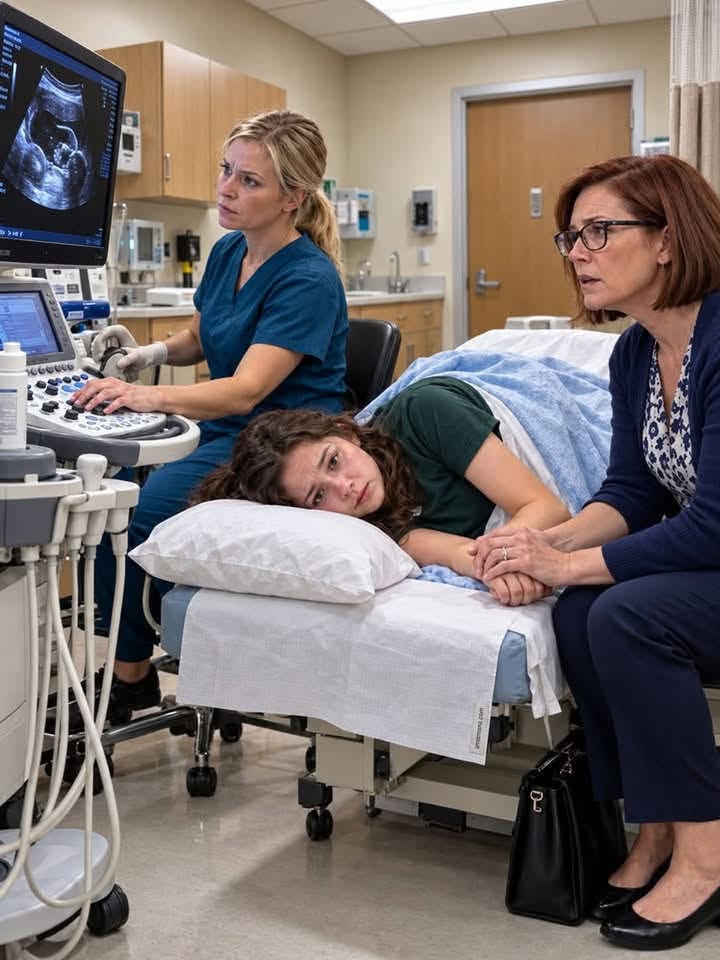
My daughter was fifteen when she finally looked at me and whispered, “I stopped telling Dad when it hurts. He says I’m just doing it for attention.”
The next afternoon, I signed her out of school and took her to the hospital without telling my husband. Halfway through the scan, the technician went quiet. Then the doctor came in, closed the door, and asked me, “How long has her father known about this?”
The exam room smelled sharply of sanitizer. The paper beneath my daughter crackled when she shifted, and I stared at the doctor because I could not make sense of the question.
“He doesn’t know,” I said. “I didn’t tell him we were coming.”
“I’m not asking about today.”
He turned the monitor toward me and brought up an older entry in her chart. Five weeks earlier, my daughter had been evaluated for the same pain. Her father was listed as the parent who brought her in. The note said additional imaging had been recommended because her symptoms needed follow-up.
I had not known there had been a first visit.
My daughter pulled the sleeves of her hoodie over her hands and stared at the edge of the exam bed.
“Did Dad take you?” I asked.
She nodded.
The doctor explained, evenly and without accusing anyone, that what they were seeing now needed prompt attention and more testing. He was trying to understand why the earlier follow-up had not happened.
So was I.
“What did Dad tell you after that appointment?”
She swallowed. “He said they didn’t find anything important.”
The doctor turned the screen far enough for me to read the earlier discharge note myself. The follow-up was part of the plan. It was not a casual suggestion that could have been missed in passing.
I sat beside her. “You are not in trouble. I need the truth, even if you think it’s going to make me angry.”
Her eyes filled, but she kept looking at me.
“He got mad after the appointment,” she said. “He said you were already stressed about money and work, and I was making everything worse.”
My husband had always disliked problems he considered unnecessary drama: a missed shift, an unexpected bill, anything that could not be fixed quickly and forgotten. Still, I kept searching for an explanation I could live with. Maybe he had misunderstood the instructions. Maybe he thought the pain had passed. Maybe my daughter had heard fear in his words that he had not meant to put there.
Then the doctor asked, “Did your father ever tell you not to tell your mother about the follow-up?”
My daughter’s fingers tightened inside her sleeves. She pulled one farther over her hand, then nodded.
I reached for her hand beneath the cuff.
“What exactly did he tell you?”
She opened her mouth, but my phone began vibrating inside my purse. I pulled it out. Dad.
My daughter saw the name on the screen, and her face tightened. The phone kept buzzing in my hand.
“Do you want me to answer?” I asked her.
She looked down. “He’ll be mad if you don’t.”
“He can be mad at me.”
I answered and put the call on speaker so I would not have to turn away from her.
“Where are you?” my husband asked.
“At the hospital.”
There was a pause. “Why?”
“She’s being seen for the pain you took her in for five weeks ago.”
He did not ask what the doctor had found. He said, “I told you they didn’t find anything.”
“You told her that.”
“I thought it had settled down.”
“The doctor is asking why the follow-up didn’t happen.”
My daughter watched the phone. Her sleeve was still pulled over her fingers.
“Can we talk when you get home?” he said.
“No. We’re not leaving this out of the conversation.”
He let out a breath. “I don’t want to do this over the phone.”
“Neither do I. But she’s here, and you called.”
He asked to speak with her. I looked at my daughter. She shook her head, once.
“She doesn’t want to talk right now,” I said.
“She’s my daughter.”
“She’s the one who has to decide whether she can talk to you.”
He went quiet. Then he said he would come to the hospital.
I told him not to come into the room until I had spoken with our daughter. He started to object, then stopped. I ended the call.
The doctor gave us time before asking what she wanted to do next. He explained that the current concern needed prompt attention and more testing. He did not offer a diagnosis, and I did not ask him to guess. I wanted to know what we had to do now.
“What happens next?” I asked.
He described the next steps in the care plan. I listened and wrote down what I needed to remember. My daughter stayed close to me, still quiet, but she no longer looked only at the edge of the bed.
When the doctor left, I asked her again about the first appointment. This time, she did not make me pull the story from her one piece at a time.
“He took me after school,” she said. “I told him it still hurt. They said they wanted to do more pictures, but he said we’d see.”
“Did you know they wanted you to come back?”
“I knew they said something about it. I didn’t know it was important.”
“And when you got home?”
“He said it was nothing. He said you had enough to deal with.”
I wanted to ask why she had not told me. The question was already in my mouth, and I swallowed it. She had been fifteen, hurting, and told by her father that bringing it to me would make things worse. I could not ask her to defend the choice an adult had pushed her into.
“I’m sorry I didn’t see how bad it was,” I said.
“You asked me.”
“I did.”
“I said I was fine.”
“I know.”
She glanced at me. “I didn’t want you to get upset.”
That was the part I am ashamed to say: some days, when she said she was fine, I was relieved. I wanted it to be ordinary. I had noticed her moving more slowly in the mornings, leaving food on her plate, and taking the heating pad to her room. I had asked, and she had answered. I let those answers close the conversation because I wanted them to be true.
“You can tell me even if I’m upset,” I said. “You don’t have to protect me from it.”
She gave a small nod. It was not forgiveness or a promise. I was grateful she had answered at all.
The doctor came back with the next steps, and I asked him to go over them once more. I wanted my daughter to hear the same information I did, not a softened version later from either parent. She listened and asked a question of her own. He answered her directly.
When he left, she said, “Are you going to tell Dad what I said?”
“He already knows what he told you. I’m not going to make you explain it to him.”
She looked at me as if she was trying to decide whether I meant it.
“I’ll talk to him,” I said. “You don’t have to be in that conversation unless you want to.”
“What if he says I got it wrong?”
“Then I’ll tell him what the chart says. And I’ll tell him what you told me.”
She drew her knees closer, then let them fall back against the paper. “I don’t want him to think I’m lying.”
“I know.”
I was nervous to post this part, because I had spent years believing that keeping the peace at home was the same as keeping our family safe. It wasn’t. Not when peace meant my daughter was learning to hide pain.
My husband arrived later. I did not bring him into the room. I stepped into the hall while our daughter stayed with the nurse, and I told him the doctor had shown me the earlier note.
He looked at the floor. “I didn’t think it was serious.”
“They recommended follow-up.”
“I know.”
“Then why did you tell her they found nothing important?”
He rubbed his forehead. “Because I thought it would go away. She’d been saying it hurt, and I didn’t want every ache to turn into a whole thing.”
“She told you it was the same pain.”
“I know what she said.”
“And you told her not to tell me.”
He started to answer, stopped, and glanced toward the room. “I said you were stressed. You were working, money was tight. I didn’t want to add another problem.”
“You made her responsible for deciding what I could handle.”
“I wasn’t trying to do that.”
“But you did.”
He looked up. “I thought I was keeping it from becoming bigger than it was.”
I felt the old urge to help him finish the sentence in a way that made it kinder. I had done that before: he was tired, he was worried, he hated medical appointments, he did not want to miss work. Those things could explain his impatience. They could not explain telling a child to keep a follow-up from her mother.
“What did you think would happen if I knew?” I asked.
He shook his head. “I don’t know. I thought you’d panic. I thought we’d deal with it if it kept hurting.”
“It kept hurting.”
“I know.”
“Do you understand that she stopped telling us?”
“I didn’t know she stopped.”
“She just told me.”
He opened his mouth, then looked away. For a few seconds, neither of us said anything. He wanted me to accept that he had not understood the consequences. I wanted him to admit that he had known enough to tell her to hide the appointment.
Finally he said, “I shouldn’t have told her not to tell you.”
“No.”
“I was wrong.”
That was the first plain thing he had said. It did not undo the five weeks, or the months before them when she had been trying to describe pain and had been told it was for attention. But it was an admission, not another explanation dressed up as one.
“Did you know the doctor wanted more imaging?” I asked.
“Yes.”
“And you didn’t tell me.”
“I thought we could wait and see.”
“You decided that alone. Then you told her it wasn’t important.”
He looked toward the door again. “I was trying to keep things manageable.”
“For whom?”
He did not answer.
A nurse came out and said the doctor was ready to speak with us about the plan. I told my husband he could come in if our daughter agreed. He waited while I asked her.
She said, “He can come in. I don’t want to talk about the first appointment again.”
I told him that was the boundary. He nodded and came in.
The doctor went over what needed to happen next. My husband listened without interrupting. When he tried to ask whether the earlier visit had been enough, the doctor answered that the recommended follow-up still mattered. He did not accuse my husband or make a judgment about what he had intended. He stayed with the care plan.
Afterward, my husband started to speak to our daughter.
“I’m sorry,” he said. “I should have told your mom.”
She kept her eyes on the blanket. “You said I was doing it for attention.”
“I was frustrated. That doesn’t make it okay.”
“You said I made everything worse.”
He shifted in his chair. “I shouldn’t have put that on you.”
She did not answer. I did not tell her she should. My husband glanced at me, perhaps waiting for me to help him get past that silence. I stayed where I was.
When we left, I carried the instructions and the next steps. My daughter walked beside me. My husband followed a few paces behind us, not because I had asked him to, but because she had not invited him closer.
At home, I told him we would follow the care plan and that I would handle the appointments. He said he could help.
“You can help when she asks you to,” I said. “You don’t get to decide she isn’t hurting.”
“I’m not saying that.”
“You did.”
He started to argue, then sat down. “I don’t want her to be afraid of telling me things.”
“She already is.”
He pressed his lips together. “I can fix that.”
“You can start by not asking her to make this easier for you.”
He said he understood. I told him I did not want our daughter pulled into another conversation about his intentions. He agreed, though he looked as if he wanted me to take that agreement as a resolution.
It was not.
The next day, I showed him the note in the chart. I had access to it because I was there with our daughter; I did not need to rely on anyone’s memory. I read the follow-up recommendation aloud, then passed him the screen so he could read it himself.
“I knew they wanted us to come back,” he said.
“And you told her they found nothing important.”
“I thought it wasn’t urgent.”
“You didn’t tell me that. You told her not to tell me.”
He leaned back. “I didn’t want you to worry over something they hadn’t even figured out.”
“They said it needed follow-up.”
“I know.”
Our daughter sat at the other end of the room. She had said she wanted to hear the conversation, but not be questioned. She listened without looking at either of us.
My husband turned toward her. “I’m sorry I made you keep it from your mom.”
She said, “You made me feel like I was making it up.”
“I didn’t mean, ”
“But you said it.”
He stopped. Then he said, “Yes. I did.”
I watched him try to find a reason that would make the apology easier to accept. He did not find one. The chart was there. So was our daughter. Nothing in his explanation changed what he had asked her to do.
“I was scared it would become expensive and take time from work,” he said. “That’s the truth. I thought I could wait and see, and I didn’t want to admit I’d made the wrong call.”
That was not a defense. It was the first time he had named what he was protecting: his time, his sense that the problem could be put off, and himself from having to say he was wrong.
“You should have told me,” I said.
“I know.”
“You should have told her the appointment mattered.”
“I know.”
“And you don’t get to call her pain attention-seeking again.”
He looked at our daughter. “I won’t.”
She answered quietly, “You said that before about other stuff.”
He began to say something, then stopped. I did not supply a softer version for him. He sat with what she had said.
I told him we would not carry on as if this had been a misunderstanding. He had known there was a recommendation. He had hidden it from me and told our daughter to keep it hidden too. The immediate consequence was not a dramatic speech or a punishment for its own sake. I told him to stay elsewhere while I decided what I could live with, and that for now I would take our daughter to every appointment.
He looked startled. “You’re asking me to leave?”
“I’m telling you I need you to go tonight.”
“Can’t we talk about this without making it bigger?”
“It is already bigger. She was the one carrying it.”
He looked at our daughter. “Do you want me to go?”
She did not answer right away. Then she said, “I want you to stop asking me to take care of how you feel.”
He lowered his eyes. He did not argue with her.
He left that evening. I did not tell our daughter she had caused it or that she had to decide what happened next between us. I told her the decision was mine. She nodded, and we stayed focused on the care plan and the next appointment.
The medical testing continued, and I kept the information direct between the doctor, my daughter, and me. I did not tell her everything would be fine when I could not know that. I also did not let anyone call the follow-up unnecessary. She was still being evaluated. That was enough reason to keep showing up.
My husband did not come back into the house the next day and pretend nothing had happened. He asked to speak with her. I asked her first. She said not yet. I told him that was her answer.
“I’m her father,” he said.
“She knows that.”
“I should be able to apologize.”
“You did. She doesn’t owe you a response on your schedule.”
He was quiet. Then he said, “I don’t know how to make this right.”
“Start by respecting what she said.”
He did not push past that. It was a small thing, but it was the first time he let her answer stand without making her take care of his disappointment.
I did not promise him that our marriage would return to what it had been. I did not ask our daughter to reassure him. I told him we would talk about the marriage separately, and that the next medical decisions belonged with the adults who would listen when she said she hurt.
For a while, she still spoke carefully. When I asked how she felt, she sometimes said, “I don’t know,” and I learned not to fill the pause for her. I asked whether she wanted me to sit with her or give her space. Sometimes she wanted one; sometimes the other. We kept the appointments and followed the instructions. I listened when she spoke, even when the answer made me ashamed of what I had missed.
Her father had told her it was for attention. She had believed telling me would make things worse. I cannot make that part disappear by saying I am sorry. I can make sure she no longer has to carry it alone.
She told me it hurt. I listened.