MY SON-IN-LAW THOUGHT HE WOULD STEAL OUR FAMILY FORTUNE IN DIVORCE COURT. HE NEVER IMAGINED THE SIGNATURE I EXPOSED WOULD UNCOVER A SECRET BURIED FOR TWENTY-SEVEN YEARS.
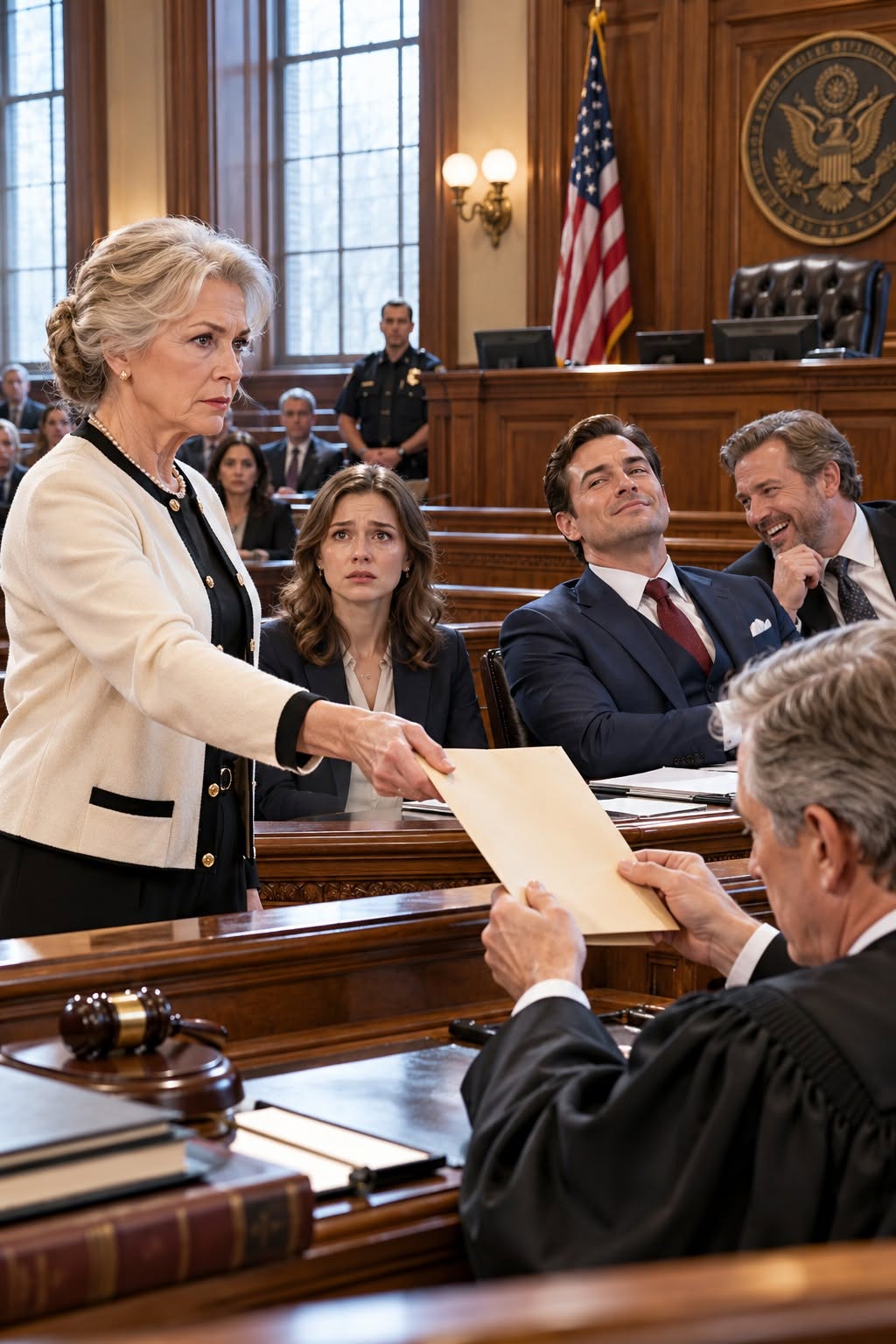
The first time I saw my former son-in-law in handcuffs, he was still smiling.
Not because he was innocent.
Not because he believed the police had made a mistake.
He was smiling because he knew something about my daughter that I didn’t.
And when he finally told me what it was, I discovered that the man I’d trusted to protect my family for thirty years had been helping destroy it.
But that wasn’t the worst discovery.
The worst came when I learned why my husband had really died.
My name is Marianne Bellamy.
I’m sixty-three years old, a widow, a mother, and a grandmother to two children who mean more to me than anything else in this world.
For most of my life, I believed that being careful, working hard, and treating people decently would protect you from the worst things life could throw at you.
I was wrong.
Sometimes the greatest danger doesn’t come from strangers.
**Sometimes it comes from the people who know exactly where you keep your spare keys.**
And sometimes, by the time you realize someone is trying to destroy your family, they’ve already been sitting at your dinner table for years.
***
CHAPTER ONE: THE ENVELOPE
“Time to collect my share of the family fortune.”
Graham said those words in a crowded divorce courtroom while sitting less than twenty feet from the woman he’d spent four years manipulating.
His attorney, Richard Collins, gave a quiet laugh.
My daughter Lydia stared at her folded hands.
I sat behind her, holding a cream-colored envelope against my knees.
Graham looked handsome that morning.
He always did.
His dark hair was neatly combed, his navy suit probably cost more than most people’s monthly mortgage payments, and his expression carried the effortless confidence of a man who had never seriously considered the possibility of losing.
He had arrived expecting a generous settlement.
He believed he had paperwork establishing financial claims involving my daughter’s assets and, indirectly, the Bellamy family trust.
He thought everything had already been arranged.
What he didn’t know was that I’d spent the previous six weeks gathering evidence.
What he couldn’t have imagined was that one document in my handbag was about to destroy his carefully constructed identity.
“Mrs.
Bellamy?”
The judge’s voice interrupted my thoughts.
I stood.
“Your Honor, I have evidence concerning the validity of the financial documents being presented.”
Graham rolled his eyes.
“Here we go.”
His attorney whispered something to him.
They both smiled.
Judge Eleanor Whitcomb, a gray-haired woman with sharp eyes and very little patience for courtroom theatrics, studied me.
“Mrs.
Bellamy, these documents should have been provided through counsel.”
“They have been, Your Honor.
Copies were submitted this morning.
I’m asking that you examine the originals.”
My attorney, seated beside Lydia, confirmed the submission.
The judge nodded.
I approached the clerk and handed over the envelope.
Inside were three documents.
A purported financial power of attorney.
A hospital record.
And an official notice concerning a notary whose commission had been revoked.
Judge Whitcomb studied the first page.
Then the second.
Her eyebrows drew together.
“Mr.
Graham, this document bears Marianne Bellamy’s signature, correct?”
Graham leaned forward.
“Yes, Your Honor.”
“And you maintain that she signed it willingly?”
“Absolutely.
I was there.”
I felt Lydia stiffen beside me.
The judge looked down.
“November seventeenth.”
“That’s correct,” Graham replied.
I drew one slow breath.
**”Your Honor, on November seventeenth, I was unconscious in an operating room at St.
Mary’s Hospital.”**
Graham’s smile disappeared.
“I underwent emergency surgery,” I continued.
“I was under anesthesia for almost eight hours.
The hospital records include the operating room log and the attending physician’s statement.”
Richard Collins immediately stood.
“Your Honor, there may have been a clerical error concerning the date.”
“Then perhaps,” I replied, “you can explain why the notary whose seal appears on that document lost his commission two years earlier.”
The courtroom became completely silent.
I watched Graham’s expression change.
Confusion.
Calculation.
Then anger.
Judge Whitcomb turned another page.
“And the signature itself?”
“A forensic document examiner has identified significant inconsistencies,” my attorney explained.
“We have also supplied evidence suggesting this document was created using a scanned signature from an earlier legitimate transaction.”
Collins looked at Graham.
Graham looked toward the exit.
The judge closed the folder.
“Mr.
Graham, given the evidence and the outstanding warrant brought to the court’s attention this morning, I am directing the courtroom officer to take you into custody.”
Two officers moved forward.
Graham shot to his feet.
“This is ridiculous!”
“Sit down,” Judge Whitcomb ordered.
Instead, he pointed at me.
“You think you’ve won, Marianne?”
I held his gaze.
He gave a strange, ugly laugh.
**”Ask your daughter what she signed last Tuesday.”**
My heart lurched.
I turned toward Lydia.
Her face had lost every trace of color.
“Lydia?”
She started crying.
“Mom,” she whispered, “there’s something I haven’t told you.”
And that was the moment I understood something terrible.
**The man being arrested wasn’t the only person who had betrayed us.**
***
CHAPTER TWO: THE MAN EVERYONE LOVED
Four years earlier, Graham had entered our lives like an answer to a prayer.
Lydia was thirty-four at the time, raising Noah and Lily after a painful first marriage.
She worked as a registered nurse at St.
Mary’s Hospital, usually taking extra shifts because she worried constantly about money.
Her first husband, Jason, had struggled with gambling and drinking.
When their marriage finally ended, Lydia walked away with two young children, a stack of unpaid bills, and the exhausting belief that every problem in her life was hers alone to solve.
I helped whenever I could.
I picked up the children after school.
I cooked meals.
I paid for swimming lessons and bought winter coats when Lydia insisted the old ones would last another year.
But I couldn’t give her what she wanted most.
Someone beside her.
Someone who would love her children.
Someone who would stay.
Then Graham arrived.
They met at the community center where Noah attended an after-school robotics program and Lily took dance classes.
Graham volunteered there twice a week.
At least, that’s what he told everyone.
He helped Noah construct a model bridge for a school competition.
He sat through Lily’s entire recital and brought her yellow roses afterward.
He remembered that Lydia preferred dark roast coffee, hated cilantro, and always forgot to eat breakfast before a morning shift.
When she mentioned that her washing machine had been making a strange noise, he came over the next afternoon and repaired it.
He didn’t ask for anything.
That was the part Lydia loved most.
“He just helps, Mom,” she told me one Sunday.
“He doesn’t keep score.”
I wanted to believe her.
But something about Graham felt familiar.
It took me several days to remember where I’d seen him.
The accounting office.
I had worked part-time for a small accounting firm since retiring from my full-time career.
Several weeks before meeting Lydia, Graham had visited the office asking questions about family trusts.
Not ordinary questions.
He wanted to know how assets were transferred when elderly account holders became incapacitated.
He asked about financial powers of attorney.
He seemed particularly interested in what happened when adult children disagreed with their parents over estate planning.
At the time, I thought he might be researching a problem involving his own family.
Then he began appearing at my coffee shop.
On one occasion, he mentioned Noah’s interest in robotics.
I remember staring at him.
“How do you know about my grandson?”
Graham smiled.
“Small town.
People talk.”
The answer should have reassured me.
Instead, it bothered me.
Still, Lydia was happy.
And after watching her cry herself to sleep for months following her divorce, I couldn’t bring myself to interfere without proof.
So I invited him to dinner.
Graham arrived with flowers.
He helped carry dishes.
He praised my cooking.
He listened attentively when I talked about my late husband, Martin.
Then he disappeared down the hallway.
Five minutes later, I found him in my home office.
**He was photographing my bank statements.**
His phone was raised toward an open folder containing investment reports and information about our rental properties.
“Graham?”
He spun around.
“Marianne!”
I looked at his phone.
“Did you get lost?”
He laughed awkwardly.
“Just admiring how organized you are.”
“Good records matter,” I said.
He nodded.
“Absolutely.”
“Especially when you’re protecting something.”
His smile tightened.
I showed him the bathroom and returned to the kitchen.
I didn’t tell Lydia.
Not yet.
But that night, after everyone had gone home, I sat beneath the photograph of Martin and me on our thirty-fifth wedding anniversary.
He had been dead for nearly five years.
I still missed him every morning.
Martin had started out as a construction supervisor.
Later, we bought and renovated modest rental properties together.
We weren’t extravagantly wealthy, but decades of hard work had given us financial security.
More importantly, we’d built something we intended to leave behind for Lydia and the children.
Martin used to say, “Money isn’t the point, Marianne.
The point is making sure the people we love have somewhere safe to land.”
I stared at his photograph.
Then I reached for the telephone.
“Thomas,” I said when our family attorney answered, “I need you to review the trust.”
Thomas Avery had known my husband for more than thirty years.
He’d helped us purchase our first rental property.
He’d written our wills.
He’d handled Martin’s estate after his death.
I trusted him completely.
Or so I thought.
***
CHAPTER THREE: THE FIRST WARNING
Thomas listened patiently while I described Graham’s behavior.
When I finished, he sighed.
“Marianne, it’s possible the young man is simply curious.”
“He photographed my financial documents.”
“That’s certainly inappropriate.”
“Inappropriate?”
“I understand your concern.
But we should be careful not to create a family conflict without knowing his intentions.”
I rubbed my forehead.
“Can you at least review our financial protections?”
“Of course.”
Over the following weeks, Thomas arranged updated trust documents and additional safeguards.
I signed everything he recommended.
He assured me my accounts and properties were protected.
Meanwhile, Graham continued charming everyone around him.
Three months later, he proposed to Lydia.
He did it in our backyard.
Noah and Lily held a banner covered in colorful drawings.
Lydia cried.
Graham got down on one knee.
And everyone applauded.
Including me.
Because despite my concerns, I wanted my daughter to be happy.
Their wedding was small.
Lydia wore an ivory dress and carried white roses.
Noah stood beside Graham in a miniature navy suit.
Lily scattered flower petals down the aisle.
When Graham promised to love and protect all three of them, Lydia looked as though every broken part of her life had finally been put back together.
I remember feeling something dangerously close to hope.
For almost two years, nothing happened that I could clearly identify as abuse.
At least, nothing dramatic.
Instead, there were small changes.
Lydia stopped calling during her lunch breaks.
She began declining invitations to Sunday dinner.
Graham often answered her phone.
When I asked why she seemed tired, she blamed work.
“He worries about me,” she explained.
“Sometimes he thinks I take on too much.”
Then came the comments.
Graham would laugh and say Lydia was terrible with money.
He’d joke that she couldn’t make a decision without checking with her mother.
At family gatherings, he’d tell stories about her forgetfulness.
Everyone laughed.
Sometimes Lydia laughed too.
But I began noticing the way her eyes lowered whenever he spoke.
Then Noah stopped talking about his school projects.
He’d once been an enthusiastic boy who could spend an hour explaining the difference between bridges and suspension structures.
Now, when Graham entered a room, Noah became quiet.
One afternoon, while we were baking cookies, I asked whether everything was all right at home.
Noah shrugged.
“Graham says Mom worries too much.”
“About what?”
“Everything.”
“And what do you think?”
He stared at the dough.
“Sometimes it’s easier when nobody asks questions.”
I looked at him carefully.
“Sweetheart, has Graham ever frightened you?”
Noah hesitated.
Then he shook his head.
“He doesn’t hit us or anything.”
The words chilled me.
**I hadn’t asked whether Graham hit them.**
Before I could say anything else, Lily came running into the kitchen.
“Grandma!
Look!”
She held up a drawing.
It showed our family standing outside my house.
There was Lydia.
Noah.
Lily.
Me.
And a tall man in a black suit.
Everyone had smiling faces except the man.
His mouth was a straight red line.
“Who’s that?”
I asked.
“Graham.”
“Why isn’t he smiling?”
Lily considered the drawing.
“He only smiles when people are looking.”
I said nothing.
But that evening, after the children left, I placed the picture inside my desk drawer.
I would look at it many times over the next two years.
***
CHAPTER FOUR: CHRISTMAS DINNER
The first open attack came on Christmas Eve.
I had spent two days preparing dinner.
The house smelled of roasted turkey, cinnamon, and fresh bread.
Martin’s old record player was filling the living room with Christmas music.
For a few hours, everything felt almost normal.
Then Graham placed a thick folder beside my plate.
“Marianne, we’ve been meaning to discuss something.”
I looked at him.
“What’s that?”
“Your financial arrangements.”
Lydia stopped pouring coffee.
Graham continued pleasantly.
“At your age, managing multiple properties and investment accounts must be exhausting.”
“I’m managing quite well.”
“Of course.
But there are professionals who could take some of that responsibility off your shoulders.”
He opened the folder.
Inside were charts, account summaries, and a proposal from a financial management company.
I recognized several figures.
They came directly from documents Graham had photographed in my office.
He was presenting them as though they’d been supplied to him legitimately.
“I know people who specialize in estate optimization,” he said.
“They could consolidate your accounts and simplify the trust.”
I looked at Lydia.
“Did you know he was bringing this?”
She nodded nervously.
“We thought it might help, Mom.”
I turned back to Graham.
“Who prepared these figures?”
“An associate.”
“What’s his name?”
“Victor Shaw.”
I had never heard of him.
Graham slid a pen toward me.
“Nothing needs to happen tonight.
We just want your permission to begin reviewing the documents.”
I closed the folder.
“No.”
His smile faltered.
“Marianne—”
“I said no.”
Lydia flushed.
“Mom, please don’t make this difficult.”
Graham leaned back.
“Don’t you want the children to inherit as much as possible?”
I met his eyes.
**”How do you know the exact value of investments I never discussed with you?”**
The room fell silent.
For one brief moment, Graham looked genuinely caught.
Then he laughed.
“Marianne, we’re family.”
As though that explained everything.
Lydia looked hurt.
“Mom, you’re acting like he’s a stranger.”
I could have told her about my office.
I could have demanded that Graham leave.
Instead, I looked at my daughter and saw how desperately she wanted me to approve.
“I appreciate your concern,” I said quietly.
“But the answer is still no.”
Graham closed the folder.
“Fine.”
His voice was pleasant.
His eyes weren’t.
Later, while Lydia helped me clear the table, she whispered, “Why can’t you just trust him?”
I felt something crack inside me.
“Because trust isn’t something a person gets by demanding it.”
She shook her head.
“You’ve never really given him a chance.”
Then she left the kitchen.
I stood alone at the sink, staring at the Christmas lights reflected in the window.
Martin had always been the one who could talk sense into Lydia without making her feel judged.
I missed him so fiercely that I had to grip the counter.
After the family left, I called Thomas Avery.
“Graham is trying to get access to the trust.”
Thomas sounded concerned.
“Did you sign anything?”
“No.”
“Good.
Don’t sign anything without consulting me.”
I felt some of my fear ease.
Then he added, “But Marianne, try not to make an enemy of your son-in-law.
Family disputes have a way of becoming expensive.”
I thanked him and hung up.
What I didn’t know was that Thomas made another telephone call less than ten minutes later.
That call would become one of the most important pieces of evidence in the case.
***
CHAPTER FIVE: THE INVESTIGATOR
I hired Denise Kellan three days after Christmas.
She was a private investigator in her late forties with short brown hair, a calm voice, and the exhausted expression of someone who had spent too many years discovering ugly things about ordinary people.
We met at a diner outside town.
I brought photographs of Graham, his business card, and everything I could remember about his questions at the accounting office.
Denise listened without interrupting.
Then she asked a question I hadn’t expected.
“Has your attorney ever met him?”
“I assume so.
Thomas has been our family lawyer for decades.”
“Have they communicated directly?”
“I don’t know.”
She wrote something in her notebook.
“Let’s start with his history.”
Three weeks later, she called.
“Marianne, we need to talk.”
She’d found discrepancies in Graham’s employment records.
One company listed on his résumé had closed before he supposedly worked there.
Another denied ever employing him.
His claimed business degree could not be verified through the school he’d named.
Then came the previous relationships.
There were two women.
Both had been involved with Graham under slightly different names.
Both reported financial irregularities during their relationships.
One woman’s elderly father had lost substantial savings after signing documents he didn’t fully understand.
The other woman’s mother had been placed under a court-supervised conservatorship following allegations of declining mental capacity.
Graham had been connected to both families.
But in neither case had investigators established enough evidence to charge him.
“Do you think he’s a professional con artist?”
I asked.
Denise hesitated.
“I think he has a pattern.”
I stared at her.
“What kind of pattern?”
“He enters families with money, makes himself indispensable, and becomes involved in decisions that give other people control over the assets.”
I felt sick.
“And then?”
“The relationships collapse.”
I thought about Lydia.
Her exhaustion.
Her quietness.
The way Noah stopped talking whenever Graham walked into a room.
“What do I do?”
“Document everything.
Don’t confront him alone.
And don’t assume the people around him are uninvolved.”
That final warning bothered me.
“What do you mean?”
Denise looked down at her notebook.
“People who operate like this usually have professional help.”
I thought of the financial adviser Graham had mentioned at Christmas.
Victor Shaw.
I asked Denise to investigate him.
Meanwhile, I tried carefully approaching Lydia.
We met for lunch at a small restaurant near the hospital.
She looked thinner than the last time I’d seen her.
There were dark circles beneath her eyes.
“Sweetheart,” I began, “is everything all right between you and Graham?”
She sighed.
“Mom, not this again.”
“I’m worried about you.”
“You’re always worried.”
“That’s what mothers do.”
“No, Mom.
You don’t understand.
Graham says you have a hard time letting me make my own decisions.”
I felt the sting.
“And what do you think?”
Lydia stared at her salad.
“I think you don’t like him.”
“That’s not the same thing.”
She pushed her plate away.
“He’s my husband.”
“I know.”
“Then please respect my marriage.”
I wanted to reach across the table and shake her.
Instead, I took her hand.
“Listen to me carefully.
If you ever need to come home, for any reason, you don’t have to explain.
You don’t have to apologize.
The door will always be open.”
Her eyes filled.
For one second, I thought she might tell me something.
Then her phone buzzed.
Graham.
She pulled her hand away.
“I have to go.”
I watched her leave.
And I understood that Graham wasn’t simply trying to steal money.
**He was slowly teaching my daughter that the people who loved her were the people she couldn’t trust.**
***
CHAPTER SIX: THE MORNING EVERYTHING BROKE
Six months later, Lydia called me at 6:03 a.m.
I remember the exact time because I had been awake since five, unable to sleep.
“Mom?”
Her voice sounded wrong.
Thin.
Shaking.
“Lydia, what’s happened?”
For several seconds, she couldn’t speak.
Then she began crying.
“I think Graham has been lying to me.”
I sat upright.
“What did you find?”
“He left his laptop open last night.
I wasn’t snooping, Mom.
I just needed to print Lily’s permission slip.”
“All right.”
“There was a folder with my name on it.”
I waited.
“Mom, it had copies of my pay stubs.
My bank statements.
Pictures of our house.
Even copies of the kids’ birth certificates.”
A cold sensation spread through my chest.
“What else?”
“Documents about your trust.”
I closed my eyes.
“And there were papers with your signature on them.”
“What papers?”
“Financial authorizations.
Something about appointing Graham to act on your behalf.”
I got out of bed.
“Listen to me.
Don’t confront him.”
“I already asked him.”
My heart stopped.
“What did he say?”
“He got angry.
He said I was paranoid, just like you.”
“Did he threaten you?”
She started crying again.
“He took my phone.
He said I couldn’t be trusted with money anymore.”
I gripped the edge of the dresser.
“Where are you now?”
“At work.
I borrowed a phone from another nurse.”
“Are the children safe?”
“They’re at school.”
“Stay there.
I’ll come get you.”
Before hanging up, I asked one more question.
“Lydia, did you see anything unusual about those documents?”
She paused.
“One had a date on it.”
“What date?”
“November seventeenth.”
I felt my stomach drop.
That date.
My emergency surgery.
A day when I had been completely unconscious.
**A day when it would have been physically impossible for me to sign anything.**
I immediately called Thomas.
He sounded alarmed.
“Marianne, that’s very serious.”
“Can you help?”
“Of course.”
“I want to file a police report.”
“Let’s not rush.
We should establish exactly what we’re dealing with.”
I frowned.
“Thomas, someone forged my signature.”
“Allegedly.”
“Allegedly?”
“I know you’re upset, but we need to proceed carefully.”
He suggested bringing Lydia and the documents to his office.
I agreed.
But after hanging up, something about the conversation troubled me.
Thomas had always been cautious.
Yet this time, his caution felt different.
Almost like reluctance.
I called Denise.
She listened to everything.
Then she asked, “Did you give Thomas the original documents?”
“Not yet.”
“Good.”
“Why?”
“Don’t.”
The word came so sharply that I went silent.
Denise lowered her voice.
“Marianne, Victor Shaw’s name appears in records connected to your attorney’s office.”
I froze.
“What?”
“They’ve shared business interests.”
“Thomas and Victor?”
“Yes.”
“That doesn’t mean—”
“I know.
But until we understand the relationship, don’t hand over anything you can’t replace.”
For the first time in thirty years, I found myself wondering whether Thomas Avery had been telling me the truth.
I hated the thought.
Thomas had stood beside me at Martin’s funeral.
He’d helped carry my husband’s coffin.
He’d sat in my kitchen afterward and told me I wouldn’t have to handle everything alone.
He was practically family.
But Denise’s warning wouldn’t leave me.
That afternoon, I met Lydia outside the hospital.
She ran into my arms.
For a long time, neither of us spoke.
Then she whispered something against my shoulder.
“Mom, I think he married me because of your money.”
I held her tighter.
“Oh, sweetheart.”
“I thought he loved me.”
I could feel her trembling.
“I thought he loved the kids.”
I wanted to say something comforting.
Something that would make the past four years disappear.
But there are moments when love means refusing to offer a lie.
So I said the only thing I knew was true.
**”Whatever he wanted, he doesn’t get to keep hurting you.”**
***
CHAPTER SEVEN: THE DIVORCE
Lydia moved into my house that evening.
Noah and Lily came with her.
They arrived carrying backpacks, two suitcases, and a stuffed rabbit Lily had slept with since she was three.
Noah was unusually quiet.
When I showed him the guest room, he asked whether Graham had a key.
“No, sweetheart.”
“Are you sure?”
I looked directly into his eyes.
“Yes.”
He nodded.
Then, very softly, he said, “Can we lock the door anyway?”
Something inside me broke.
“Of course.”
That night, while Lydia slept on the couch, I sat beside her and brushed the hair from her forehead.
For the first time in years, she looked peaceful.
I wanted desperately to believe the worst was behind us.
It wasn’t.
Graham began calling the next morning.
At first, he apologized.
Then he blamed Lydia.
Then he threatened to take her to court.
He sent messages accusing her of stealing documents from their shared home.
He claimed she’d abandoned the marriage.
He demanded access to Noah and Lily, despite never having legally adopted them.
He also began making financial claims.
He insisted that money he’d supposedly invested in Lydia’s household entitled him to compensation.
Then his attorney sent a letter referring to my family trust.
I stared at the document in disbelief.
“He can’t possibly think he has a right to Martin’s estate.”
My new attorney, Serena Cho, adjusted her glasses.
“Legally, his claims appear extremely weak.
But that doesn’t mean he won’t use them to create pressure.”
Serena was in her early forties, with an understated manner that made people underestimate her.
I had hired her after Denise suggested finding counsel outside Thomas Avery’s professional circle.
Serena’s first question had been simple.
“Who drafted your current trust?”
“Thomas Avery.”
“Who witnessed the amendments?”
“His staff.”
“Who has access to the original documents?”
I hesitated.
“Thomas does.”
She wrote something down.
“Then we need independent copies and a complete review.”
Over the next several weeks, Serena discovered irregularities that made my hands shake.
Several documents in Thomas’s files did not match copies I had kept at home.
Some pages had been replaced.
Certain provisions appeared to grant broader powers to successor trustees than I remembered approving.
And one document contained an authorization appointing Graham as a financial representative under specific circumstances.
My signature appeared at the bottom.
Dated November seventeenth.
I stared at the page.
“I never signed this.”
Serena nodded.
“I believe you.”
“Can you prove it?”
“We’re going to try.”
She arranged for a forensic document examiner.
We obtained hospital records showing exactly where I had been that day.
Then Denise uncovered the notary problem.
The seal belonged to a man whose commission had been revoked two years earlier.
The evidence was mounting.
But Graham’s attorney continued insisting that the documents were valid.
He believed we’d eventually settle to avoid an expensive legal fight.
And for a while, I worried we might have to.
Legal battles consume money.
They consume time.
Worse, they consume the emotional strength people need simply to survive.
Lydia was already struggling.
She barely slept.
She jumped whenever someone knocked on the door.
Once, I found her sitting on the kitchen floor at midnight, staring at a cereal box because she couldn’t remember why she’d opened the cabinet.
“Mom,” she whispered, “how could I have been so stupid?”
I sat beside her.
“You trusted someone you loved.”
“He never loved me.”
I didn’t answer.
She began crying.
“What if the kids never forgive me?”
I took her hands.
“Look at me.”
She raised her eyes.
“Your children don’t need you to have made perfect decisions.
They need you to keep choosing them now.”
Lydia leaned against my shoulder.
For a long time, we sat together on the kitchen floor.
And I promised myself that whatever happened in court, she would never again have to face Graham alone.
***
CHAPTER EIGHT: WHAT LYDIA SIGNED
After Graham’s arrest, Judge Whitcomb ordered a recess.
The officers escorted him out while his attorney protested.
Lydia sat motionless.
I turned toward her.
“What did you sign last Tuesday?”
She covered her face.
“Mom, I thought I was protecting you.”
My pulse quickened.
“Protecting me from what?”
She looked toward the courtroom doors.
“Thomas called me.”
I felt the room tilt.
“Thomas Avery?”
She nodded.
“He said Graham was about to file another lawsuit.
He said he’d discovered a problem in the trust and needed my signature to stop the accounts from being frozen.”
“What exactly did he ask you to sign?”
“A statement.
Something about family protection.”
Serena moved closer.
“Did he give you a copy?”
Lydia shook her head.
“He said it was confidential until it was filed.”
I closed my eyes.
“Tell me everything.”
Lydia swallowed.
“He came to the hospital during my lunch break.
He had a folder.
He said he’d worked with you for thirty years and would never do anything to hurt us.”
My chest tightened.
“He said if I signed, he’d be able to stop Graham from touching the trust.”
“Did you read it?”
“Yes.
The first pages.
They talked about financial safeguards and emergency family protections.”
“And the signature page?”
She stared at me.
“He had it clipped to the back.”
Serena’s expression changed.
“Was the document already assembled?”
“I thought so.”
“What did the signature page actually say?”
Lydia shook her head.
“I don’t remember.
Thomas said it was a standard authorization.”
My daughter began trembling.
Then she whispered, “He also asked me questions about your memory.”
I went still.
“What questions?”
“Whether you’d been forgetting appointments.
Whether you sometimes became confused.
Whether you were making unusual financial decisions.”
A terrible possibility formed in my mind.
“What did you tell him?”
“I told him you were fine.”
“Then why would he ask those things?”
“Because…”
Her voice broke.
“Because he said Graham’s lawyers might try to make you look incompetent.”
I looked at Serena.
She was already reaching for her phone.
“Marianne, I need to check something.”
Twenty minutes later, she returned looking grim.
“A petition was filed in probate court yesterday afternoon.”
“What kind of petition?”
She hesitated.
**”An emergency petition seeking temporary conservatorship over you.”**
The words didn’t make sense.
“Conservatorship?”
Serena nodded.
“The petition alleges you’re experiencing cognitive decline and may be unable to manage your finances.”
I stared at her.
“That’s absurd.”
“It also requests appointment of a temporary financial conservator pending evaluation.”
“Who?”
She looked directly at me.
“Thomas Avery.”
The room seemed to shrink.
“And Lydia?”
I whispered.
Serena took a breath.
“According to the filing, your daughter supports the request.”
Lydia made a small choking sound.
“No.”
Serena continued.
“The petition includes a sworn statement bearing her signature.”
“No!”
Lydia cried.
“I didn’t sign that!”
She looked at me desperately.
“Mom, I swear I didn’t know!”
I believed her.
But the damage had already begun.
Thomas had apparently used her signature to support an attempt to gain control over my finances.
And if the court accepted the petition, he could potentially obtain authority over assets Graham had been unable to reach directly.
I sank onto a chair.
Thirty years.
Thirty years of trusting Thomas Avery.
He had helped us create the trust.
He had known every account, every property, every inheritance provision.
He had comforted me after Martin’s death.
And now his name appeared on a petition that could strip me of control over the life Martin and I had built.
Lydia began sobbing.
“I’m sorry, Mom.”
I wrapped my arms around her.
“Listen to me.
Thomas deceived you.”
“But I signed it.”
“He deceived you,” I repeated.
Then I looked toward Serena.
“What happens now?”
Her face was serious.
“We have a hearing tomorrow morning.”
“And if we lose?”
She paused.
“Depending on the order, Thomas could gain temporary control of important financial decisions.”
I stared at the empty doorway where Graham had disappeared.
**He’d never needed to win the divorce.**
**He only needed to keep us distracted while someone else reached for the trust.**
***
CHAPTER NINE: THE SECOND BETRAYAL
That evening, Thomas called.
His name appeared on my phone as though nothing had happened.
For several seconds, I simply stared at it.
Then I answered.
“Marianne.”
His voice was gentle.
Familiar.
Almost comforting.
“Thomas.”
“I understand today’s hearing was difficult.”
“Did you file a petition to have me declared incompetent?”
Silence.
Then a sigh.
“Marianne, I was hoping we could discuss this calmly.”
My hand tightened around the phone.
“Answer the question.”
“I filed a protective petition.”
“Without telling me?”
“I had concerns.”
“About my memory?”
“About your judgment.”
I looked across the kitchen.
Lydia and the children were sitting at the table.
Noah was helping Lily with her homework.
They looked so ordinary.
So innocent.
And suddenly I hated Thomas more fiercely than I had ever hated Graham.
“What exactly is wrong with my judgment?”
I asked.
“You’ve become increasingly suspicious.
You’ve accused people of crimes without understanding the full picture.”
“I have hospital records proving someone forged my signature.”
“Marianne—”
“And now you’ve used my daughter’s signature to try to take control of my money.”
His voice hardened.
“You’re making a serious mistake.”
For the first time, I heard the man beneath the soothing professional tone.
“What mistake?”
“Turning this into a public spectacle.”
I stood.
“Did you tell Graham about the trust?”
“Be careful what you’re accusing me of.”
“Did you?”
Another silence.
Then he said, very quietly, “You don’t understand how much trouble you’re creating.”
I felt cold.
“Is that a threat?”
“It’s advice from someone who’s protected your family for decades.”
I thought about Martin.
About all the years Thomas had sat at our table.
About the papers he had placed in front of me after my husband’s funeral.
“Thomas,” I said, “what happened to Martin?”
There was a pause.
“What?”
“You heard me.”
“Your husband died of a heart attack, Marianne.”
“I know what the death certificate says.”
“Then why are you asking?”
I couldn’t explain it.
Something in his voice had changed.
A tiny hesitation.
Barely noticeable.
But after years spent examining financial records, I’d learned that the smallest inconsistencies often mattered most.
“Goodbye, Thomas.”
I hung up.
Immediately, I called Denise.
“I think Thomas is involved.”
“I know.”
The calm certainty in her voice startled me.
“What do you mean, you know?”
“I found something this afternoon.”
“Tell me.”
“Not over the phone.”
“Denise—”
“Marianne, I need you to hear me carefully.
Is your house secure?”
I looked toward the front door.
“Yes.”
“Do not let Thomas inside.”
My skin prickled.
“Why?”
She hesitated.
Then she said something I would never forget.
**”Because I don’t think your husband’s death was the beginning of this story.
I think it was the first time someone tried to stop him.”**
***
CHAPTER TEN: MARTIN’S LAST PROJECT
Denise arrived after dark.
She carried a canvas bag and a folder thick with documents.
Serena joined us twenty minutes later.
We sat around my kitchen table while the children slept upstairs.
Denise opened the folder.
“Before Martin died, he was investigating financial irregularities involving several elderly property owners.”
I stared at her.
“Martin?”
She nodded.
“Remember the old Millbrook redevelopment project?”
I did.
Martin had purchased two small rental houses near the project area years earlier.
The city had planned to redevelop the neighborhood.
Several elderly homeowners had sold their properties during that period.
Martin had complained about the process.
I remembered him saying that too many people were being pressured into selling.
“Those transactions weren’t all legitimate,” Denise said.
She laid out copies of property records.
Several homeowners had transferred property after legal petitions claiming they were unable to manage their affairs.
Temporary conservators had been appointed.
Properties had been sold.
The proceeds were routed through companies with complicated ownership structures.
My stomach tightened.
“Who represented them?”
Denise slid a document toward me.
**Thomas Avery.**
I stared at his name.
Then at another.
Victor Shaw.
And another.
A holding company I recognized from Graham’s Christmas proposal.
“No,” I whispered.
Denise continued.
“Some of these people were elderly widows.
Others had adult children living out of state.
A few were dealing with serious medical problems.”
Serena leaned forward.
“Thomas had legal access to the records.
Victor handled the financial side.”
“And Graham?”
I asked.
Denise hesitated.
“We’re still establishing his role.”
I looked at the documents.
Numbers.
Signatures.
Transfers.
They reminded me of the records Martin used to spread across our dining table.
He’d sometimes spent entire weekends studying property deeds and county maps.
I thought he’d simply been following the redevelopment project.
Now I wasn’t so sure.
“Martin was looking into this?”
Denise nodded.
“We found a reference to him in an archived complaint.”
She handed me a copy.
It had been filed by a woman named Evelyn Mercer.
The complaint alleged that her mother’s property had been transferred improperly during a conservatorship proceeding.
At the bottom was a handwritten note.
I recognized Martin’s writing immediately.
**”Check the dates.
Someone signed after the hospitalization.”**
I covered my mouth.
The same pattern.
The same trick.
A questionable signature.
A date that didn’t fit.
For a moment, I could almost hear Martin’s voice.
“Marianne, numbers don’t lie.
People do.”
I looked up.
“Where did you find this?”
“In records from a legal-aid organization.
Martin had been communicating with them.”
“Why didn’t he tell me?”
Denise looked uncomfortable.
“According to one person I interviewed, he was trying to verify the evidence before involving you.”
I stared at the papers.
My husband had been investigating the same people who were now trying to take our family’s assets.
And then he’d died.
Five years earlier, Martin had collapsed in his workshop behind the house.
I’d found him lying beside his workbench.
The doctors said he’d suffered a massive heart attack.
He had been sixty-six.
There had been no sign of violence.
No reason to suspect anything else.
Thomas had helped with the arrangements.
Thomas had helped handle the estate.
Thomas had reassured me when I couldn’t stop wondering whether I’d missed some warning sign.
I pressed my fingers against my temples.
“What are you saying?”
Denise answered carefully.
“I’m saying we need to learn what Martin discovered before he died.”
Serena nodded.
“And we need to find out whether any of it still exists.”
I looked toward the dark window.
Beyond it stood Martin’s old workshop.
I hadn’t changed much inside since his death.
His tools were still on their hooks.
His workbench still smelled faintly of cedar and machine oil.
And suddenly I remembered something.
Three days before he died, Martin had spent an entire afternoon working on a wooden dollhouse for Lily.
He’d insisted on finishing it himself.
Lily had been only four at the time.
I remembered laughing because he’d spent more effort on that little house than on the real porch we’d been meaning to repair.
When I asked why, he’d smiled.
“Every good house needs a secret.”
At the time, I thought he was joking.
Now I wasn’t so sure.
***
CHAPTER ELEVEN: THE HOUSE WITH TWO DOORS
The dollhouse stood in Lily’s bedroom.
Martin had built it from oak and painted it pale blue.
It had white shutters, a tiny porch, six rooms, and a red front door.
Lily adored it.
Even at eleven, she occasionally arranged her miniature furniture inside.
When I entered her room that night, she was sitting on the bed reading.
“Grandma?”
“Sweetheart, can I look at the dollhouse?”
She blinked.
“Sure.”
I knelt beside it.
My hands trembled as I examined the roof, windows, and tiny doors.
Everything looked ordinary.
Lily watched curiously.
“What are you looking for?”
I hesitated.
“Did Grandpa ever tell you anything special about this house?”
She smiled.
“He said it was magic.”
I looked up.
“What kind of magic?”
“He said the house had two doors.”
I stared at the red front door.
“And the other one?”
Lily climbed off the bed.
“He said the important door wasn’t the one people could see.”
My heart started beating faster.
“Do you remember where it was?”
She shook her head.
“I was little.”
I ran my fingers along the back wall.
Nothing.
I examined the roof.
Still nothing.
Then Noah appeared in the doorway.
“What are you doing?”
“Looking for something Grandpa might have hidden.”
He came closer.
“Grandpa always made secret compartments.”
I turned toward him.
“What?”
“He put one in the toolbox he made for me.
You had to slide the handle sideways.”
I looked at the dollhouse again.
There was a small chimney on the roof.
It seemed solid.
I touched it.
Then pushed gently.
Nothing.
Noah knelt beside me.
“Try turning it.”
I twisted the chimney.
It moved.
Only slightly.
Then a tiny wooden panel beneath the roof clicked open.
My breath caught.
Inside was a narrow compartment.
I reached in.
My fingers brushed something wrapped in faded blue cloth.
I pulled it out.
A small metal box.
Lily gasped.
“Grandpa’s treasure!”
I sat back on my heels.
The box was heavier than I’d expected.
It had a simple brass latch.
I opened it.
Inside were an old flash drive, a key, and a folded piece of paper.
My husband’s handwriting covered the front.
**”For Marianne, if I don’t get the chance to explain.”**
The room blurred.
I hadn’t seen those letters written by his hand in years.
The familiar slant.
The way he crossed his sevens.
The slightly crooked capital M.
My fingers trembled as I unfolded the paper.
“My love,
If you’re reading this, something has gone wrong.
I hope I’m being foolish.
I hope I’ve worried for nothing.
But if I’m right, there are people who will do terrible things to keep their secrets.
I’ve copied what I found.
Don’t give it to Thomas.
Please forgive me for not telling you sooner.
I thought I could fix this without frightening you.
There is one more thing you need to know.
The answer isn’t in our money.
It’s in the people who helped us protect it.
I love you more than all the years we’ve had.
Martin.”
I pressed the letter against my chest.
For several seconds, I couldn’t breathe.
Lily reached for my hand.
“Grandma, why are you crying?”
I pulled her into my arms.
“Because Grandpa left us something very important.”
Noah picked up the flash drive.
“Can we see what’s on it?”
I looked at my grandchildren.
My husband had hidden evidence inside a toy he’d built for a little girl.
He had trusted that someday, someone who loved him would find it.
And for the first time since the nightmare began, I felt something stronger than fear.
I felt Martin standing beside me again.
***
CHAPTER TWELVE: THE RECORDING
We waited until morning to examine the flash drive.
Serena insisted that a digital forensic specialist preserve the original data before we opened any files.
I hated waiting.
But I understood why.
If Martin had left evidence, we couldn’t risk damaging it or making it impossible to authenticate.
By noon, a specialist had created a verified copy.
Serena, Denise, Lydia, and I gathered in my living room.
The first folder contained scanned property records.
Dozens of them.
There were financial statements, transaction histories, court filings, and lists of elderly homeowners.
Some documents showed suspiciously low sale prices.
Others contained signatures that appeared inconsistent across records.
Several properties had ultimately been acquired by companies connected to Victor Shaw.
Then we opened a folder labeled PERSONAL.
Inside were audio recordings.
The first was dated several weeks before Martin’s death.
His voice filled the room.
“October ninth.
Meeting with Evelyn Mercer.
She says her mother’s house was sold without proper authorization.
Thomas claims the court approved everything.
Need to verify.”
I closed my eyes.
Martin sounded exactly as I remembered.
Calm.
Practical.
A little tired.
The next recording was shorter.
“October sixteenth.
Found another case.
Same notary, different county.
Dates don’t match hospital records.
This isn’t coincidence.”
Denise leaned forward.
The next file was dated October twenty-third.
Martin sounded frightened.
“I confronted Thomas today.
He told me to leave it alone.”
There was a pause.
Then Martin continued.
“He said I could damage innocent people if I didn’t understand the full picture.
I asked him why so many widows had lost their homes.
He wouldn’t answer.”
I felt sick.
Another recording.
“October twenty-eighth.
Victor Shaw called.
He knows I’ve been reviewing the transfers.
I haven’t told Marianne.
I don’t want her involved until I have proof.”
Lydia reached for my hand.
I squeezed hers.
Then we opened the final recording.
It was dated two days before Martin died.
For several seconds, there was only background noise.
Then my husband’s voice.
“Marianne, if something happens to me, don’t accept the first explanation.”
My breath caught.
“I should have told you sooner.
Thomas isn’t the man we thought he was.
I have evidence that he’s been involved in taking property from vulnerable people.”
His voice grew quieter.
“And there’s something else.”
A long pause.
“Someone has been helping him.
Someone connected to our family in a way you would never suspect.”
The recording crackled.
Martin continued.
“I found a photograph.
I wish I hadn’t.”
Then there was a sudden noise.
A door opening.
Footsteps.
A man’s voice in the background.
“Martin?”
Thomas.
I recognized him instantly.
Martin stopped speaking.
The recording continued for another twenty seconds.
Thomas’s voice became clearer.
“We need to talk.”
Martin answered.
“I told you to stay away from my house.”
Thomas sounded unusually calm.
“You’re making this harder than it needs to be.”
Then the recording ended.
I stared at the screen.
Thomas had been at our house two days before Martin died.
He had never told me.
And Martin had been afraid of him.
For several minutes, nobody spoke.
Then Lydia whispered, “Mom, do you think…”
She couldn’t finish.
Neither could I.
I had spent five years believing my husband died from natural causes.
Now I wasn’t certain of anything.
Serena broke the silence.
“We need to give these recordings to investigators.”
Denise nodded.
“And I need to look into the photograph Martin mentioned.”
“What photograph?”
I asked.
Denise looked thoughtful.
“The one he said he wished he’d never found.”
I stared at the screen.
Somewhere, buried inside my husband’s final investigation, was a secret connecting Thomas Avery to my family.
And I had a terrible feeling we were only beginning to understand it.
***
CHAPTER THIRTEEN: THE HEARING THAT WAS SUPPOSED TO SILENCE ME
The emergency conservatorship hearing began the following morning.
I wore the same navy dress I’d worn to Martin’s memorial service.
Not because I wanted to relive that day.
Because I wanted to remember who I was before Graham and Thomas tried to turn my life into something they could control.
Serena sat beside me.
Lydia sat behind us.
Thomas entered carrying a leather briefcase.
He looked almost exactly as he had for thirty years.
Expensive gray suit.
Silver hair.
Kind eyes.
A face people trusted instinctively.
When he saw me, he offered a small, sorrowful smile.
I didn’t return it.
The judge reviewed the petition.
Thomas’s attorney argued that recent events suggested I was becoming dangerously suspicious.
He pointed to my decision to hire a private investigator.
My allegations against Graham.
My removal of certain accounts from established management arrangements.
And my increasingly strained relationship with Thomas.
“Mrs.
Bellamy,” he said gently, “has become convinced that people close to her are conspiring against her.”
Serena stood.
“Because we have substantial evidence that two of those people were involved in financial misconduct.”
The judge raised a hand.
“Counsel, we’ll address that.”
Thomas avoided looking at me.
Then his attorney presented Lydia’s sworn statement.
My daughter stood.
“Your Honor, I need to clarify something.”
The judge allowed her to speak.
“I did sign papers last Tuesday.
But the pages I was shown were different from the statement filed with this court.”
Thomas’s attorney objected.
Lydia continued.
“I never believed my mother was incompetent.
I never asked anyone to take control of her money.”
Her voice shook.
“I was told I was helping protect her from my husband.”
The judge examined the filing.
Serena then produced copies of messages Thomas had sent Lydia arranging the meeting.
The messages described the paperwork as a financial protection authorization.
Nothing mentioned a conservatorship.
We also provided a photograph Lydia had taken of the first page she’d been shown.
Its title did not match the document filed in court.
The judge’s expression grew increasingly stern.
Then Serena introduced a report from an independent physician who had recently evaluated me.
There was no evidence of cognitive impairment.
Finally, she submitted evidence of the forged November seventeenth authorization and the ongoing criminal investigation.
The judge denied Thomas’s emergency request.
He also ordered preservation of all relevant records and referred the disputed filing to the appropriate authorities for investigation.
I should have felt triumphant.
Instead, I felt exhausted.
Thirty years of friendship had ended in less than an hour.
As we left the courtroom, Thomas approached me.
“Marianne.”
I stopped.
Serena moved closer.
Thomas looked older than he had that morning.
“You don’t understand what you’ve done.”
I felt a flash of anger.
“What I’ve done?”
“There are things Martin never told you.”
My heart pounded.
“Then tell me.”
Thomas glanced toward Lydia.
“This isn’t the place.”
“Then where is?”
He leaned closer.
His voice dropped.
“Your husband was not the innocent man you remember.”
For a moment, I couldn’t speak.
Then Thomas walked away.
I watched him disappear through the courthouse doors.
Lydia touched my arm.
“Mom?”
I stared after him.
I’d expected Thomas to threaten me.
I’d expected him to deny everything.
But I hadn’t expected him to attack Martin’s memory.
And the worst part was that I knew Thomas had been telling at least one truth.
**Martin had kept secrets from me.**
The question was why.
***
CHAPTER FOURTEEN: THE PHOTOGRAPH
Denise called that afternoon.
“I found someone who remembers Victor Shaw.”
“Who?”
“Evelyn Mercer.”
The name sounded familiar.
Then I remembered.
The woman whose complaint Martin had investigated.
“Is she still alive?”
“Yes.
She lives in Ohio now.”
“What did she say?”
Denise paused.
“She knew Martin.”
I gripped the phone.
“How well?”
“Well enough that he asked her to keep something safe.”
My pulse quickened.
“What?”
“A photograph.”
Two days later, Evelyn arrived at my house.
She was seventy-one, with bright blue eyes and silver hair pulled into a neat bun.
She carried an old handbag and wore a plain brown coat.
When I opened the door, she looked at me for a long moment.
Then tears filled her eyes.
“You look just like the photograph he showed me.”
“Martin?”
She nodded.
“He talked about you constantly.”
I stepped aside.
“Please come in.”
We sat in the living room beneath Martin’s portrait.
Evelyn looked at it.
“He was a good man.”
I swallowed.
“I hope so.”
She turned toward me.
“Oh, Marianne.
He was better than good.
He was one of the only people who believed me.”
She told me how her mother had been placed under a temporary conservatorship after a medical crisis.
Thomas had represented the family.
Victor Shaw had become involved in managing assets.
Within months, her mother’s house had been sold.
The proceeds were largely consumed by fees and questionable transactions.
By the time Evelyn understood what had happened, her mother was too ill to fight.
Martin had helped her obtain records.
He’d paid for an independent review.
He’d connected her with a legal-aid organization.
Then he’d begun investigating similar cases.
“He was furious,” Evelyn said.
I smiled sadly.
“Martin didn’t get angry often.”
“No.
But when he did, he became very determined.”
She opened her handbag.
Inside was a sealed envelope.
“Martin gave me this shortly before he died.”
“Why didn’t you contact me?”
“He told me to keep it safe until someone came asking about Thomas Avery.”
She hesitated.
“I tried to reach you after his funeral.
Thomas told me you were too overwhelmed and that I should leave you alone.”
My hands curled into fists.
Of course he had.
Evelyn placed the envelope on the table.
Inside were three photographs.
The first showed Thomas at a charity dinner many years earlier.
The second showed Victor Shaw standing beside him.
The third was older.
A family photograph.
Thomas stood on a lawn beside a dark-haired woman.
Between them was a boy of perhaps twelve.
The child had dark eyes, a straight nose, and a small scar near his left eyebrow.
I stared at the boy.
My heart began pounding.
“No.”
Evelyn watched me.
“Do you recognize him?”
I couldn’t breathe.
The boy’s face had changed with age.
His hair was darker.
His jaw stronger.
But the eyes were unmistakable.
And the scar…
I’d seen it hundreds of times.
At Christmas.
At Lydia’s wedding.
Across my dinner table.
**The boy in the photograph was Graham.**
I looked at Evelyn.
“Who is he?”
She took a deep breath.
“Thomas Avery’s son.”
The room seemed to spin.
“That’s impossible.”
Evelyn shook her head.
“His name was Simon Avery.”
I stared at the photograph.
Thomas had told me years earlier that his only son died as a teenager.
I remembered attending a memorial service.
I remembered Thomas standing beside an empty photograph frame, telling everyone his son had died after a long illness while living with relatives out of state.
Martin and I had sent flowers.
We’d brought meals to Thomas and his wife.
We had mourned with them.
And now the boy we had mourned was sitting in a jail cell after trying to steal my family’s assets.
I looked at Evelyn.
“Why would Thomas tell us his son was dead?”
She swallowed.
“Because Simon didn’t die.”
I waited.
“He was sent away after becoming involved in a financial crime with older boys.
Thomas used his connections to keep the matter out of public view.”
My blood ran cold.
“The family moved him under another name,” she continued.
“Later, Thomas told everyone Simon had died.”
I looked at the photograph again.
**Graham wasn’t a stranger who had happened into Lydia’s life.**
**He was the son of the man who had managed our family’s legal affairs for thirty years.**
And suddenly everything made sense.
His questions at the accounting office.
His appearances at my coffee shop.
His knowledge of our investments.
His carefully timed arrival in Lydia’s life.
He hadn’t found my family by accident.
**He’d been sent.**
***
CHAPTER FIFTEEN: A FATHER’S PRICE
Serena immediately gave the photograph and accompanying records to the investigators.
Within days, they confirmed Graham had used multiple names.
His connection to Thomas became a central part of the expanding investigation.
Records showed communications between the two men going back years.
Not occasional family calls.
Hundreds of contacts.
Business meetings.
Financial transfers.
Shared addresses on older documents.
They had concealed their relationship while participating in transactions involving vulnerable families.
But one question continued haunting me.
Why?
Why had Thomas gone to such extraordinary lengths to involve his son with Lydia?
He already controlled much of our estate planning.
He knew our finances.
He knew our vulnerabilities.
He knew exactly how to approach us.
Why send Graham to marry my daughter?
The answer came from the flash drive.
The digital specialist recovered a damaged folder that initially appeared empty.
Inside were copies of correspondence between Martin and another attorney.
One letter was dated shortly before Martin’s death.
It concerned a proposed civil action against Thomas, Victor Shaw, and several connected companies.
Martin had apparently gathered enough evidence to support an investigation into years of financial misconduct.
But he hadn’t wanted to act alone.
He had been consulting independent counsel.
And he had made one decision that changed everything.
**He intended to remove Thomas Avery as trustee and attorney for our family.**
Not eventually.
Immediately.
The paperwork was nearly ready.
Then Martin died.
Thomas remained in place.
For five years, he continued managing our legal affairs.
But he had a problem.
Martin had copied evidence.
And Thomas didn’t know where he’d hidden it.
I sat in Serena’s office staring at the documents.
“He was searching for Martin’s files.”
Serena nodded.
“Graham was probably hoping to gain access to your home and records through Lydia.”
“The photographs in my office…”
“That may have been part of it.”
“The questions about the trust…”
“Those too.”
I pressed my hand against my mouth.
“So this wasn’t just about taking our money.”
“No,” Serena replied.
“It was about making sure nobody could prove what Thomas had done.”
My thoughts returned to Martin’s final recording.
The fear in his voice.
The warning.
The secret compartment in Lily’s dollhouse.
Then I remembered something else.
After Martin’s funeral, Thomas had encouraged me to sell our remaining rental properties.
He’d said managing them would be too stressful.
He’d recommended consolidating the proceeds.
He’d suggested cleaning out Martin’s workshop.
I’d refused.
At the time, I thought he was simply trying to help.
Now I understood.
He’d wanted Martin’s papers.
And when I refused to dispose of the workshop, he’d found another route into the family.
Lydia.
My beautiful, exhausted daughter.
A woman desperate to give her children stability.
Thomas had apparently watched Graham court her, marry her, isolate her, and eventually begin pressuring me.
All while pretending to be our trusted adviser.
I felt sick.
“How could someone do that?”
Serena’s expression softened.
“People can rationalize terrible things when they’re protecting themselves.”
I stared at the photograph of Graham as a boy.
Then at Thomas standing beside him.
A father and son.
Two generations.
One terrible secret.
And I wondered what kind of man could teach his child that love was simply another way to gain access to somebody else’s life.
***
CHAPTER SIXTEEN: THE NIGHT SOMEONE CAME BACK
The first break-in attempt happened on a Thursday.
It was 11:47 p.m.
Lydia and the children were asleep upstairs.
I was in the kitchen making tea when I heard a noise behind the house.
Metal scraping against metal.
Then a dull thud.
I turned off the kitchen light.
Through the window, I saw a figure near Martin’s workshop.
Someone was trying the door.
My heart hammered.
I backed away and called 911.
Then I called Serena.
While I waited, I watched the figure move toward the side window.
A flashlight appeared.
The glass broke.
I felt a surge of anger so powerful that it almost overcame my fear.
That workshop was the last place in the world that still smelled like Martin.
His tools.
His unfinished projects.
His old coffee mug.
And now someone was breaking into it because they couldn’t bear the thought of his secrets becoming public.
I stayed inside.
The dispatcher told me officers were on the way.
Minutes later, police vehicles turned onto the street.
The figure ran.
Officers caught him near the fence.
His name was Caleb Price.
He had previously worked for a security company associated with Victor Shaw.
Inside his backpack, officers reportedly found tools, gloves, and a photograph of Martin’s workbench.
That final detail made my blood run cold.
He hadn’t come to steal random valuables.
He’d been looking for something specific.
The following morning, investigators obtained additional warrants.
Computers were seized.
Financial records were preserved.
Employees were interviewed.
I learned that Caleb had been communicating with people connected to Thomas’s law office.
The investigation widened.
And Thomas became increasingly desperate.
He left me three voicemails.
The first sounded almost apologetic.
The second accused me of destroying his reputation.
The third was different.
“Marianne, you and I both know Martin wasn’t perfect.
If you continue down this road, you may learn things you wish you’d never discovered.”
I replayed the message twice.
Then sent it to Serena.
That evening, Lydia found me sitting alone in the workshop.
Martin’s old jacket still hung on a hook.
I held it against my chest.
“Mom?”
I looked up.
She sat beside me.
“I’m scared.”
“So am I.”
She stared at the tools.
“Do you think Grandpa Martin knew Graham?”
I shook my head.
“I don’t know.”
Lydia wiped her eyes.
“All those times I defended him…”
I reached for her hand.
“Stop punishing yourself.”
“But I let him into our lives.”
“You didn’t know who he was.”
She took a shaky breath.
Then she said something I’ll never forget.
“When Graham first started dating me, he told me his father had died.”
I looked at her.
“He said he didn’t have any family.”
Her voice broke.
“He told me he understood what it felt like to lose someone.”
I closed my eyes.
He had used grief.
Not just hers.
Mine.
Martin’s death.
The children’s longing for a father.
Every vulnerable part of us had become something Graham could study and exploit.
Lydia leaned against me.
For a long time, we sat in silence.
Then I looked at Martin’s workbench.
And I remembered a conversation we’d had shortly before he died.
He’d been standing in that exact spot.
Holding a small brass key.
He’d smiled and said, “One day, Marianne, you’ll be glad I never throw anything away.”
At the time, I’d teased him about the clutter.
Now I looked at the key we’d found in the dollhouse.
**Maybe Martin had left us more than one secret.**
***
CHAPTER SEVENTEEN: THE LOCKED DRAWER
The brass key didn’t fit anything in the workshop.
We tried the old filing cabinet.
The tool chest.
The desk drawers.
Even the antique cabinet in the hallway.
Nothing.
For two days, I carried it in my pocket.
Then Noah noticed it while helping me sort old photographs.
“Grandma, that looks like the key to Grandpa’s train box.”
I stared at him.
“His what?”
“The box with the little trains.”
Martin had collected model trains.
For years, he’d stored them in a wooden trunk in the basement.
I hadn’t opened it since his death.
Noah and I hurried downstairs.
The trunk stood beneath an old blanket.
I knelt and inserted the key.
It turned.
Inside were neatly wrapped model trains, miniature trees, sections of track, and a small leather-bound notebook.
There was also an envelope.
This one had my name written across the front.
I opened it.
Inside was a single page.
“My darling Marianne,
If you’ve found this, you’ve probably found the other things too.
I know you must be angry that I kept secrets.
You have every right.
But I need you to understand something.
I discovered what Thomas was doing only after I noticed discrepancies in our own paperwork.
At first, I thought he’d made mistakes.
Then I realized the mistakes always benefited the same people.
I confronted him.
He admitted enough to frighten me.
And he asked me to help him cover it up.
I refused.
That was when he told me about his son.
I recognized the boy in the photograph from years ago.
Thomas insisted he’d died.
But he hadn’t.
And Thomas made it clear that exposing their financial operations would also expose what they’d done to hide Simon.
I’m leaving you everything I’ve found.
But there is one more truth.
I didn’t tell you because I was ashamed.
Please read the notebook before you judge me.
Martin.”
My hands were shaking.
I opened the notebook.
At first, it contained ordinary entries.
Dates.
Names.
Phone numbers.
References to property transfers.
Then I reached a page titled:
**”THE FIRST TRANSACTION.”**
I read it once.
Then again.
And the world beneath my feet seemed to disappear.
The entry concerned a property transferred twenty-seven years earlier.
The property had belonged to a widow named Helen Price.
She had signed a power of attorney while recovering from a serious illness.
Her house had then been sold through a company Thomas represented.
Martin had been involved in the renovation and resale.
He’d received a large payment.
And according to his notes, he’d later discovered that Helen Price had never understood what she’d signed.
My throat tightened.
Martin had unknowingly benefited from one of the schemes.
The money from that transaction had helped us buy our first rental property.
I stared at the page.
It felt as though the room had tilted.
The foundation of everything we’d built…
Our first investment.
The beginning of our financial security.
A woman may have lost her home because of paperwork Thomas manipulated.
And my husband had profited.
I wanted to throw the notebook across the room.
Instead, I forced myself to keep reading.
Martin had discovered the problem years later.
He’d tried to find Helen.
She had died by then.
He’d contacted her family.
The family had moved.
He’d eventually established a fund intended to compensate people harmed by those transactions.
There were records of payments.
Letters.
Attempts to trace former homeowners.
He had been trying to make things right.
But he hadn’t told me.
Not once.
I closed the notebook and began to cry.
Not because Martin had been exposed as a villain.
Because he had been human.
Because he had made a terrible mistake without knowing its full consequences.
Because he’d spent years trying to repair damage he couldn’t undo.
And because, for the first time since his death, I understood why he’d been so determined to expose Thomas.
He wasn’t merely protecting our family.
**He was trying to make sure nobody else lost theirs.**
***
CHAPTER EIGHTEEN: THE REAL FORTUNE
The investigation accelerated after we turned over Martin’s notebook.
Authorities identified additional transactions connected to Thomas, Victor Shaw, and companies they controlled.
The suspected scheme had operated over many years.
Victims had been pressured into signing documents, subjected to questionable conservatorship petitions, or misled about financial arrangements.
Properties had been transferred and sold.
Money had passed through layers of companies.
Some victims had died before anyone realized what happened.
Others had been unable to afford legal representation.
The amounts involved were staggering.
But the most disturbing discovery had nothing to do with the money.
It involved the victims themselves.
One woman had been forced to leave the home where she’d raised four children.
Another had spent her final years in a nursing facility while her former property generated substantial rental income for someone else.
A retired teacher had lost the small house she’d inherited from her parents.
Every file contained a life.
Not simply a number.
A kitchen where someone had made pancakes.
A backyard where children had played.
A front porch where an old couple had watched the sunset.
I spent an entire evening reading their names.
Then I opened Martin’s notebook again.
He’d written something near the end.
“Every number belongs to someone.”
I touched the words.
That was Martin.
He hadn’t been a perfect man.
He’d made mistakes.
But he’d never been able to look at suffering and convince himself it didn’t matter.
Serena helped me understand the restitution fund he’d created.
Over the years, Martin had quietly placed money into an account administered through an independent nonprofit legal-aid organization.
The account had grown.
He’d also designated proceeds from certain legitimate property investments for future restitution if the victims could be found and their claims established.
The arrangements weren’t flawless.
Some records needed review.
But his intentions were clear.
He wanted the people who had lost their homes to receive whatever help could still be provided.
When I learned how much he’d set aside, I sat in silence.
It represented a significant portion of our estate.
Money I’d believed would someday belong to Lydia and the grandchildren.
For a moment, I felt hurt that he hadn’t told me.
Then I thought about Helen Price.
The woman whose home had helped finance our first investment.
I pictured her packing boxes.
Leaving behind years of memories.
Perhaps wondering how a signature on a document had destroyed the life she’d known.
I looked at Serena.
“I want the restitution effort continued.”
She nodded.
“We can work with the organization and the authorities to determine what’s appropriate.”
“And the remaining properties?”
“Those are still protected, subject to the ongoing review.”
I looked down at Martin’s notebook.
“I don’t want Noah and Lily to inherit money that rightfully belongs to someone else.”
Serena’s expression softened.
“Marianne, we need to establish the facts and each person’s legal rights.”
“I know.”
I closed the notebook.
“But I also know what Martin would have wanted.”
For years, I’d imagined our family fortune as a legacy we were preserving for the children.
Now I understood that Martin had been trying to leave something more important.
**A way to repair harm, even after he was gone.**
But the investigation still hadn’t answered the question that kept me awake at night.
What had actually happened the day he died?
***
CHAPTER NINETEEN: THE WITNESS
The answer began with Caleb Price.
The man arrested near Martin’s workshop.
Investigators discovered that Caleb had worked for Victor Shaw on several properties connected to the questionable transactions.
But he’d also been employed as a driver and occasional handyman for Thomas Avery.
During questioning, Caleb initially denied knowing anything about Martin’s death.
Then investigators confronted him with records placing a company vehicle near our house that afternoon.
His story changed.
He admitted he’d driven Thomas to our property on the day Martin died.
My heart nearly stopped when Serena told me.
“Thomas was there?”
She nodded.
“According to the statement.”
I gripped the phone.
“He told me he was in another county that day.”
“I know.”
“What else did Caleb say?”
Serena paused.
“He says Thomas asked him to remain in the vehicle.”
I held my breath.
“Then?”
“Thomas went into the workshop.”
I closed my eyes.
“How long?”
“Approximately forty minutes.”
Forty minutes.
My husband had been alone in that workshop when I found him.
Or so I’d believed.
“What happened after Thomas came out?”
“Caleb says he appeared shaken.”
I pressed a hand against my mouth.
“And Martin?”
“Caleb claims he never saw Martin.”
I stared at the wall.
Forty minutes.
Thomas had spent forty minutes inside my husband’s workshop on the afternoon he died.
Then he’d left without telling me.
By the time I returned from grocery shopping, Martin was on the floor.
The emergency responders arrived quickly.
But there was nothing they could do.
I’d spent five years wondering whether arriving ten minutes earlier might have saved him.
Now I knew someone else had been there.
Someone who might have known he needed help.
The possibility was unbearable.
Investigators reopened the circumstances surrounding Martin’s death.
Medical experts reviewed available records.
The original findings remained consistent with a cardiac event.
There was no preserved evidence proving he’d been poisoned or physically attacked.
But the investigators weren’t finished.
They obtained another piece of evidence.
A recording.
Not from Martin’s flash drive.
From an old digital security system installed in his workshop.
Martin had used the camera to monitor expensive tools.
The original recorder had disappeared after his death.
I remembered Thomas telling me the equipment had probably failed.
Now investigators had found archived files among material seized from a storage unit connected to Victor Shaw.
One file was dated the day Martin died.
Serena called me into her office.
Two investigators were waiting.
One of them, Detective Paul Henson, spoke gently.
“Mrs.
Bellamy, this may be difficult to watch.”
I nodded.
“Show me.”
The screen flickered.
Martin stood beside his workbench.
He wore his old plaid shirt.
Thomas stood near the door.
For several seconds, there was no sound.
Then the audio became clear.
Martin was speaking.
“I won’t help you.”
Thomas stepped closer.
“You don’t understand what happens if this gets out.”
“I understand perfectly.”
“You’ll destroy families.”
Martin shook his head.
“No.
You already did that.”
Thomas looked toward the window.
Then back at Martin.
“You took the money too.”
Martin’s voice hardened.
“I didn’t know where it came from.”
“You benefited.”
“And I’ve been trying to make it right ever since.”
Thomas said something too quietly for the camera to capture.
Martin moved toward the workbench.
Then he stopped.
His hand went to his chest.
I leaned forward.
On the screen, my husband staggered.
Thomas reached toward him.
For one brief second, I thought he was going to help.
Instead, he stepped back.
Martin collapsed.
I made a sound I didn’t recognize.
On the screen, Thomas stood over him.
My husband moved.
He was still conscious.
His hand reached toward Thomas.
“Call…”
His voice was faint.
“Call Marianne…”
Thomas didn’t move.
Martin struggled to breathe.
Seconds passed.
Then Thomas turned toward the desk.
He began opening drawers.
Searching.
My entire body went numb.
He was looking for the evidence.
While my husband lay dying on the floor.
I watched Thomas open a filing cabinet.
Pull out folders.
Search beneath papers.
Martin moved again.
Barely.
“Please…”
Thomas glanced at him.
Then continued searching.
Finally, he grabbed a stack of documents and hurried out.
He never called an ambulance.
He never called me.
He left Martin on the floor.
I stared at the screen long after it went black.
For five years, I’d wondered whether I could have saved my husband.
Now I knew the man who’d stood beside me at his funeral had left him there without getting help.
Detective Henson spoke softly.
“Mrs.
Bellamy, the medical evidence cannot tell us whether earlier treatment would have saved him.
But this recording is extremely important.”
I couldn’t answer.
Serena took my hand.
I looked at the frozen image of Martin’s workshop.
Then I whispered something I’d been carrying inside me for five years.
“Martin, I’m sorry I wasn’t there.”
And for the first time, I understood that the guilt I’d been carrying didn’t belong to me.
***
CHAPTER TWENTY: THE MAN WHO HELPED CARRY THE COFFIN
Thomas was arrested the following week.
The initial charges related to financial crimes, forgery, fraudulent filings, and obstruction of the investigation.
Additional allegations concerning his conduct during Martin’s medical emergency were referred for prosecutorial review.
Victor Shaw was also taken into custody.
Graham remained in detention pending the resolution of his criminal case.
The story spread quickly.
Newspapers published photographs.
Former clients came forward.
Families began questioning transactions they’d once believed were legitimate.
The legal-aid organization working with Martin’s records received dozens of calls.
I watched the news one evening with Lydia beside me.
The reporter described an expanding investigation into suspected financial exploitation involving elderly homeowners.
Then Thomas’s photograph appeared.
I looked away.
I couldn’t bear seeing his face.
Lydia reached for the remote.
“Want me to turn it off?”
I nodded.
She switched off the television.
We sat quietly.
Then she said, “Mom, do you remember when Dad taught me how to ride a bike?”
I smiled through my tears.
“Of course.”
“He ran behind me for almost an hour.”
“Your father was stubborn.”
Lydia laughed softly.
“He kept telling me not to look down.”
I remembered.
Martin had been running behind her, one hand holding the bicycle seat.
Lydia had shouted that she was afraid.
And Martin had called back, “Keep looking where you want to go!”
Then he’d let go.
She’d ridden halfway down the street before realizing she was alone.
I had never forgotten the joy on her face.
Lydia wiped her eyes.
“I think that’s what he’d tell us now.”
I looked at her.
“Don’t look down.”
I squeezed her hand.
“Keep looking where we want to go.”
For the first time in months, my daughter smiled.
Not the careful smile she’d worn while married to Graham.
Not the exhausted smile she used to reassure the children.
A real one.
I realized then that Graham had taken something precious from her.
But he hadn’t taken everything.
He hadn’t destroyed her ability to love.
He hadn’t broken the bond between us.
And he hadn’t prevented her from coming home.
***
CHAPTER TWENTY-ONE: GRAHAM’S LAST OFFER
Three months later, Graham’s attorney requested a meeting.
Serena advised against speaking with him directly.
But Graham claimed he had information relevant to the investigation.
The meeting was arranged through counsel, with appropriate safeguards.
I saw him in a small interview room.
He looked thinner.
His hair was longer.
Without the expensive suit and confident smile, he seemed almost ordinary.
For a moment, I wondered whether he’d finally understood what he’d done.
Then he spoke.
“Marianne, you look well.”
I said nothing.
He smiled faintly.
“Still angry?”
I stared at him.
“You manipulated my daughter.
You frightened my grandchildren.
You tried to steal from my family.”
His smile faded.
“I did what I was told.”
“By your father?”
He looked away.
I leaned forward.
“Thomas Avery.”
Graham flinched.
For the first time, I saw something resembling fear.
“You don’t understand him.”
“Then explain.”
He laughed bitterly.
“My father always had plans.”
I waited.
“He told me your family was the last obstacle.”
“To what?”
“Keeping everything buried.”
I thought about Martin’s notebook.
The victims.
The stolen homes.
The footage from the workshop.
“Your father left my husband to die.”
Graham looked down.
“He never told me that.”
“Would it have mattered?”
He didn’t answer.
I leaned closer.
“Did you ever love Lydia?”
For a long time, he stared at his hands.
Then he said, “At first, she was just part of the job.”
The words hit me harder than I’d expected.
I thought of my daughter in her wedding dress.
The children holding flowers.
The promises he’d made.
“And later?”
His jaw tightened.
“She made things complicated.”
I stared at him.
“Because she loved you?”
He looked away.
“Because she believed me.”
There it was.
The closest thing to honesty I’d ever heard from Graham.
I sat back.
“You had four years to choose differently.”
He swallowed.
“I know.”
For several seconds, neither of us spoke.
Then he said something unexpected.
“There’s another file.”
I felt my pulse quicken.
“What file?”
“In my father’s office.
He called it the Bellamy contingency.”
I looked toward Serena.
She remained silent.
Graham continued.
“He told me never to open it.”
“Why?”
“I don’t know.”
“Where is it?”
He hesitated.
Then he gave us a location.
A storage cabinet in an old office Thomas had used before moving into his current building.
Investigators later obtained access to the relevant records.
Inside was a folder labeled BELLAMY CONTINGENCY.
The documents were disturbing.
They included a proposed strategy for challenging my competence.
Copies of my medical records.
Information about Lydia’s divorce.
Drafts of financial petitions.
And a handwritten memorandum outlining ways to gain control of our family assets if I refused voluntary cooperation.
But one page was different.
It was a letter.
Written by Thomas.
Never sent.
Addressed to Martin.
Dated the week before his death.
The first line made me stop breathing.
**”You were right about Simon, but you never understood why I brought him back.”**
I read on.
And the last remaining piece of the puzzle finally fell into place.
***
CHAPTER TWENTY-TWO: THE SECRET THOMAS COULDN’T BURY
Thomas’s letter explained something that had puzzled investigators.
Why involve Graham at all?
Why bring his supposedly dead son back into the same community where people might recognize him?
Why risk exposing the family secret?
The answer was buried in an old transaction.
Twenty-seven years earlier, when Thomas had first become involved in questionable property transfers, Simon had been a teenager.
He’d been present during one transaction that went wrong.
A frightened elderly woman had refused to sign away her property.
An argument followed.
Simon was accused of taking documents and participating in an attempt to pressure her.
Thomas had intervened.
He’d used his influence to prevent the matter from becoming a public scandal.
Then he’d sent Simon away.
The boy grew up under different names.
But instead of abandoning the scheme, Thomas eventually drew him deeper into it.
Over time, Simon learned the business of gaining people’s trust.
He learned how to identify vulnerable families.
How to charm widows and divorced women.
How to become indispensable.
How to make someone doubt their own judgment.
Thomas supplied legal expertise.
Victor handled the financial transactions.
Simon handled the people.
Together, they had built a system designed to turn trust into access.
But Martin had discovered their connection.
And that made him dangerous.
The final paragraph of Thomas’s letter contained the truth.
“Martin, you think exposing Simon will end this.
It won’t.
You know what your signature appears on, and you know what happened in the early transactions.
You have as much to lose as I do.
Walk away.
Let me correct what I can.
If you force this into the open, neither of our families will survive it.”
I closed my eyes.
Thomas had tried to blackmail Martin with his own past.
He’d assumed my husband would choose silence to protect us.
But Martin hadn’t.
He’d kept investigating.
He’d preserved evidence.
He’d made plans to remove Thomas from our affairs.
And after Martin died, Thomas had spent years trying to locate the documents.
Graham’s marriage to Lydia had been part of that search.
I felt sick.
Not simply because of the cruelty.
Because of the patience.
Thomas had been willing to wait years.
He’d allowed his son to marry my daughter.
To become a familiar face in our home.
To sit beside my grandchildren at Christmas.
All so he could get closer to a secret that threatened him.
But the most painful realization came when I looked at Graham’s wedding photograph.
I remembered Thomas standing near the back of the room.
He’d congratulated Lydia.
He’d shaken Graham’s hand.
He’d pretended they were barely acquainted.
**A father had watched his own son marry an innocent woman as part of a scheme to destroy her family.**
And neither of them had cared what would happen when the truth came out.
***
CHAPTER TWENTY-THREE: THE DAY WE WENT BACK TO COURT
The legal proceedings continued for months.
Civil claims, criminal charges, restitution efforts, and professional disciplinary matters moved through different courts and agencies.
I learned more about legal procedure than I’d ever wanted to know.
I learned that discovering wrongdoing doesn’t instantly repair the harm.
That stolen money can disappear through complicated transactions.
That victims may wait years for compensation.
That even overwhelming evidence can take time to organize and present.
But I also learned something else.
There are people who refuse to look away.
Investigators who work late into the night.
Lawyers who help families who cannot afford representation.
Accountants who trace a suspicious transfer through ten layers of paperwork.
Ordinary people who remember something important and decide to speak.
Evelyn Mercer testified about her mother’s property.
Other families described what they’d lost.
Lydia testified about Graham’s manipulation and Thomas’s deceptive paperwork.
I testified about the forged signature and the attempts to gain control over my assets.
The prosecution also presented evidence from Martin’s files.
His recordings.
His notebook.
His correspondence.
For years, my husband had been dead.
Now his words were helping tell the truth.
During one hearing, I saw Thomas seated beside his attorney.
He looked older.
Smaller.
His once-perfect silver hair had thinned.
When our eyes met, he looked away.
I thought I’d feel victorious.
Instead, I felt a deep, exhausted sadness.
Thirty years of friendship had been a lie in ways I was still struggling to accept.
After the hearing, a reporter asked whether I was relieved.
I considered the question.
“Relieved that my family is safer,” I said.
“Yes.”
“Do you feel justice has been served?”
I looked toward the courthouse doors.
“Justice isn’t only about punishing the people who did wrong.”
The reporter waited.
“It’s also about remembering the people they hurt.”
I thought of Helen Price.
Evelyn’s mother.
The elderly teacher who lost her house.
The families whose savings disappeared.
And Martin.
My husband, who’d tried to correct a mistake and paid a terrible price for refusing to remain silent.
Then I thought of Lydia.
Noah.
Lily.
The family we still had.
“I hope the people who lost their homes and savings get a real chance to rebuild,” I finished.
That evening, I took the children out for ice cream.
Noah ordered chocolate.
Lily chose strawberry with rainbow sprinkles.
Lydia ordered vanilla.
I sat across from them and watched my grandchildren argue cheerfully about whose flavor was better.
For the first time in years, Noah was talking without worrying who might overhear.
He told me about a robotics competition.
Lily announced that she wanted to become an architect.
“Like Grandpa Martin?”
I asked.
She nodded.
“Because he made things that lasted.”
I smiled.
“Yes, sweetheart.
He did.”
***
CHAPTER TWENTY-FOUR: THE LETTER THAT CHANGED EVERYTHING
I believed the final surprise came six months later.
I was wrong about many things during those years.
But nothing prepared me for that afternoon.
Serena called and asked me to come to her office.
She sounded strange.
Not frightened.
Not excited.
Almost stunned.
When I arrived, she was waiting with Denise.
A large archival folder lay on her desk.
“What happened?”
I asked.
Serena motioned for me to sit.
“We’ve received additional records from the independent legal-aid organization Martin worked with.”
I frowned.
“More victim claims?”
“Something different.”
She opened the folder.
Inside were copies of documents bearing Martin’s signature.
But they weren’t ordinary financial records.
They concerned the restitution fund he’d established.
I recognized the organization’s name.
Then Serena pointed toward a handwritten instruction attached to the founding documents.
My name appeared in the first paragraph.
I read it slowly.
Martin had created the fund years before his death.
Its purpose was to compensate victims of improper property transactions connected to the network he’d uncovered.
But there was an additional provision.
An instruction concerning what should happen if he died before the investigation was completed.
I looked at Serena.
“What is this?”
She answered carefully.
“Martin appointed an independent oversight committee.
He also established a provision allowing you to participate in the administration of the restitution effort if you chose.”
I frowned.
“Why didn’t anyone tell me?”
“Because the organization had difficulty locating some records after Martin died.
Thomas was listed in correspondence as the family’s attorney, and communications were directed through his office.”
I felt anger rise again.
Thomas.
Always Thomas.
Then I saw another name.
Helen Price.
I stared at it.
“The widow?”
Denise nodded.
“Her family was eventually located.”
I looked up.
“When?”
“Several months before Martin died.”
My heart quickened.
“Did he meet them?”
Denise slid a letter toward me.
“Yes.”
I unfolded it.
The letter was from Helen Price’s daughter, Margaret.
She thanked Martin for finding her family and acknowledging what had happened to her mother’s house.
She explained that the family had struggled for years after losing the property.
But she also wrote something unexpected.
“Mr.
Bellamy, I don’t want you to spend the rest of your life punishing yourself for something you didn’t understand at the time.
You came looking for us when nobody else cared.
You listened.
You believed us.
That matters more than you know.”
My eyes filled.
I turned the page.
There was a second letter.
Written by Martin.
Addressed to Margaret.
“I know you say you forgive me.
I’m grateful beyond words.
But forgiveness doesn’t erase responsibility.
I intend to keep working until the truth comes out.”
I pressed the letter against my heart.
My husband had been carrying guilt I never knew existed.
He’d spent years trying to repair the damage.
And someone had used that guilt against him.
Then Serena spoke.
“Marianne, there’s another document.”
She placed it in front of me.
It was a copy of an old property record.
The address seemed familiar.
I stared at it.
Then suddenly I understood.
It was the address of our first rental house.
The property Martin and I had purchased all those years ago.
But the document showed a later transfer.
Not to Thomas.
Not to Victor.
Not to one of their companies.
**To the restitution fund.**
I looked up.
“Martin transferred the house?”
Serena nodded.
“Years ago.”
“But we still collected rent.”
“Yes.
Under the management agreement, the net proceeds were being directed toward restitution after maintenance and required expenses.”
I stared at her.
“Thomas told me those proceeds were being reinvested.”
“Some funds were handled properly.
Others appear to have been diverted.
We’re still reviewing the records.”
My chest tightened.
Martin had tried to use the very property linked to an old injustice to help compensate the people harmed.
And Thomas had interfered again.
I looked at Denise.
“Is the house still there?”
She smiled faintly.
“Yes.”
I sat in silence.
A thought began forming.
Not a plan for revenge.
Not another courtroom battle.
Something better.
I looked at Serena.
“Can we visit it?”
***
CHAPTER TWENTY-FIVE: THE HOUSE ON WILLOW STREET
The house stood on Willow Street, beneath two enormous maple trees.
It was smaller than I remembered.
A two-story brick building with white trim and a narrow porch.
Martin and I had spent countless weekends repairing it.
I remembered painting the kitchen cabinets while Lydia, only seven years old, played with dolls on the floor.
I remembered Martin installing new windows one freezing November afternoon.
I remembered the first tenants moving in.
A young couple expecting their first child.
The house had been part of our family story for decades.
But now I understood that its history began long before us.
With Helen Price.
A widow whose home had been taken through a transaction she may never have fully understood.
I stood on the sidewalk staring at the front door.
Denise stood beside me.
“What are you thinking?” she asked.
I looked at the porch.
“That someone loved this house before we did.”
She nodded.
“I’ve been thinking about that too.”
I walked up the steps.
The current tenants had agreed to let us visit briefly.
They were a young family with a toddler.
The mother welcomed us inside.
The living room smelled of fresh coffee.
Children’s toys lay scattered across the carpet.
Sunlight streamed through the windows.
I suddenly imagined Helen Price standing in that same room decades earlier.
Perhaps holding a cup of tea.
Perhaps looking at photographs on the mantel.
Perhaps believing she’d spend the rest of her life there.
My throat tightened.
The young mother noticed.
“Are you all right?”
I nodded.
“It’s just been a long time.”
She smiled.
“It’s a wonderful house.”
I looked around.
“Yes,” I whispered.
“It is.”
Afterward, Denise and I walked to the sidewalk.
I stared back at the building.
Then I made a decision.
I wanted the house’s future to mean something different from its past.
Working with Serena and the restitution organization, I began exploring whether the property’s legitimate proceeds could support a small housing-assistance initiative.
Not a grand foundation.
Not a monument to our family name.
Something practical.
Temporary rental assistance.
Help with legal fees.
Emergency support for older people facing suspicious property transactions.
It would take time.
There were legal and financial issues to resolve.
But for the first time since Martin died, I felt that the story might end somewhere other than a courtroom.
Months later, the program began accepting its first referrals.
We named it the Willow Street Housing Project.
I didn’t put Martin’s name on the building.
I didn’t put mine there either.
Instead, we placed a small plaque near the entrance.
It read:
**”A home is more than something you own.
It is somewhere you are safe.”**
When I showed Lydia, she cried.
Then she hugged me.
“Dad would have loved that.”
I smiled through my tears.
“I think so too.”
***
CHAPTER TWENTY-SIX: THE LAST THING GRAHAM NEVER KNEW
A year after the divorce hearing, life had begun to settle.
Lydia rented a small house ten minutes from mine.
She continued working at the hospital, but she’d learned to turn down extra shifts when she needed rest.
Noah was fourteen and building increasingly complicated robots.
Lily was twelve and designing elaborate houses in sketchbooks.
The children came over every Sunday.
Sometimes they stayed for dinner.
Sometimes we played board games.
Sometimes we talked about Martin.
And sometimes we talked about what had happened.
We didn’t pretend Graham had never existed.
We didn’t pretend Lydia’s marriage had been happy.
But we also refused to let those four years define the rest of our lives.
The criminal cases continued through the courts.
Victim compensation efforts moved slowly but steadily.
Several families recovered portions of their losses through settlements and asset recovery.
Others faced longer battles.
Not everything could be repaired.
Some houses were gone.
Some people had died.
Some wounds would never heal completely.
But the truth was no longer hidden.
And for me, that mattered.
Then, on a quiet Sunday afternoon, I received a letter forwarded through Serena’s office.
It came from Graham.
I almost threw it away.
Instead, I opened it.
“Marianne,
I know you probably won’t read this.
I don’t expect forgiveness.
My father taught me that people were opportunities.
He taught me to find what they wanted most and become the person who could give it to them.
I knew Lydia wanted someone to stay.
I knew the children wanted a father.
I knew you were afraid of losing them.
I used all of that.
There is no excuse.
But there’s something I need you to know.
The day I first visited your house, I saw a photograph of Martin on the mantel.
I recognized him.
My father had kept his photograph in a locked drawer for years.
I asked why.
He told me Martin was the reason our family had been ruined.
I believed him.
It took me a long time to understand that Martin hadn’t ruined anything.
He’d simply refused to keep our secrets.
I know it’s too late.
But I wanted you to know.”
I read the letter twice.
Then placed it on the table.
Lydia entered the kitchen.
“Who was that from?”
“Graham.”
She went still.
“What did he want?”
I considered the question.
“To tell me something he should have understood years ago.”
She watched me.
“Are you going to answer?”
I shook my head.
“No.”
“Why not?”
I looked at my daughter.
“Because I don’t owe him another piece of our lives.”
Lydia nodded slowly.
Then she stepped closer and hugged me.
And for a moment, I remembered the little girl she’d once been.
The one who fell off her bicycle and insisted she would never try again.
The one Martin had helped climb back onto the seat.
My daughter had fallen harder this time.
But she was standing.
That was enough.
***
CHAPTER TWENTY-SEVEN: THE SECRET IN THE FINAL PAGE
I thought I had found everything Martin left behind.
The flash drive.
The notebook.
The letters.
The records.
The hidden compartments.
I thought the remaining years of my life would be spent learning how to live with what I’d discovered.
Then Lily found a folded page inside the back cover of Martin’s old notebook.
It had been tucked beneath the leather lining.
She brought it to me one Sunday evening.
“Grandma, I think Grandpa left one more note.”
I smiled sadly.
“Your grandfather certainly liked hiding things.”
She handed it to me.
The paper was yellowed.
The ink had faded slightly.
At the top, Martin had written:
**”For Marianne, when the truth is finally known.”**
I sat down.
Lily settled beside me.
I unfolded the page.
“My darling,
By now, I hope you understand why I couldn’t walk away.
Thomas told me that exposing what happened would destroy everything we worked for.
He said people would discover that the first rental property had been purchased with money connected to Helen Price’s loss.
He said you’d hate me.
That our daughter would be ashamed.
That our grandchildren would grow up hearing terrible things about their grandfather.
And for one moment, I was afraid he might be right.
Then I remembered something you told me when we were young.
We were standing in our first apartment, arguing about whether we could afford a house.
You said, ‘Martin, I don’t need a big house.
I need a life I can be proud of.’
You were right then.
You’re right now.
I made mistakes.
I trusted Thomas.
I accepted a transaction I should have questioned.
And I waited too long to understand what had happened.
But I won’t spend the rest of my life protecting a lie.
I don’t know what Thomas will do.
I don’t know whether he’ll leave us alone.
But if you ever have to choose between protecting our reputation and telling the truth, please choose the truth.
Even if it costs us everything.
Because the only fortune I ever wanted was the life we built together.
And the only inheritance worth leaving Lydia is the courage to do what’s right.
All my love,
Martin.”
I read the letter slowly.
Then again.
Tears slipped down my cheeks.
Lily leaned against me.
“Grandma?”
“Yes, sweetheart?”
“Was Grandpa scared?”
I looked at the page.
“Yes.”
She seemed surprised.
“But he was brave.”
I kissed her forehead.
“Those two things can happen at the same time.”
She considered that.
Then she said, “I want to be like him.”
I smiled.
“Me too.”
I placed the letter beside his photograph.
For five years, I’d been angry that Martin hadn’t told me everything.
I’d wished he’d trusted me sooner.
I’d wished he’d asked for help.
And part of me would always grieve the years we might have had if he’d made different choices.
But as I looked at his handwriting, I realized something.
Martin hadn’t hidden those records because he wanted to protect his money.
He’d hidden them because he wanted the truth to survive him.
And he’d placed the first clue inside a dollhouse built for a little girl.
A child who would grow up in a family where secrets had caused terrible damage.
A child he hoped would someday understand that love should never require silence about wrongdoing.
I folded the letter carefully.
Then I looked toward the living room.
Lydia was laughing at something Noah had said.
Lily ran to join them.
The house filled with the ordinary sounds I’d once feared we’d lost forever.
And suddenly I understood the real meaning of everything that had happened.
Graham had believed our fortune was hidden in bank accounts.
Thomas had believed it was buried inside trust documents.
Victor Shaw had believed it could be measured in property values and investment returns.
They’d spent years trying to take it.
They’d forged signatures.
Manipulated legal proceedings.
Destroyed relationships.
And left a dying man without help.
All because they believed our family’s greatest treasure was something they could transfer into their own names.
**They were wrong.**
The fortune Martin left behind wasn’t simply the property we owned.
It wasn’t the money we’d saved.
It wasn’t even the restitution fund he’d helped establish.
It was the truth he’d refused to abandon.
The courage he’d hoped his family would inherit.
And the chance he’d given us to make something good out of a terrible wrong.
I looked at my daughter’s smiling face.
At Noah and Lily laughing beside her.
At the photograph of Martin on the mantel.
Then I said the words I’d wanted to tell my husband for five long years.
“You were right, sweetheart.”
My voice trembled.
**”A home isn’t worth protecting if we have to destroy other people’s lives to keep it.”**
***
EPILOGUE: THE FINAL SURPRISE
Two years after Graham’s arrest, the Willow Street Housing Project helped its fiftieth family avoid displacement.
We held a small gathering to mark the occasion.
There were no television cameras.
No elaborate decorations.
Just volunteers, families, coffee, and homemade cookies.
Lydia helped organize the event.
Noah managed the sound system.
Lily designed a simple wooden sign for the entrance.
I stood near the front door greeting visitors when an elderly woman approached me.
She wore a pale blue cardigan and carried a small handbag.
“Mrs.
Bellamy?”
“Yes?”
“My name is Margaret Price.”
I froze.
Helen Price’s daughter.
The woman whose letter had helped Martin find peace.
I reached for her hand.
“Margaret.
I’m so glad to meet you.”
She smiled.
“I’ve wanted to meet you for years.”
We sat on a bench outside.
For a while, she told me about her mother.
Helen had loved gardening.
She made the best peach cobbler in her neighborhood.
She kept birthday cards in a shoebox beneath her bed.
And even after losing her home, she had never stopped believing people could be kind.
I listened with tears in my eyes.
Then Margaret opened her handbag.
“I brought something for you.”
She handed me an old photograph.
It showed a young Martin standing beside Helen Price.
They were smiling in front of the Willow Street house.
I stared at it.
“Where did you get this?”
“My mother kept it.”
I looked up.
Margaret’s eyes softened.
“Marianne, there’s something your husband never told you.”
My heart began pounding.
Not again.
Please.
Not another secret.
Margaret took my hand.
“When Martin came to apologize to our family, my mother was already very ill.
He offered money.
He offered legal help.
He told her he wanted to make things right.”
I nodded.
“She refused to blame him for something he hadn’t understood.”
Margaret smiled through her tears.
“But she asked him for one thing.”
“What?”
“She asked him to promise that someday, another elderly person facing the same situation would have someone willing to stand beside them.”
My throat tightened.
“Martin promised her he would.”
I looked toward the building.
The volunteers.
The families.
The children.
Everything we’d built.
Margaret continued.
“Before my mother died, she told me that a man named Martin Bellamy had given her something she thought she’d lost forever.”
I wiped my eyes.
“What was that?”
Margaret squeezed my hand.
“Faith that somebody would do the right thing, even when it cost them.”
For a long time, neither of us spoke.
Then she reached into her handbag again.
There was one more envelope.
Inside was a handwritten note from Helen.
It contained only a few lines.
“Dear Martin,
I know you’re trying to repay what was taken from me.
But I want you to know that you’ve already given me something money cannot buy.
You believed me.
Please don’t let this be the end.
Let it be the beginning.
Helen.”
I stared at the letter.
The words blurred.
For years, I’d believed that the worst day of my life was the day Martin died.
Then I’d believed it was the day Graham betrayed Lydia.
Then the day I discovered Thomas had been involved.
But sitting on that bench, holding Helen’s letter, I realized those weren’t the moments that defined our family’s story.
The defining moments came afterward.
When Lydia found the courage to leave.
When Noah learned he could speak without fear.
When Lily opened a tiny hidden door.
When Martin’s records helped other families tell their stories.
When victims began receiving help.
When the house on Willow Street became part of something better.
Margaret rose to leave.
I stood and hugged her.
“Thank you,” I whispered.
She smiled.
“No, Marianne.
Thank your husband.”
I watched her walk away.
Then I looked toward the doorway.
Lydia stood there with Noah and Lily.
They were waiting for me.
“Grandma!”
Lily called.
“We’re about to take the family picture!”
I smiled.
“I’m coming.”
As I walked toward them, I thought about the day Graham grinned in that courtroom and announced that he was finally going to collect his share of our fortune.
He’d been so certain he knew what mattered.
So certain he’d already won.
He hadn’t understood that the most valuable things in our family had never belonged to him.
They couldn’t be forged.
They couldn’t be transferred through a fraudulent document.
They couldn’t be taken through a courtroom settlement.
And they couldn’t be stolen by a man who didn’t understand what love meant.
I stepped beside my daughter.
Noah wrapped an arm around Lily.
Lydia took my hand.
The photographer raised her camera.
“Everybody ready?”
I looked at the three people standing beside me.
Then I glanced at the small wooden sign Lily had made.
Beneath the name of the housing project, she’d carved a simple sentence.
It was something Martin used to say whenever he finished building or repairing something.
**”What matters isn’t what you take from this world.
It’s what you leave standing when you’re gone.”**
I felt tears rise again.
But this time, they weren’t tears of fear.
They weren’t tears of betrayal.
They were tears of gratitude.
Because after everything we’d lost, something beautiful was still standing.
My family.
Our love.
Our courage.
And a legacy that would reach people Martin had never met.
The photographer smiled.
“On three.”
Lily squeezed my hand.
“One.”
Noah grinned.
“Two.”
And before anyone could say three, Lydia leaned toward me and whispered something that made my heart ache in the most beautiful way.
“Mom, I used to think Dad left us a fortune.”
I turned toward her.
She smiled through her tears.
**”Now I know he left us a reason to become better people.”**
The camera flashed.
And for the first time in years, I didn’t wonder what tomorrow would take from us.
I simply held my daughter’s hand.
And smiled.
THE END.

Leave a Reply

Your email address will not be published. Required fields are marked *