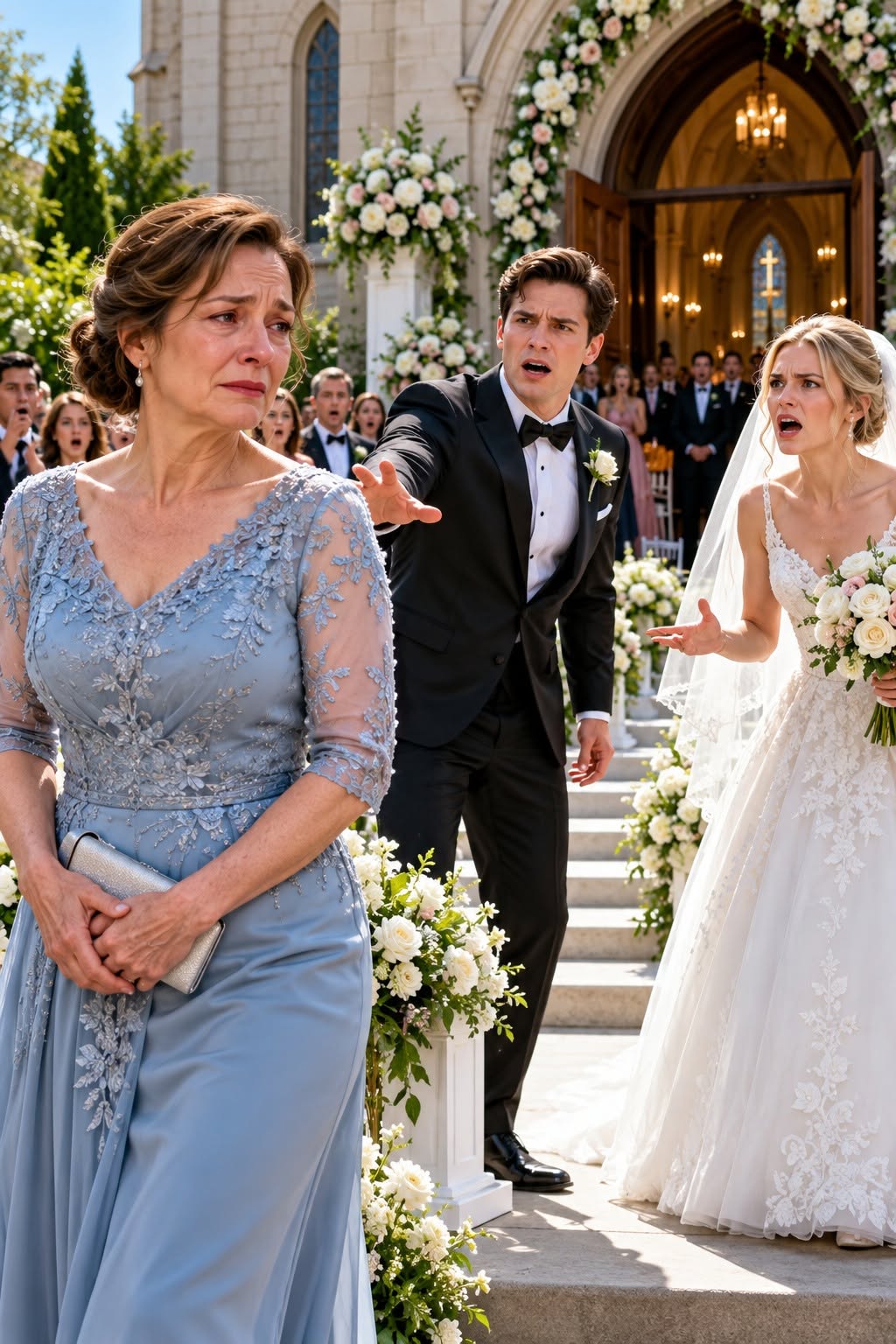
The first time I heard my son pounding on my front door on what should have been his wedding day, I thought someone had died.
The second time he shouted my name, I realized something even worse had happened.
“Mom!
Open the door!
Please!”
I stood frozen in my kitchen, clutching my phone, my sister’s terrified words still ringing in my ears.
**“There’s something you need to know about Dad.”**
Those seven words made no sense.
Daniel’s father had been dead for twenty-seven years.
At least, that was what I had believed.
And until that morning, I had never imagined that the man who had left me a widow with an eight-month-old baby could have anything to do with the beautiful young woman my son was supposed to marry.
I certainly never imagined that the woman who had humiliated me the night before would lead me straight to a secret worth millions.
But before I tell you what happened when I opened that door, you need to understand something.
**I had already lost my son once that weekend.**
And I was terrified that opening the door would mean losing him all over again.
—
My name is Margaret Miller.
I’m fifty-six years old, and for most of my adult life, I’ve been exactly the kind of woman people overlook.
I live in a modest three-bedroom house outside Columbus, Ohio.
I drive a twelve-year-old Honda.
I buy my winter coats on clearance and keep a little notebook where I write down every bill before I pay it.
I’ve never owned expensive jewelry.
I’ve never flown first class.
And until the weekend of my son’s wedding, I had never raised my voice at another woman in public.
My greatest accomplishment wasn’t something I could hang on a wall.
It was my son.
Daniel.
Twenty-seven years earlier, when Daniel was only eight months old, his father, Thomas Miller, died in what police described as a single-vehicle accident.
Thomas had been thirty-one.
He worked as a mechanical engineer and spent most evenings in our garage tinkering with equipment, drawing diagrams, and talking about inventions that might one day make industrial workplaces safer.
We didn’t have much money.
Our kitchen table had one uneven leg.
Our bedroom window rattled when the wind blew, and the refrigerator made a sound like an old tractor.
But we had plans.
Thomas wanted to start his own company.
I wanted to go back to school and finish my engineering degree.
And together, we wanted to give our little boy a childhood filled with everything we’d never had.
Then one rainy November night, Thomas left the house carrying a brown leather briefcase.
He kissed Daniel on the forehead.
He kissed me on the cheek.
And he said, “Don’t wait up, Maggie.
I’ve got something important to finish.”
**He never came home.**
The police said his car had gone off a rural highway and struck a concrete barrier.
There had been a fire.
By the time I arrived at the hospital, there was nothing anyone could do.
I buried my husband six days later.
The funeral was small.
His employer sent flowers.
A man named Graham Whitcomb, whom Thomas had occasionally mentioned as a business associate, came by afterward and told me that Thomas had been a brilliant engineer but an unfortunate businessman.
“He had some ideas,” Graham said, adjusting the cuffs of his expensive coat.
“But unfortunately, none of them worked out financially.”
I remember nodding.
I was too exhausted to argue.
A few weeks later, a representative from Graham’s company brought me a packet of documents.
They said Thomas’s projects had failed.
There were debts.
There was no company left.
And there would be no significant insurance payment because Thomas had apparently missed some paperwork.
I signed what they told me was a final settlement acknowledgment.
I received twelve thousand dollars.
After the funeral expenses, there was barely enough left to keep the mortgage current.
That was how my life as a single mother began.
I worked at a medical billing office during the day and cleaned offices three nights a week.
When Daniel was little, I sometimes took him with me.
He would sleep beneath my coat in the employee lounge while I emptied trash cans and polished conference tables.
I missed school plays because I couldn’t get time off.
I missed Christmas parties because overtime paid better.
And more than once, I spent the last week of the month eating toast and peanut butter so Daniel wouldn’t notice that money was running out.
But I never resented him.
Not once.
**Every sacrifice felt worthwhile when I watched him become the kind of man his father would have been proud of.**
Daniel grew up thoughtful, hardworking, and remarkably kind.
He graduated from college with a degree in civil engineering, found a good job, and eventually bought his own townhouse.
When he called me to say he’d met someone special, I was thrilled.
Her name was Jessica Whitcomb.
And when I heard her last name, I remember feeling a strange flicker of recognition.
“Whitcomb?”
I repeated.
“Yeah,” Daniel said.
“Her dad owns a big manufacturing company.
You might have heard of it.”
I probably had.
But Graham Whitcomb was such a distant figure from my past that I didn’t immediately connect the dots.
Twenty-seven years is a long time.
People change.
Companies change names.
Memories fade.
And I had spent so much of my life trying to move forward that I rarely looked backward.
Jessica seemed lovely at first.
She had long blonde hair, a dazzling smile, and an effortless confidence that made people pay attention when she entered a room.
She worked in corporate public relations and came from money.
Real money.
Her family owned several properties, traveled internationally, and belonged to a country club where the membership fee probably exceeded my annual salary.
None of that bothered me.
Daniel loved her.
That was enough.
When they announced their engagement, I hugged Jessica and told her I was delighted to welcome her into our family.
She smiled.
“That’s so sweet, Margaret.”
I didn’t notice that she never hugged me back.
—
The first warning came six months before the wedding.
Daniel invited me to dinner at their townhouse.
I’d made his favorite homemade lasagna and brought it over in the same blue ceramic dish I’d used since he was a child.
Jessica opened the door.
She glanced at the dish, then at my shoes.
“Oh,” she said.
“You cooked.”
I laughed.
“Of course.
Daniel mentioned he’d had a rough week.”
“How thoughtful.”
She took the dish from my hands but didn’t step aside.
For one uncomfortable moment, I stood on the porch like a delivery driver waiting for a signature.
Then Daniel appeared behind her.
“Mom!”
He pulled me into the house and kissed my cheek.
Jessica’s expression changed instantly.
Suddenly she was smiling again.
During dinner, she mentioned that they were considering having children someday.
My heart lifted.
“Whenever that happens, I’d love to help,” I said.
“Babysitting, school pickups, whatever you need.”
Jessica set down her fork.
“Actually, Margaret, we’re planning to hire professional help.”
“Of course,” I said quickly.
“I only meant—”
“We believe boundaries are important.”
Daniel looked up.
“Jess, Mom was just offering.”
“I know, sweetheart.”
She smiled at him.
“I’m simply trying to avoid confusion.”
I told myself she was nervous about becoming a mother.
I told myself I was being overly sensitive.
But the comments continued.
When I offered to help address wedding invitations, Jessica said they had hired someone.
When I asked about flowers, she explained that the floral arrangements were too sophisticated for someone unfamiliar with the venue.
When I mentioned that I had saved my mother’s pearl necklace in case she wanted to wear something old, Jessica laughed.
“Oh, Margaret.
That’s adorable.
But my jewelry has already been arranged.”
I put the necklace away.
Then I stopped offering.
But I continued supporting them.
When Daniel needed help covering the deposit on the reception venue, I transferred him eight thousand dollars from my savings.
He protested.
“Mom, you don’t have to do that.”
“I know,” I told him.
“I want to.”
He hugged me so tightly I could barely breathe.
Jessica thanked me with a handwritten card.
Inside, she wrote:
*Your generosity is appreciated.*
There was no *love*.
No *family*.
Just those four perfectly measured words.
Still, I kept hoping.
I believed that once the stress of wedding planning ended, things would improve.
**I didn’t understand that Jessica wasn’t trying to become part of my family.
She was trying to erase me from it.**
—
The night before the wedding, I drove to the rehearsal dinner venue carrying a scrapbook.
I’d spent nearly three months creating it.
Its pages contained photographs of Daniel’s first birthday, his first lost tooth, his awkward middle-school haircut, and his college graduation.
There were pictures of him asleep on his father’s chest.
Pictures of Thomas holding him beside a half-finished wooden crib.
And one photograph of the three of us in our tiny kitchen, taken just weeks before Thomas died.
I had carefully arranged everything in chronological order.
On the final page, beneath a photograph of Daniel and Jessica laughing together, I’d written:
**“May you build a home where love is never something anyone has to earn.”**
I thought it would be the perfect wedding gift.
When I arrived, Jessica met me near the entrance to the private dining room.
She wore a cream-colored dress and diamond earrings.
“Margaret,” she said, clearly surprised.
“What are you doing here?”
“I wanted to give you something.”
I held out the scrapbook.
She didn’t take it.
Instead, she looked over her shoulder, checking whether anyone was close enough to hear.
Then she stepped toward me.
“Actually,” she whispered, “I’m glad you’re here.”
Something about her expression made my chest tighten.
“Is everything all right?”
Her smile disappeared.
**“After tomorrow, you’re not part of this family anymore.”**
I blinked.
“I’m sorry?”
“You heard me.”
Her voice was quiet, controlled, and terrifyingly cold.
“You’ve done your job.
You raised Daniel.
But tomorrow he becomes my husband, and we’re starting our own family.”
I stared at her.
“Jessica, I’m his mother.”
“And you’ll always be the woman who gave birth to him.
That doesn’t mean you get to follow us around for the rest of our lives.”
I felt my fingers tighten around the scrapbook.
“I’ve never tried to interfere.”
“Please.”
She rolled her eyes.
“The constant calls.
The invitations.
The sentimental gifts.
You’re always finding some excuse to make yourself important.”
Her gaze fell on the scrapbook.
“Honestly, Margaret, it’s embarrassing.”
I swallowed.
“I made this because I love you both.”
“Then prove it.”
“What?”
“Stay away tomorrow.”
I couldn’t speak.
Jessica leaned closer.
“Daniel has spent his whole life feeling responsible for you.
It’s unhealthy.
He deserves to be free of that.”
Tears burned behind my eyes.
“Does Daniel know you’re saying this?”
She laughed softly.
“Daniel knows what I tell him he needs to know.”
Then she touched my arm as though we were sharing a pleasant secret.
“Go home, Margaret.
Sleep in.
Tomorrow is supposed to be the happiest day of our lives.”
She paused.
**“We don’t need you there to ruin it.”**
Then she turned and disappeared into the dining room.
I stood there for several seconds.
From inside, I could hear laughter.
Glasses clinking.
Someone calling for a toast.
Life continuing as though nothing had happened.
I looked down at the scrapbook in my hands.
Twenty-seven years of memories.
Twenty-seven years of loving my son.
And suddenly, I felt as though someone had decided none of it mattered.
I drove home without remembering most of the journey.
That night, I took my pale blue wedding dress out of the closet, held it against myself, and began to cry.
Eventually, I hung it back up.
Then I sat on the edge of my bed and whispered into the darkness.
**“If she doesn’t want me there, I won’t go.”**
—
The next morning, I woke before sunrise.
For a moment, I forgot what day it was.
Then I saw the garment bag hanging on the closet door.
My stomach sank.
Across town, flowers were being delivered, musicians were arriving, and two hundred guests were preparing to witness my only son’s wedding.
I stayed in my pajamas.
At eight thirty, Daniel texted me.
*Morning, Mom!
Big day!
Can’t wait to see you.*
I stared at the message until the words blurred.
At nine, he called.
I let it go to voicemail.
“Mom, where are you?
Jessica says you’re not feeling well, but that doesn’t sound like you.
Call me, okay?”
I couldn’t bring myself to answer.
At ten, someone began pounding on my front door.
My sister Susan stood outside wearing a dusty rose bridesmaid dress.
Her hair was curled, her makeup was perfect, and her expression was furious.
“Margaret Miller, what on earth are you doing?”
“I’m not going.”
She stared at me.
“What?”
“I’m staying home.”
“Your son’s wedding starts in an hour!”
I tried to explain calmly.
I failed.
Halfway through describing what Jessica had said, I started sobbing.
Susan listened without interrupting.
By the time I finished, her face had gone white.
“She said WHAT?”
“Please don’t make a scene.”
“A scene?”
Susan repeated.
“Margaret, that girl just told you to disappear from your own son’s life!”
“I don’t want Daniel caught in the middle.”
Susan gripped my shoulders.
“He’s already in the middle.
He just doesn’t know it.”
Then she suddenly became very quiet.
Her eyes narrowed.
“Wait.”
“What?”
“Last night, Jessica was talking to her maid of honor in the dressing room.”
I frowned.
“So?”
“I went in to retrieve my purse.
They didn’t realize I was there.”
Susan reached into her handbag and pulled out her phone.
“I was recording a voice message for my daughter before I walked in.
I never stopped recording.”
My heart began pounding.
“Susan?”
She pressed her lips together.
“I didn’t understand everything they were saying at the time.”
“What did they say?”
Susan looked at me.
**“I think this wedding is about something much bigger than Daniel.”**
Before I could ask another question, her phone rang.
She glanced at the screen.
It was Daniel.
She stepped into the hallway to answer.
I heard her say, “Yes, I’m with her.”
Then silence.
Then, “No, Daniel.
You need to listen to me carefully.”
A minute later, she hurried toward the door.
“I have to go back.”
“Susan, what’s happening?”
“I don’t know yet.”
She kissed my forehead.
“But I promise you, Margaret, I’m not letting that woman get away with this.”
At eleven, church bells began ringing.
I sat alone at my kitchen table.
At eleven forty-five, my phone began buzzing.
Missed calls.
Messages.
Notifications from family members.
At noon, Susan called.
Her voice trembled.
“Margaret, the wedding isn’t happening.”
My heart stopped.
“What?”
“Daniel called it off.”
“Why?”
There was shouting in the background.
Then I heard my son’s voice.
Loud.
Angry.
Unlike anything I’d ever heard from him.
“WHERE IS MY MOTHER?”
Susan whispered, “Margaret, there’s something you need to know about Daniel’s father.”
Then the call disconnected.
Twenty minutes later, Daniel was pounding on my door.
—
I opened it.
My son stood on the porch in his black tuxedo.
His tie hung loose around his neck.
His eyes were red.
He looked like a little boy who had gotten lost and spent hours trying to find his way home.
“Mom.”
That one word broke me.
Before I could say anything, he wrapped his arms around me.
“I’m sorry,” he whispered.
I held him tightly.
“Daniel, what happened?”
He pulled away just enough to look at me.
“Why didn’t you tell me?”
“Tell you what?”
“What Jessica said.”
I glanced toward the driveway.
Susan had parked behind him.
She climbed out of her car carrying her handbag and a thick white envelope.
Daniel followed my gaze.
“Aunt Susan told me everything.”
I closed my eyes.
“Oh, sweetheart—”
“No.”
His voice cracked.
“Mom, don’t defend her.”
He stepped inside.
“I was standing at the altar.
The minister was waiting.
Jessica was ready to walk down the aisle.”
He swallowed.
“Then Aunt Susan came to me with a recording.”
I looked at Susan.
She nodded.
Daniel continued.
“I heard Jessica laughing about how she’d finally gotten rid of you.”
My stomach twisted.
“She said you were too poor to fit into her family.
She said once we were married, I’d stop feeling obligated to visit you.”
He stopped.
His jaw tightened.
“And then she said something else.”
“What?”
“She said, ‘Once he signs the papers, Daddy won’t have to worry about the Miller problem anymore.’”
I stared at him.
“The Miller problem?”
Daniel nodded.
“I didn’t understand it either.”
He sat down heavily at my kitchen table.
“When I confronted her, she told me it was a joke.
She said Susan had taken everything out of context.”
He laughed bitterly.
“Then she blamed you.”
My heart hurt.
“She said you were jealous of her.
That you couldn’t stand the idea of losing control over me.”
“What did you say?”
Daniel looked at me.
**“I told her that any woman who wanted me to abandon my mother didn’t understand what love meant.”**
Advertisement
Tears slipped down my cheeks.
He reached for my hand.
“And then I told the minister there wouldn’t be a wedding.”
For several seconds, I couldn’t speak.
Finally, I whispered, “I’m so sorry.”
Daniel shook his head.
“Stop apologizing, Mom.
You didn’t do anything wrong.”
He glanced at the white envelope Susan had placed on the table.
“But that’s not why I came here.”
Susan sat beside us.
Daniel opened the envelope.
Inside were several sheets of legal paperwork.
The first bore the letterhead of a company called **Apex Industrial Systems**.
The name meant nothing to me.
Until I saw the second line.
*Formerly Whitcomb-Miller Engineering, Incorporated.*
My breath caught.
“Miller?”
Daniel nodded.
“Mom, did Dad ever tell you he owned part of a company?”
I stared at the paper.
“He worked on engineering projects.
He hoped to start a business someday.”
Daniel looked at Susan.
Then back at me.
“Mom, according to these documents, Dad didn’t just start a business.”
He slid another page across the table.
At the bottom were two signatures.
Thomas Miller.
And Graham Whitcomb.
Dated September 14, 1999.
Daniel pointed to a paragraph highlighted in yellow.
“Dad owned forty percent of the original company.”
I frowned.
“That can’t be right.”
“It is.”
“Then why did Graham tell me the business had failed?”
Daniel’s expression hardened.
“Because apparently, Mom, it didn’t fail.”
He opened his phone and showed me a company website.
Apex Industrial Systems.
Global manufacturing.
Facilities in twelve countries.
Billions in annual revenue.
My stomach turned.
I looked at Daniel.
“What are you saying?”
He took a shaky breath.
**“I’m saying Dad may have left me an inheritance worth more than eighty million dollars.”**
The kitchen seemed to tilt.
I grabbed the edge of the table.
“No.”
“Mom—”
“No.
That’s impossible.”
Susan put a hand on my shoulder.
Daniel lowered his voice.
“And Jessica’s father has been trying to get me to sign it over.”
—
I had never fainted in my life.
But that morning, I came very close.
Daniel helped me onto the sofa while Susan poured three glasses of water.
For several minutes, nobody said anything.
Finally, I looked at my son.
“Start from the beginning.”
Daniel nodded.
“Two weeks ago, Jessica told me her father wanted us to sign some financial documents after the ceremony.”
“What kind of documents?”
“She said they were standard family trust arrangements.
Something about protecting assets after marriage.”
He rubbed his forehead.
“I didn’t question it.
Her father handles investments.
I assumed it was normal for wealthy families.”
Susan made a disgusted sound.
“Of course he did.”
Daniel continued.
“This morning, when I canceled the wedding, Graham came into the church carrying a folder.”
“He was furious,” Susan added.
Daniel nodded.
“He kept saying I was making a terrible mistake.
He told me the ceremony needed to happen before the paperwork could be finalized.”
I frowned.
“Why?”
“That’s what I asked.”
“And?”
“He wouldn’t answer.”
Daniel pulled another document from the envelope.
It was titled:
**IRREVOCABLE PROXY AND ASSIGNMENT OF BENEFICIAL INTEREST.**
The words meant nothing to me.
But the paragraph beneath them was frighteningly clear.
It referred to an investment trust.
A beneficiary named Daniel Thomas Miller.
And the authorization of voting rights to a corporate representative.
“Graham wanted me to sign this after the wedding,” Daniel explained.
“Why after?”
“Because he’d been telling me it was part of establishing our marital estate.
Jessica would become a co-manager of our financial affairs, and I would authorize her to handle everything related to the trust.”
Susan leaned forward.
“But the wording doesn’t just give Jessica permission to handle documents.”
Daniel nodded.
“It gives Graham’s company control over the voting rights.”
I stared at him.
“Voting rights?”
“Control of the company, Mom.”
I looked at the papers again.
“Then why would your father give you shares in a company he supposedly lost?”
Daniel hesitated.
“That’s what we need to find out.”
“Who gave you these documents?”
“An attorney at the church.”
I frowned.
“Graham’s attorney?”
“No.
Another attorney.
A woman named Evelyn Park.”
The name sounded unfamiliar.
Daniel continued.
“She approached me after the ceremony was canceled.
She said she’d been trying to reach me for months.”
“Why didn’t she?”
“Because someone kept returning her letters.”
My stomach tightened.
Advertisement
“Who?”
Daniel looked down.
“The letters were going to the townhouse.”
Jessica’s townhouse.
My son stared at his hands.
“Mom, I think Jessica knew about this inheritance before she ever agreed to marry me.”
Outside, a car passed slowly along our street.
A dog barked somewhere in the distance.
Ordinary sounds.
From an ordinary neighborhood.
While my entire understanding of the past twenty-seven years began falling apart.
Then Daniel said something that made the room go silent.
“Mom, Evelyn also said there may be a problem with Dad’s death certificate.”
I stared at him.
“What problem?”
He swallowed.
“She said the date on one of the corporate transfer documents is three days after Dad died.”
I felt my blood turn cold.
Daniel slid the paper toward me.
There was my husband’s signature.
Dated three days after his funeral.
**A dead man had apparently signed away his company.**
—
Evelyn Park arrived at my house that afternoon.
She was in her early sixties, with short silver hair, sharp brown eyes, and the kind of quiet authority that makes people sit up straighter without knowing why.
She wore a charcoal suit and carried a leather briefcase that looked older than Daniel.
“Mrs.
Miller,” she said, shaking my hand.
“I’ve wanted to meet you for a very long time.”
I didn’t know what to say.
We gathered around the kitchen table.
Evelyn placed her briefcase beside her chair.
“Before we begin, I need to make something clear.
I’m not here to promise you a fortune.
I’m here because I’ve uncovered evidence of serious irregularities involving your husband’s business interests.”
“Did Thomas own forty percent of that company?”
I asked.
“Yes.”
“Then why didn’t I know?”
Evelyn looked genuinely troubled.
“That is one of the questions I intend to answer.”
She explained that her father, Robert Park, had been an attorney who worked with Thomas shortly before his death.
He had helped establish an irrevocable trust for Daniel.
The trust held shares in a young engineering company that eventually became Apex Industrial Systems.
The assets were supposed to remain protected until Daniel reached twenty-eight.
“Your husband believed that holding the shares in trust would keep them safe from creditors and hostile business partners,” Evelyn explained.
I felt a bitter laugh rising in my throat.
“Thomas had a hostile business partner?”
Evelyn didn’t answer immediately.
Then she said, “Graham Whitcomb.”
The name landed between us like a stone.
“Why didn’t anyone tell me?”
I asked.
Evelyn folded her hands.
“My father was instructed to send notice through a separate trustee when certain conditions were met.
Unfortunately, he became seriously ill shortly after your husband’s death.
The trustee’s successor accepted records claiming the underlying shares had been surrendered.”
“Surrendered?”
Daniel repeated.
“Under a document bearing your husband’s signature.”
“The one dated after his funeral,” I said.
Evelyn nodded.
“For years, the trust was classified as having no realizable assets.
When I began reviewing my father’s archived cases, I discovered that the supposed surrender had never been properly validated.”
She opened a folder.
Inside was a photocopy of an old letter.
Thomas’s handwriting.
I recognized it immediately.
Even after twenty-seven years.
The same slanted letters.
The same way he crossed his sevens.
My fingers trembled as I picked it up.
*Robert,*
*If anything happens to me before the trust is secure, protect Daniel’s interests.
Graham cannot be trusted.
He has already tried to make me surrender the original designs.*
*Most importantly, make certain Margaret is never pressured into signing anything she doesn’t understand.*
*She has already sacrificed enough.*
I stopped reading.
For several seconds, I couldn’t breathe.
Thomas had written my name.
He had been thinking about me.
About Daniel.
About protecting us.
And somebody had spent twenty-seven years making me believe he had left nothing behind.
“Mrs.
Miller?”
Evelyn asked gently.
I looked up.
“Was my husband’s death an accident?”
Evelyn’s expression changed.
“I don’t know.”
It was the first answer that frightened me more than silence.
“But,” she continued, “I believe he was afraid of something shortly before he died.”
Daniel leaned forward.
“Afraid of Graham?”
“Possibly.”
She opened another folder.
“Your husband’s company was developing a pressure-isolation valve designed to prevent catastrophic failures in industrial machinery.
The technology eventually became the foundation of Apex’s most profitable product line.”
I stared at her.
Thomas used to work on valves in our garage.
I remembered him explaining pressure differentials while I rocked Daniel to sleep.
I remembered coffee-stained drawings.
And late nights spent helping him calculate tolerances.
“Was it called the Sentinel Valve?”
I asked.
Evelyn looked up sharply.
“Yes.”
I swallowed.
“Thomas and I worked on that.”
The room went silent.
Evelyn slowly lowered her pen.
“I’m sorry?”
“The Sentinel Valve,” I repeated.
“We worked on it together.”
Daniel turned toward me.
“Mom, you never told me that.”
I gave a helpless shrug.
“It was just a project.
Your father was the engineer.”
Evelyn watched me carefully.
“What exactly did you do?”
I hesitated.
Then I began describing the mechanism.
The emergency shutoff.
The secondary pressure chamber.
The way the inner seal was supposed to respond when the main line exceeded a certain threshold.
I spoke for nearly five minutes.
When I finished, Evelyn looked stunned.
“Mrs.
Miller,” she said slowly, “how do you remember all of that?”
I stared at her.
“Because I designed part of it.”
Silence filled the kitchen.
Then Evelyn asked the question that changed everything.
**“Do you still have your original drawings?”**
—
At first, I thought the answer was no.
Twenty-seven years had passed.
I’d moved twice.
Donated furniture.
Thrown away old papers.
Packed and unpacked countless boxes.
But then I remembered the garage.
More specifically, I remembered the old wooden workbench Thomas had built himself.
It stood against the back wall beneath a dusty window.
I’d considered selling it dozens of times.
But I never could.
Whenever I walked past it, I still imagined Thomas standing there in his faded college sweatshirt, a pencil tucked behind his ear.
“Follow me,” I said.
Daniel helped move a stack of Christmas decorations.
Susan pulled aside a folded tarp.
There it was.
The workbench.
Stained with oil.
Marked by cigarette burns from a previous owner.
And beneath the work surface, a narrow drawer Thomas had fitted with a brass lock.
I had never found the key.
“Dad built this?”
Daniel asked softly.
I nodded.
“He used to say every good workbench needed a place for unfinished ideas.”
Evelyn stepped closer.
“Would you mind if we examined it?”
We searched the drawers first.
Old screws.
Metal washers.
A broken measuring tape.
Three rusty drill bits.
Nothing important.
Then Daniel noticed something.
“Mom, look at this.”
He was pointing beneath the bench.
There was a narrow wooden panel secured by two small brass screws.
I frowned.
“I’ve never noticed that.”
Daniel borrowed a screwdriver.
The first screw came loose.
Then the second.
He removed the panel.
Behind it sat a small metal box.
My heart began pounding.
The box was wrapped in a faded blue dish towel.
The same kind I’d used in our kitchen when Daniel was a baby.
Across the lid, written in black marker, were three words.
**FOR MAGGIE ONLY.**
My knees weakened.
Daniel caught my arm.
“Mom?”
I touched the handwriting.
Thomas.
It was unmistakably Thomas.
Inside the box were several folded letters, a leather-bound notebook, a cassette tape, and a small velvet pouch.
There was also a photograph.
Thomas stood beside a much younger Graham Whitcomb in front of a warehouse.
Between them was a prototype of the Sentinel Valve.
On the back, Thomas had written:
*First successful pressure test.
Maggie’s design worked.*
I stared at those words.
Maggie’s design.
Not Thomas’s.
Mine.
Evelyn carefully examined the notebook.
The first page bore my maiden name.
**Margaret Calder — Preliminary Safety Mechanism, March 1998.**
I had forgotten that notebook existed.
I opened it.
There were my sketches.
My calculations.
My handwriting.
The drawings I’d made at our kitchen table while Daniel slept in his crib.
Page after page.
Some neat.
Some covered in corrections.
Some marked with Thomas’s comments in red pencil.
On one page, beneath a diagram of the pressure chamber, he’d written:
*Brilliant solution, sweetheart.
I married a genius.*
I began crying.
Not because of the company.
Not because of the money.
But because for the first time in twenty-seven years, I could hear my husband’s voice again.
Daniel put his arm around me.
“Mom.”
I shook my head.
“I forgot.”
“Forgot what?”
“I forgot how much I loved this work.”
I turned another page.
And found something that made my heart stop.
A date.
October 28, 1999.
Just two weeks before Thomas died.
Beneath it, he’d written:
**“Graham knows Margaret owns the original design.
He says he’ll ruin us before he lets her take her share.”**
I looked at Evelyn.
Her face had gone pale.
She closed the notebook gently.
“Mrs.
Miller,” she said, “I think we need to preserve everything in this box.”
“Why?”
“Because this may be evidence of fraud.”
Daniel looked from her to me.
“And maybe something worse.”
—
That night, my house became the center of a mystery I had never asked to solve.
Evelyn arranged for the documents to be copied and secured.
She also brought in a forensic accountant named Michael Torres, who had spent years investigating corporate misconduct.
Michael was a calm man in his forties with rectangular glasses and a habit of writing everything down.
By Tuesday afternoon, he had uncovered several disturbing facts.
First, Thomas had never voluntarily surrendered his shares.
Second, the transfer document filed after his death appeared to contain a copied signature.
Third, Graham Whitcomb had taken control of the company through a series of transactions that Michael described as “deeply questionable.”
And fourth, the original trust documents contained a separate provision concerning me.
When Evelyn called me Tuesday evening, her voice sounded different.
“Margaret, we found something.”
I sat down.
“What?”
“Do you remember signing an agreement with Thomas before he died?”
I thought for a moment.
“We signed lots of papers.”
“Something involving your invention?”
I frowned.
Then a memory surfaced.
Thomas and I sitting at our kitchen table.
Daniel sleeping nearby.
Thomas sliding a document toward me.
He’d been excited.
Almost giddy.
He’d said, “Maggie, this means nobody can ever take your work away from you.”
I remembered laughing.
I’d told him I didn’t need my name on anything.
Advertisement
We were married.
Whatever belonged to him belonged to me.
But Thomas had been unusually serious.
“No,” he’d said.
“This matters.
Someday, you’ll understand.”
I pressed the phone closer to my ear.
“Yes,” I whispered.
“I remember.”
Evelyn exhaled.
“Margaret, Thomas filed a formal acknowledgment of your contribution to the Sentinel technology.”
My pulse quickened.
“What does that mean?”
“It means the legal ownership history is much more complicated than Graham has represented.”
“How complicated?”
She paused.
“The records suggest that before the company was incorporated, you and Thomas had agreed that you would retain a substantial ownership interest in the technology.”
I stared at the wall.
“But Graham told me Thomas owned nothing.”
“Yes.”
“And I’ve believed him for twenty-seven years.”
“Yes.”
I closed my eyes.
The years flashed through my mind.
The double shifts.
The overdue bills.
The Christmases when I counted quarters.
The nights I cried in the bathroom because I couldn’t afford new shoes for Daniel.
All while Graham Whitcomb built an empire around something Thomas and I had created in our garage.
A terrible thought occurred to me.
“Evelyn?”
“Yes?”
“If Graham knew about the trust and the invention, why did he let Daniel date Jessica?”
There was a long silence.
Then Evelyn said something that chilled me.
**“Margaret, I don’t think he let them date.
I think he arranged for them to meet.”**
—
I remembered the first time Daniel mentioned Jessica.
They’d met at a charity fundraiser.
Daniel had attended because his engineering firm was sponsoring a housing initiative.
Jessica had been introduced to him by one of the event organizers.
Someone connected to Graham’s company.
At the time, I’d thought it sounded romantic.
Two ambitious young people meeting at a beautiful event.
But now I wondered whether any of it had been accidental.
Daniel came over that evening.
We sat together on the porch while the sun disappeared behind the neighborhood rooftops.
He looked exhausted.
He hadn’t returned to work.
His phone hadn’t stopped ringing.
Jessica had left dozens of messages.
Her friends had sent angry texts.
Her family had apparently begun telling people that I had manipulated Daniel into canceling the wedding because I couldn’t bear to share him.
“Are you all right?”
I asked.
Daniel laughed without humor.
“I was supposed to be on my honeymoon in Italy right now.”
I looked down.
“I’m sorry.”
“Mom.”
“I know.
I keep saying that.”
He took my hand.
“Please stop.”
For a while, we sat quietly.
Then he said, “I need to tell you something.”
I turned toward him.
“When Jessica and I first started dating, she asked a lot of questions about Dad.”
My stomach tightened.
“What questions?”
“Where he worked.
What he did.
Whether he’d left me anything.”
I stared at him.
“What did you tell her?”
“The truth.
That he died when I was a baby and you raised me alone.”
Daniel looked away.
“She seemed disappointed.”
“Disappointed?”
He nodded.
“She said it was strange that I didn’t know more about my own father.”
I swallowed.
“She was probably trying to learn about the trust.”
“Yeah.”
He rubbed his face.
“And then, about six months ago, she started pushing for a wedding date.”
I frowned.
“You’d been engaged almost a year.”
“Exactly.
We’d originally planned to wait another eighteen months.
But suddenly, she wanted everything moved up.”
“Why?”
“She said her grandmother was getting older and she wanted her there.”
“Is her grandmother ill?”
Daniel shook his head.
“Apparently not.”
I stared into the darkness.
Then he continued.
“Her dad started inviting me to business lunches.
He talked about my future.
About joining the family company.
About how the Whitcombs take care of their own.”
He gave a bitter laugh.
“I thought he was being generous.”
“Daniel—”
“He even offered me a vice president position after the wedding.”
I turned sharply.
“At Apex?”
He nodded.
“The same company Dad helped create.”
Suddenly, the entire scheme began taking shape.
Jessica hadn’t simply wanted to marry Daniel.
Her father had wanted Daniel connected to the company.
Legally.
Financially.
And preferably without me asking questions.
I looked at my son.
“Did Graham ever ask you to sign anything before the wedding?”
Daniel hesitated.
“An agreement.”
My stomach dropped.
“What agreement?”
“Something he called a pre-marital family participation plan.”
“Did you sign it?”
“No.
Jessica said we’d finish the paperwork after the ceremony.”
I let out a breath.
Daniel stared at me.
“Mom, if Aunt Susan hadn’t recorded that conversation…”
He didn’t finish.
He didn’t need to.
I reached for his hand.
“We would have figured it out eventually.”
He shook his head.
“No.”
His voice cracked.
“I trusted her.
I was ready to spend the rest of my life with her.”
He looked at me, tears gathering in his eyes.
**“I almost gave away everything Dad wanted us to have.”**
I put my arms around him.
For the first time in years, my grown son cried against my shoulder.
And I held him the way I used to when he was little.
Because sometimes, no matter how old our children become, heartbreak makes them young again.
—
On Wednesday morning, Jessica came to my house.
I knew it was her before I opened the door.
A white luxury SUV was parked at the curb.
She stood on my porch wearing a pale pink suit and enormous sunglasses.
When I opened the door, she removed them.
Her eyes were swollen.
For a moment, I almost felt sorry for her.
“Margaret,” she said.
“Can we talk?”
I remained in the doorway.
“What do you want, Jessica?”
She glanced toward the street.
“Please.
Not out here.”
I hesitated.
Then I stepped aside.
She entered the living room and looked around with an expression I couldn’t quite read.
I’d seen that expression before.
The faint discomfort wealthy people sometimes show when they enter a house that doesn’t meet their expectations.
But this time, something was different.
Jessica was nervous.
She sat on the edge of the sofa.
“I need you to help me fix this.”
I stared at her.
“Fix what?”
“Daniel.”
I almost laughed.
“Daniel isn’t broken.”
“You know what I mean.”
“No, Jessica.
I don’t.”
She took a breath.
“I said things I shouldn’t have said.”
I waited.
“I was under pressure.”
“From whom?”
She looked away.
“My family.”
I sat in the chair opposite her.
“Then perhaps you should tell me exactly what pressure your family was putting on you.”
She hesitated.
Then she folded her hands.
“My father has been dealing with some serious financial problems.”
I said nothing.
“Apex has expansion loans.
Investors are nervous.
There are some disputes involving old contracts.”
“Old contracts?”
Her eyes flickered.
“Yes.”
“Contracts involving Thomas Miller?”
Jessica went completely still.
Then she whispered, “You know?”
I leaned back.
“I know your father tried to get Daniel to sign away control of something that belonged to his father.”
She looked toward the window.
“You don’t understand.”
“Then explain it.”
She pressed her lips together.
“My father says the trust could destroy the company.”
“How?”
“Because if Daniel claims those shares, the voting structure changes.
And if the old ownership agreements are reviewed, everything becomes complicated.”
“Complicated for whom?”
Jessica didn’t answer.
I leaned forward.
“Your father?”
She looked down.
“Margaret, thousands of people work for Apex.”
“And?”
“If the company collapses, they’ll lose their jobs.”
I studied her.
For the first time, I saw the argument Graham had probably been using.
He wasn’t stealing.
He was protecting the company.
He wasn’t hiding fraud.
He was preserving jobs.
He wasn’t taking Daniel’s inheritance.
He was keeping a business stable.
But underneath those elegant explanations was the same ugly truth.
**Graham Whitcomb had built his fortune on the work of people he believed were too powerless to challenge him.**
I looked at Jessica.
“Did you know about Daniel’s inheritance when you started dating him?”
She remained silent.
“Jessica.”
Her eyes filled.
“Not everything.”
“That wasn’t my question.”
Finally, she nodded.
My stomach twisted.
“How long?”
“My father told me about the trust before I met Daniel.”
The room went quiet.
I felt something inside me break.
Not for myself.
For my son.
All the dinners.
The vacations.
The engagement photographs.
The whispered promises.
Had any of it been real?
I looked at Jessica.
“Did you ever love him?”
She began crying.
“Yes.”
I waited.
“I did,” she insisted.
“At first, it was supposed to be an introduction.
Daddy said Daniel was a good man from a family with an old business connection.”
“And then?”
“Then I fell in love with him.”
I wanted to believe her.
For Daniel’s sake, I desperately wanted to.
But her next words destroyed whatever sympathy I had left.
“If you could just convince Daniel to sign the agreement, we could still work everything out.”
I stared at her.
“You came here to ask me to persuade my son to surrender his inheritance?”
“It’s more complicated than that.”
“No.”
I stood.
“It isn’t.”
Jessica rose too.
“Margaret, please.
Daddy says if those documents become public, people could go to prison.”
There it was.
Not concern for Daniel.
Not remorse for what she’d said to me.
Fear.
Fear of losing the life she’d always known.
I walked to the front door.
“Jessica, you told me I wasn’t part of your family.”
She began crying harder.
“I didn’t mean it.”
I opened the door.
“You meant every word.”
She looked at me.
“Please don’t do this.”
I shook my head.
**“I’m not doing anything to you.
I’m simply refusing to let you do anything else to my son.”**
She left without another word.
I watched her drive away.
Then I called Evelyn.
“Jessica just admitted her father arranged the introduction.”
Evelyn was silent for a moment.
Then she said, “Margaret, I think it’s time we talked to the authorities.”
—
The next two weeks were unlike anything I’d ever experienced.
Investigators began reviewing the old corporate records.
Evelyn filed requests to preserve documents and prevent questionable transfers.
Michael Torres traced transactions involving companies I’d never heard of.
And Daniel spent hours with attorneys, trying to understand the fortune he’d nearly been persuaded to surrender.
But the money was no longer my biggest concern.
It was Thomas.
Something about his death bothered me more with every passing day.
The letter he’d left behind.
The false transfer document.
The warnings in his notebook.
And the fact that Graham had personally appeared at my house after the funeral to tell me there was nothing left.
One evening, I took the cassette tape from Thomas’s metal box.
I’d been afraid to listen to it.
The label was faded.
In Thomas’s handwriting, it read:
**NOVEMBER 9 — FOR MAGGIE.**
The date was only two days before his death.
Daniel found an old cassette player online and brought it to my house.
We sat at the kitchen table.
Susan was there too.
I held the tape in my hand for several minutes.
Then I inserted it.
Pressed play.
A faint hiss filled the room.
Then a familiar voice spoke.
“Maggie?”
I gasped.
Thomas.
Not a memory.
Not a dream.
His voice.
Real.
Warm.
A little tired.
Exactly as I remembered it.
I covered my mouth.
Daniel reached for my hand.
On the recording, Thomas took a breath.
“Sweetheart, if you’re listening to this, something has gone badly wrong.”
I began shaking.
“I don’t want to frighten you,” he continued.
“But I need you to understand what I’ve been working on.”
There was a pause.
Then he said, “Graham is falsifying safety data.”
Daniel sat forward.
Thomas continued.
“He’s pushing the Sentinel system into production before it’s been properly tested.
There have been failures.
Serious ones.
I told him we needed to stop shipments until we understood what was happening.”
I stared at the player.
“He said we couldn’t afford it.”
A scraping sound followed.
Then Thomas spoke again.
“Yesterday, I found out he’s been altering the test reports.
He’s been using Margaret’s improved design in some units but producing cheaper components for others.”
My blood went cold.
“He wants the company to look successful long enough to attract investors.”
Thomas paused.
“I told him I was taking the evidence to the state safety office.”
Another silence.
Then his voice softened.
“Maggie, I’m sorry I didn’t tell you sooner.”
Tears rolled down my face.
“I thought I could fix this without worrying you.”
I shook my head helplessly.
“Oh, Tom.”
Then he said something I would never forget.
**“If something happens to me, don’t let anyone convince you that your work was worthless.
You were the one who solved the problem.
I was just lucky enough to be the man who married you.”**
The tape clicked.
For a moment, there was only static.
Then Thomas spoke again.
“And one more thing.”
His voice had changed.
He sounded frightened.
“Graham knows I’ve copied the original test results.
He came to the house while you were at work.
He asked about Daniel.”
My heart stopped.
“He said accidents happen to families that don’t know when to stop asking questions.”
Susan gasped.
Daniel whispered, “Oh my God.”
Thomas continued.
“I’ve given Robert Park copies of everything.
I’m also meeting someone tomorrow night who says he can help.”
A pause.
“If I make it home, I’ll explain.”
His voice softened again.
“Tell our boy I love him.”
Then came the last words.
**“And Maggie, whatever happens, remember that you were never the small person they wanted you to believe you were.”**
The tape ended.
I sat motionless.
My husband had known he was in danger.
He’d tried to warn me.
And he’d died the following night.
Daniel stood abruptly.
“We need to give this to the police.”
I nodded.
But I couldn’t move.
Because I was remembering something.
Something I had buried beneath twenty-seven years of grief.
The night Thomas died, I had received a phone call.
A man had said Thomas had been delayed.
He’d told me not to worry.
And when I’d asked who was calling, he’d answered:
“Graham Whitcomb.”
I had forgotten.
Or perhaps I’d forced myself to forget.
But suddenly, I remembered every word.
**“Don’t wait up for him, Margaret.
He may be gone longer than you think.”**
—
The investigation accelerated after that.
The cassette tape was copied and authenticated as far as investigators could establish.
Evelyn located one of the retired engineers who had worked on the original Sentinel project.
His name was Harold Bennett.
He was seventy-four and lived in a small town near Dayton.
When he heard I was Thomas Miller’s widow, he began crying.
“I’ve waited a long time for this call,” he said.
Two days later, he arrived at my house carrying a cardboard box.
Inside were photographs, old test reports, and several handwritten notes.
Harold looked at Daniel for a long moment.
“You look just like your father.”
Daniel smiled sadly.
“People tell me that.”
Harold shook his head.
“No.
I mean it.
Same eyes.
Same stubborn expression.”
Then he turned toward me.
“Margaret, I owe you an apology.”
I frowned.
“For what?”
“For keeping quiet.”
We sat down.
Harold explained that the original Sentinel technology had performed exceptionally well.
But Graham wanted to reduce manufacturing costs.
Against Thomas’s advice, he authorized a cheaper internal component.
The modified units failed under certain conditions.
A worker was injured during testing.
Thomas demanded production stop.
Graham refused.
“Tom said he’d report the failures,” Harold told us.
“What happened then?”
I asked.
Harold looked down.
“Graham threatened him.”
I felt Daniel stiffen beside me.
“Did you witness it?”
Evelyn asked.
Harold nodded.
“He said Tom would lose everything.
His company.
His money.
His family.”
My hands went cold.
Harold continued.
“The night Tom died, he was supposed to meet a state investigator.
I was going to go with him.”
“Why didn’t you?”
I whispered.
“Graham called and said the meeting had been canceled.”
I stared at him.
“Did you believe him?”
“At the time.”
Harold swallowed.
“Later, when I heard Tom had been killed, I started asking questions.”
“And?”
He looked toward the window.
“Two men came to my house.
They told me my family would be better off if I stopped.”
The room fell silent.
“I was a coward,” he whispered.
“I had two young daughters.
I was afraid.”
I reached across the table.
“You were threatened.”
He shook his head.
“That doesn’t excuse what I did.”
Then he opened the cardboard box.
At the bottom was a sealed envelope.
“Tom gave this to me three days before he died.
He said if anything happened, I should make sure the right person got it.”
“Why didn’t you?”
Daniel asked.
Harold’s eyes filled.
“Because I was afraid.”
He slid the envelope toward me.
Across the front, in Thomas’s handwriting, were two words.
**MARGARET CALDER.**
My maiden name.
I opened it carefully.
Inside was a document bearing several signatures.
Mine.
Thomas’s.
And a third signature.
Robert Park, attorney.
At the top were the words:
**ASSIGNMENT AND CONFIRMATION OF ORIGINAL INVENTION RIGHTS.**
Evelyn leaned forward.
She read the first page.
Then the second.
Then she sat back very slowly.
“What is it?”
Daniel asked.
Evelyn looked at me.
“Margaret, your husband didn’t simply leave his company shares in trust.”
My pulse quickened.
“He also documented the original ownership of the Sentinel technology.”
I stared at her.
“And?”
She placed the document on the table.
**“According to this agreement, the original invention belonged to you.”**
—
For several seconds, nobody moved.
Then I laughed.
Not because anything was funny.
Because the idea was too enormous to comprehend.
“That can’t be right.”
Evelyn pointed to the first page.
“You created the original mechanism.
Thomas developed it with you, and the two of you signed an agreement recognizing your contribution.”
“But I didn’t patent anything.”
“Your husband filed preliminary applications through the company.
The assignment records appear to identify your rights in the underlying invention.”
I stared at my signature.
I remembered signing the document.
Thomas had explained that it was important to establish who had created what.
I’d barely paid attention.
Daniel had been teething.
I was exhausted.
All I wanted was to get through dinner and put the baby to bed.
Now, twenty-seven years later, the same document lay on my kitchen table.
Evelyn continued.
“If this agreement is authentic and enforceable, Graham may have spent decades using technology whose ownership he misrepresented.”
Daniel looked at me.
“Mom, what does that mean?”
Evelyn was careful.
“It doesn’t mean Margaret automatically owns every product Apex has made.
There will be questions about assignments, patent terms, royalties, corporate records, and applicable deadlines.”
She paused.
“But combined with the original share records and evidence of possible fraud, it gives us a very different picture of what happened.”
I looked down at the document.
The signatures.
The dates.
The careful language Thomas had insisted on preserving.
He had known.
Somehow, he had known that one day I might need proof.
“Why didn’t he tell me?”
I whispered.
Harold shook his head.
“He tried to protect you, Margaret.”
“By hiding everything?”
Harold looked ashamed.
“Graham had already made threats.
Tom thought that if he could get the evidence safely into the hands of the authorities, the danger would end.”
I closed my eyes.
My husband had died believing he was protecting us.
And I’d spent twenty-seven years believing he had failed.
I looked at the document again.
Then at Daniel.
For the first time, I understood something that made my chest ache.
**Thomas hadn’t died leaving us nothing.
He’d died trying to make certain nobody could take away what we’d built together.**
—
Three days later, Graham Whitcomb called me.
It was Friday evening.
I was folding towels in the laundry room when my phone rang.
The number was unfamiliar.
“Margaret Miller?”
“Yes?”
“Graham Whitcomb.”
My fingers tightened around the phone.
“Hello, Graham.”
He cleared his throat.
“I think it’s time we had a conversation.”
“About what?”
“About the misunderstandings surrounding Thomas’s estate.”
Misunderstandings.
I almost laughed.
Twenty-seven years of deception.
Millions of dollars.
A dead husband.
And Graham called them misunderstandings.
“What would you like to discuss?”
I asked.
He sounded relieved by my calmness.
“I’m sure you’re aware that certain documents have recently come to light.”
“Yes.”
“Some of those documents are incomplete.
Others could easily be misinterpreted.”
I said nothing.
“Margaret, I’ve always respected you.”
That did make me laugh.
He went quiet.
“Did I say something amusing?”
“You told me my husband had failed.”
A pause.
“I don’t recall—”
“You came to my house after his funeral and told me there was nothing left.”
“That was a difficult time.”
“For me,” I said.
“Not for you.”
His voice hardened.
“I understand you’re upset.”
“No, Graham.
I don’t think you do.”
He exhaled sharply.
“I’m trying to resolve this privately.”
“Why?”
“Because litigation could be extremely damaging.”
“To whom?”
“To everyone involved.”
I thought about Thomas.
About Harold.
About the workers who had trusted machinery Graham knew might fail.
Then I asked the question that had been haunting me.
“Did you know Thomas was going to meet an investigator the night he died?”
Silence.
A very long silence.
Then Graham said, “I have no idea what you’re talking about.”
I closed my eyes.
“That’s interesting.”
“Why?”
“Because Thomas left a recording.”
I heard him inhale sharply.
“What recording?”
“One he made two days before he died.”
There was a pause.
Then his voice changed.
“Margaret, I strongly advise you not to repeat allegations you can’t prove.”
I looked toward the framed photograph of Thomas on the hallway shelf.
“I haven’t made any allegations.”
“Then what are you saying?”
“I’m saying my husband left me something.”
Graham’s breathing grew louder.
“And I intend to find out exactly why you were so afraid of him.”
He hung up.
The next morning, a black sedan appeared outside my house.
It remained parked across the street for almost an hour.
When I called Daniel, he told me not to go outside.
Then he called Evelyn.
By lunchtime, an investigator had arrived to take a statement.
I didn’t know whether the car was connected to Graham.
But for the first time, I realized that the danger Thomas had feared might not be entirely in the past.
—
The following Monday, Apex Industrial Systems announced a special shareholder meeting.
Graham claimed it was routine.
Michael Torres disagreed.
“He’s trying to push through a restructuring,” Michael explained during a conference call.
“What kind?”
Daniel asked.
“One that could transfer valuable assets into a new holding company before the old ownership claims are fully resolved.”
I frowned.
“Can he do that?”
“He can try,” Evelyn said.
“Whether it survives legal review is another question.”
Daniel leaned forward.
“Then we stop him.”
Evelyn nodded.
“We’re pursuing an injunction.”
The next several days passed in a blur.
Documents.
Affidavits.
Financial records.
Conference calls.
I learned more about corporate governance in one week than I’d ever wanted to know.
But what frightened me most wasn’t the complexity of the paperwork.
It was the realization that Graham had expected us to remain silent.
He’d expected Daniel to be confused.
He’d expected me to be embarrassed.
He’d expected us to accept whatever explanation his expensive lawyers offered.
And perhaps, twenty-seven years earlier, I would have.
Back then, I was a grieving young mother holding a baby and worrying about the mortgage.
I had no money for legal advice.
No energy to argue.
No reason to believe a wealthy businessman would lie to me about my husband’s life.
But I wasn’t that woman anymore.
I’d spent twenty-seven years solving problems no one else could solve for me.
I’d handled medical emergencies, overdue bills, car breakdowns, and nights when the loneliness felt unbearable.
I’d raised a son who knew how to stand up for what was right.
And now I had something I hadn’t possessed when Thomas died.
**I had people standing beside me.**
Daniel.
Susan.
Evelyn.
Michael.
Harold.
And the truth.
—
Two days before the shareholder meeting, Jessica appeared at Daniel’s townhouse.
He called me afterward.
“Mom, she wants to see us.”
I frowned.
“Both of us?”
“Yes.”
“Why?”
“She says she has information about her father.”
I was silent.
Daniel continued.
“She sounded scared.”
“Do you believe her?”
“I don’t know.”
I thought for a moment.
“Don’t meet her alone.”
We arranged to meet at Evelyn’s office the following afternoon.
Jessica arrived wearing jeans and a gray sweater.
Without her expensive clothes and carefully styled hair, she looked younger.
Almost fragile.
She sat across from us and kept twisting a silver bracelet around her wrist.
Daniel didn’t speak.
Neither did I.
Finally, Jessica looked at him.
“I’m sorry.”
Daniel stared at her.
“Which part?”
Her eyes filled.
“All of it.”
He shook his head.
“That’s not an answer.”
She swallowed.
“My father told me about your family’s connection to Apex before we met.”
“I know.”
“He said your father had been difficult.
That he’d made unreasonable demands before he died.”
Daniel’s jaw tightened.
“And you believed him?”
“Yes.”
Jessica began crying.
“He told me the trust was a legal mistake.
Something that could destroy the company if it was reopened.”
I leaned forward.
“Why would marrying Daniel help your father?”
She looked at me.
“Because Daddy believed Daniel would trust me enough to sign the voting agreement.”
Daniel laughed bitterly.
“So that’s what I was to you.”
“No!”
Jessica reached toward him.
He pulled back.
“I did love you.”
“Then why did you tell my mother she wasn’t family?”
She covered her face.
For several seconds, she couldn’t speak.
Finally, she whispered, “Because Daddy said she was dangerous.”
I stared at her.
“Dangerous?”
Jessica nodded.
“He said you knew more than you pretended to know.”
A chill ran down my spine.
“He said you were stubborn.
That you’d never let Daniel sign anything if you were involved.”
Daniel’s eyes narrowed.
“So you decided to get rid of her.”
Jessica nodded.
“I thought if she wasn’t at the wedding, everything would go smoothly.”
Silence filled the room.
Then Jessica reached into her bag.
She removed a small USB drive.
“My father keeps recordings of his business meetings,” she said.
Evelyn sat forward.
“What kind of recordings?”
“Audio.
Sometimes video.
He says it protects him.”
Jessica swallowed.
“Three nights ago, I heard him talking to his attorney.
They thought I was upstairs.”
She placed the drive on the table.
“I copied the file.”
Evelyn studied her.
“Jessica, are you prepared to explain exactly how you obtained this?”
She nodded.
“I know what I’ve done.”
Daniel stared at her.
“Why are you giving us this?”
Jessica began crying again.
“Because I finally asked Daddy why he was so afraid of your mother.”
I felt my heart begin to race.
“What did he say?”
Jessica looked at me.
Her face had gone pale.
**“He said that if you ever found out what was inside Thomas Miller’s original company records, you could take everything away from him.”**
—
The recording was devastating.
Graham’s voice came through clearly.
He was speaking to a man identified as his corporate attorney, Victor Sloan.
Graham sounded angry.
“The Miller trust should have been buried years ago.”
Victor replied, “The records have been reopened.
We can’t simply pretend the shares don’t exist.”
Graham cursed.
“What about the marriage?”
“It’s off.”
“Then get the boy to sign the proxy some other way.”
“He has counsel now.”
Another curse.
Then Graham said something that made my blood run cold.
**“If Margaret Calder starts asking questions about the original invention, we’re finished.”**
Victor was silent.
Then he asked, “You told me she signed away her rights.”
“She signed what we put in front of her.”
“That isn’t what I asked.”
Graham’s voice lowered.
“There was no enforceable release of her invention rights.
The acknowledgment after Thomas died covered the settlement payment, nothing else.”
I pressed a hand against my chest.
Victor continued.
“Then why did you represent to the board that all intellectual property had been assigned to the company?”
“Because Robert Park was supposed to keep his mouth shut.”
“And the original share allocation?”
“Gone.”
“Graham.”
“Buried.”
There was a long silence.
Then Victor spoke again.
“Did you destroy the records?”
Graham gave a humorless laugh.
“I destroyed what I could.”
My hands trembled.
Then came the words that changed the entire investigation.
**“Thomas was supposed to be scared.
Nobody told that idiot to drive off the road.”**
Daniel shot to his feet.
“What?”
Evelyn held up one hand, urging silence.
Victor’s voice returned.
“What do you mean?”
“Forget I said that.”
“Graham, what happened that night?”
The recording ended.
For several seconds, nobody moved.
Then Jessica began sobbing.
Daniel stared at her.
“Did you know?”
She shook her head frantically.
“No.
I swear.”
He looked toward Evelyn.
“Can this help prove what happened to Dad?”
Evelyn’s expression was grave.
“It raises serious questions.
Investigators will have to determine what Graham meant and whether other evidence supports it.”
Daniel turned toward me.
I couldn’t speak.
All I could think about was Thomas leaving our house.
The rain.
His brown briefcase.
His kiss on Daniel’s forehead.
And Graham telling me not to wait up.
My husband had believed he was going to expose wrongdoing.
Instead, he’d died on a dark highway.
And the man who had benefited most from his death had spent twenty-seven years insisting it was an unfortunate accident.
I looked at Jessica.
She was crying quietly.
For the first time, I believed her fear was real.
But fear didn’t erase what she’d done.
I stood.
“Thank you for bringing this.”
She looked up hopefully.
“Margaret—”
I shook my head.
“This doesn’t make what happened between you and Daniel disappear.”
Her face crumpled.
“I know.”
I turned toward the door.
Then I stopped.
“Jessica, you told me I was just extra baggage.”
She lowered her eyes.
I continued.
**“The woman you thought was baggage may be the only reason your father’s company exists.”**
—
The shareholder meeting never happened.
The court issued a temporary order preventing the disputed restructuring while the ownership questions were investigated.
Regulators began reviewing Apex’s historical safety disclosures.
Investigators obtained records related to the old testing program.
And within weeks, several former employees came forward.
Some described pressure to alter test results.
Others spoke of unexplained payments.
One former executive admitted that Graham had instructed staff to remove Thomas’s name from internal documents after his death.
The stories began appearing in newspapers.
Then on television.
For decades, Graham Whitcomb had presented himself as a visionary businessman.
He’d donated money to universities.
Sponsored hospital wings.
Appeared at charity galas.
Given speeches about integrity and innovation.
Now reporters were asking how he had acquired control of Apex.
Why old corporate documents conflicted.
And whether his company had concealed safety failures.
I watched one television interview from my living room.
Graham stood outside Apex headquarters in a navy suit, surrounded by microphones.
He looked older than I remembered.
His silver hair was perfectly combed.
His jaw was tight.
“These accusations are without merit,” he told reporters.
A woman called out, “Mr.
Whitcomb, did Thomas Miller invent the Sentinel Valve?”
Graham ignored her.
Another reporter shouted, “What about Margaret Calder’s ownership rights?”
He stopped walking.
For one brief second, his composure shattered.
Then he turned away.
I switched off the television.
Susan looked at me.
“You okay?”
I nodded.
But I wasn’t sure.
Winning didn’t feel the way I’d imagined.
There were no fireworks.
No sudden peace.
Only exhaustion.
And a growing realization that the truth could never give me back the twenty-seven years I’d lost with Thomas.
That evening, I went into the garage.
I sat on the stool beside his workbench.
For a long time, I stared at the scratches in the wood.
Then I whispered, “We did it, Tom.”
My voice broke.
“We found them.”
I covered my face.
And finally, after twenty-seven years, I allowed myself to grieve not just the husband I’d lost but the life we might have lived.
The business we might have built.
The work we might have done.
The ordinary evenings we might have spent together.
All the things money could never restore.
—
Three months after the canceled wedding, Evelyn called with news.
A preliminary forensic review of the old corporate records had uncovered something important.
Very important.
The original share ledger showed Thomas’s forty-percent stake had been placed in trust for Daniel, just as we’d believed.
But the disputed transfer recorded after Thomas’s death had failed to extinguish that ownership properly.
The trust still had a substantial claim.
And a separate original allocation had been issued in my name.
“Margaret,” Evelyn said, “we have evidence that you were a founding shareholder.”
I sat down.
“How much?”
“Fifteen percent.”
I stared at the wall.
Fifteen percent.
I’d spent years stretching grocery money while Graham’s company used technology I’d helped create.
And somewhere in old corporate records, my name had been attached to fifteen percent of the business.
I didn’t know whether to laugh or cry.
Evelyn continued.
“The exact current economic and voting value depends on subsequent transactions, dilution, and the outcome of the litigation.
But the evidence is strong enough that the company has agreed to participate in a formal settlement process.”
I closed my eyes.
“What about Daniel?”
“The trust’s claim is also being negotiated.”
“And Graham?”
Evelyn paused.
“His attorneys have approached us.”
I frowned.
“About what?”
“A settlement.”
“How much?”
“Enough that I strongly recommend we discuss it in person.”
I laughed softly.
“Evelyn, I don’t even know what enough means anymore.”
She didn’t laugh.
“Margaret, this could change your life.”
I looked around my kitchen.
At the chipped tile near the refrigerator.
At the little calendar hanging beside the pantry.
At the photographs of Daniel growing up.
Then I said something that surprised even me.
**“My life already changed the morning my son came home instead of getting married.”**
The money mattered.
Of course it mattered.
It meant security.
It meant freedom from worrying about medical bills and retirement.
It meant Daniel would never have to sacrifice the way I had.
But the greatest change had already happened.
My son had chosen truth over appearances.
Love over convenience.
And integrity over wealth.
I couldn’t put a price on that.
—
Six months later, the first major settlement was finalized.
It didn’t resolve every lawsuit.
It didn’t close the criminal investigation.
And it certainly didn’t erase the past.
But it recognized Daniel’s trust as holding a substantial ownership interest and compensated us for years of disputed distributions.
My separate ownership and technology claims were also addressed through a negotiated agreement.
The total figures were so large that I asked Evelyn to repeat them three times.
When she finished, I sat silently.
Then I asked, “Are you certain?”
She smiled.
“Yes, Margaret.”
I stared at the papers.
For twenty-seven years, I’d worried about whether my savings would last through retirement.
Now I was looking at numbers I’d never imagined seeing in my lifetime.
Yet the first thing I thought about wasn’t buying a mansion.
It was an old memory.
Daniel at age seven.
Standing in a department store.
Holding a red bicycle helmet.
He’d wanted it for Christmas.
I couldn’t afford the bicycle to go with it.
So I’d told him Santa might bring something different.
He’d smiled and said, “That’s okay, Mom.
I like surprises.”
I cried that night after he went to bed.
I remembered that little boy as I sat in Evelyn’s office.
Then I turned to Daniel.
“Sweetheart, do you remember the red bicycle?”
He looked confused.
“What bicycle?”
I laughed through my tears.
“Never mind.”
He took my hand.
“Mom, what’s wrong?”
I shook my head.
“Nothing.”
For the first time in a very long time, that was almost true.
—
The changes came slowly.
Daniel returned to work.
He refused to let the inheritance define him.
He said he loved engineering too much to become someone who spent every day discussing investments.
I was proud of him.
He also started seeing a therapist.
Not because anything was wrong with him, but because discovering that someone he’d planned to marry had entered his life under false pretenses had shaken his ability to trust.
Some days he was angry.
Other days he was embarrassed.
Once, while we were washing dishes, he said, “I feel like an idiot.”
I turned off the faucet.
“Don’t say that.”
“Mom, she lied to me for almost two years.”
“Then she’s responsible for the lie.”
“I should have noticed.”
I dried my hands.
“Daniel, trusting someone you love isn’t stupidity.”
He looked at me.
“Then what is it?”
I thought about Thomas.
About our marriage.
About the years I’d spent believing Graham.
Then I answered.
“It’s a risk.
Sometimes people honor it.
Sometimes they don’t.”
Daniel was quiet.
I touched his cheek.
**“What matters is what you do when you learn the truth.”**
He hugged me.
“I love you, Mom.”
I held him close.
“I love you too.”
—
Jessica wrote me a letter near the end of summer.
It arrived in a plain white envelope.
No expensive stationery.
No decorative seal.
Just my name and address written in blue ink.
I almost threw it away.
Instead, I opened it.
She wrote that she had spent years believing her family’s wealth made them better than other people.
She had grown up listening to her father describe loyalty as something that could be purchased and people as useful or useless.
She admitted that she’d treated me cruelly because I didn’t fit the image she wanted for her future.
She apologized for humiliating me.
For lying to Daniel.
For allowing her father to manipulate their relationship.
And for mistaking my quietness for weakness.
At the bottom, she’d written:
*I know you may never forgive me.
I don’t expect you to.
But I wanted you to know that I’ve started trying to become someone who deserves the kindness you showed me when we first met.*
I read the letter twice.
Then I folded it.
Put it back in the envelope.
And placed it in a drawer.
I didn’t respond.
Not because I wanted revenge.
But because some apologies deserve to be heard without creating an obligation to reopen the relationship.
**Forgiveness, I had learned, doesn’t always mean reconciliation.**
Sometimes it means refusing to carry someone else’s cruelty into the rest of your life.
—
In October, nearly a year after the wedding that never happened, Daniel asked me to visit a property outside the city.
He wouldn’t explain why.
“Just trust me, Mom.”
I laughed.
“That’s what worries me.”
He picked me up on a bright Saturday morning.
We drove through rolling hills where autumn leaves burned red and gold.
Eventually, he turned onto a long gravel driveway.
At the end stood a beautiful old farmhouse surrounded by maple trees.
White siding.
A wide front porch.
A red barn.
And a view of the countryside that made me catch my breath.
“Daniel?”
He smiled.
“Come on.”
We walked toward the barn.
Inside, the building had been completely renovated.
There were polished concrete floors, enormous windows, worktables, and rows of engineering equipment.
I stared in disbelief.
“What is this?”
Daniel handed me a folder.
On the front were four words.
**THE THOMAS AND MARGARET MILLER FOUNDATION.**
I looked at him.
“Daniel?”
He was smiling.
“I’ve been working on something.”
I opened the folder.
It described a nonprofit organization dedicated to supporting engineering scholarships for students from low-income families.
Part of its mission involved industrial safety research.
Another part funded legal support and education for workers harmed by unsafe equipment.
I stared at the pages.
Then Daniel said, “And there’s one more thing.”
He led me to the center of the barn.
A large wooden workbench stood beneath the windows.
My husband’s old workbench.
Restored.
Cleaned.
But still bearing the scratches and stains I’d known for decades.
I reached out and touched it.
“Daniel…”
He put his arm around me.
“Dad wanted to make workplaces safer.
You helped him.
I thought maybe we could finish what you both started.”
I couldn’t speak.
He continued.
“I bought the property through the foundation.
We can bring in students, engineers, researchers.
People who might never get a chance otherwise.”
Tears streamed down my face.
“I don’t know what to say.”
Daniel smiled.
“Say you’ll help me.”
I laughed.
“Sweetheart, I haven’t worked in engineering in nearly thirty years.”
He pointed toward the workbench.
“Then I guess it’s time you started again.”
I looked around the bright, beautiful barn.
For the first time, I didn’t see the years I’d lost.
I saw the years I might still have.
And I realized that perhaps the most valuable thing Thomas had left me wasn’t an inheritance.
**It was the reminder that I had once been a woman with dreams of my own.**
—
The foundation opened the following spring.
We held a small ceremony.
No extravagant decorations.
No photographers from society magazines.
Just family, friends, a few engineering students, and several people who had helped us through the investigation.
Susan cried during the ribbon cutting.
Daniel teased her about ruining her makeup.
Evelyn stood beside Michael Torres, both smiling proudly.
Harold Bennett attended in a wheelchair.
He told the students stories about Thomas.
Good stories.
Funny stories.
Stories about failed prototypes and late-night experiments.
Stories that made my husband feel alive again.
During the ceremony, Daniel gave a short speech.
He talked about perseverance.
About integrity.
About the responsibility engineers have to protect the people who depend on their work.
Then he looked at me.
“My mother spent twenty-seven years telling me my father was a brilliant man.”
I smiled.
Daniel continued.
“She never told me that she was brilliant too.”
My eyes filled.
“She worked two jobs.
She paid my tuition.
She made sure I never felt poor even when we barely had enough money for groceries.”
His voice cracked.
“And when someone tried to convince me she no longer belonged in my life, I almost didn’t understand what was happening.”
He paused.
Then he looked directly at me.
**“Mom, you were never the person holding me back.
You were the reason I got anywhere at all.”**
I began crying.
Daniel stepped down from the podium and hugged me.
The room applauded.
For a moment, I felt Thomas standing beside us.
I could almost hear his laugh.
Almost see him nodding proudly at our son.
And for the first time since his death, the ache in my chest was accompanied by something else.
Peace.
But that peace was about to be interrupted by one final revelation.
Something nobody had expected.
Not Daniel.
Not Susan.
Not even Evelyn.
And certainly not Graham Whitcomb.
—
Three days after the foundation opened, Evelyn called.
“Margaret, can you come to my office?”
Something in her tone made me uneasy.
“Is something wrong?”
“No.
But we’ve received the results of a final archival review.”
“What review?”
“The original incorporation records.
The state repository located a set of exhibits that had been misfiled under your maiden name.”
I frowned.
“Margaret Calder?”
“Yes.”
“Why would that matter now?”
Evelyn took a breath.
“Because there’s a document we haven’t seen before.”
I looked out my kitchen window.
The maple tree Thomas had planted after Daniel was born had grown taller than the roof.
“What kind of document?”
“A shareholders’ agreement.”
My stomach tightened.
“Another one?”
“Yes.”
I sighed.
“Evelyn, I thought all of this was settled.”
“Most of it is.
But this concerns something different.”
“What?”
She hesitated.
Then said, “I think you should see it for yourself.”
Daniel came with me.
We arrived at Evelyn’s office just after two.
She was waiting in the conference room.
On the table lay a thick folder secured with a faded red ribbon.
Beside it sat a smaller envelope.
Evelyn looked unusually emotional.
“Margaret, I want you to read this slowly.”
I sat down.
She opened the folder.
The first document was dated April 3, 1999.
Seven months before Thomas died.
At the top were the words:
**ORIGINAL FOUNDERS’ CONTROL AGREEMENT.**
I frowned.
“What’s this?”
Evelyn pointed to a paragraph.
“When Apex’s predecessor company was formed, Thomas and Graham created two different classes of shares.”
“I know about the shares.”
“Yes.
But this agreement established special voting rights attached to the founder shares.”
Daniel leaned forward.
“What kind of rights?”
Evelyn continued.
“The Class A founders’ shares carried enhanced voting power.
The ordinary shares carried standard voting rights.”
I stared at her.
“And?”
“The older records repeatedly referred to Thomas’s forty-percent ownership and your fifteen-percent allocation.
But the shares weren’t all equivalent.”
She turned another page.
“These original Class A shares carried the controlling votes.”
Daniel frowned.
“Who held them?”
Evelyn looked at me.
I felt my heart begin to race.
“Margaret,” she said softly, “Thomas transferred his founders’ Class A allocation into your name before he died.”
I stared at her.
“What?”
“He retained an economic interest for the trust, but the original control agreement placed the key founder voting rights with you.”
I shook my head.
“That can’t be right.
I never knew.”
Evelyn nodded.
“You signed the acknowledgment in April 1999, but the complete exhibits weren’t among the records we initially recovered.”
She slid the signature page toward me.
There it was.
My name.
My handwriting.
Margaret Calder Miller.
I stared at the document.
Then a memory surfaced.
Thomas sitting beside me at our kitchen table.
Daniel asleep upstairs.
A thunderstorm outside.
Thomas holding my hand.
“Maggie,” he’d said, “if we ever make something worthwhile, I want you to be the one who decides what happens to it.”
I’d laughed.
“Tom, you’re the businessman.”
He’d shaken his head.
“No.
I’m the guy who loves a brilliant woman who doesn’t understand how brilliant she is.”
I covered my mouth.
“Oh, Thomas.”
Evelyn waited.
Then she explained that the newly recovered records, combined with the settlement and the company’s corrected ownership register, established something extraordinary.
My founder voting rights had survived.
They were now recognized by the company under the settlement’s implementation process.
Daniel leaned toward the papers.
“Mom, do you understand what this means?”
I shook my head.
He looked at Evelyn.
She gave a small smile.
“It means Margaret holds a controlling voting position in the reorganized company.”
I stared at her.
For twenty-seven years, Graham Whitcomb had made me believe I was a poor widow who should be grateful for his sympathy.
He’d treated me as insignificant.
He’d encouraged his daughter to push me out of my son’s life.
He’d believed the best way to protect his power was to ensure I never attended Daniel’s wedding.
And all that time, buried in documents he’d tried to erase, was a decision my husband had made before he died.
**The company Graham had spent decades controlling had been placed, from the very beginning, under the authority of the woman he had dismissed as worthless.**
Me.
Margaret Miller.
The exhausted single mother.
The woman who cleaned offices at night.
The woman who bought clearance coats.
The woman Jessica said didn’t belong.
I began to laugh.
Then I began to cry.
Daniel put his arm around me.
“Mom?”
I looked at him.
And for the first time, I understood why Graham had feared my involvement so much.
He hadn’t simply been afraid I would stop Daniel from signing away his inheritance.
He had been afraid I’d discover who I really was in the history of the company.
Not an outsider.
Not a dependent.
Not someone standing at the edge of a wealthy family’s world.
**I was one of the people who had built that world.**
—
Graham requested a private meeting the following week.
His attorneys had advised him that, under the newly recognized voting structure, my position could affect the future composition of Apex’s board.
There were still investigations underway.
Still lawsuits.
Still unresolved questions concerning Thomas’s death.
But Graham’s control over the company was ending.
When I entered the conference room, he was waiting beside a long polished table.
He looked tired.
Older.
Smaller.
For a moment, I barely recognized the man who had once stood in my living room and told me Thomas had left nothing.
“Margaret,” he said.
I sat opposite him.
Daniel and Evelyn took seats beside me.
Graham glanced at them.
“I was hoping we might speak privately.”
I smiled.
“No.”
His jaw tightened.
Then he nodded.
“Very well.”
For several minutes, he spoke about the company.
Its employees.
Its history.
The importance of stability.
He described himself as a man who had made difficult decisions under pressure.
He said mistakes had been made.
He said misunderstandings had grown.
He said he regretted that our families had become entangled in such an unfortunate dispute.
Finally, he looked at me.
“Margaret, I hope you understand that destroying Apex would hurt thousands of innocent people.”
I studied him.
Then I asked, “Do you remember the day you came to my house after Thomas’s funeral?”
Advertisement